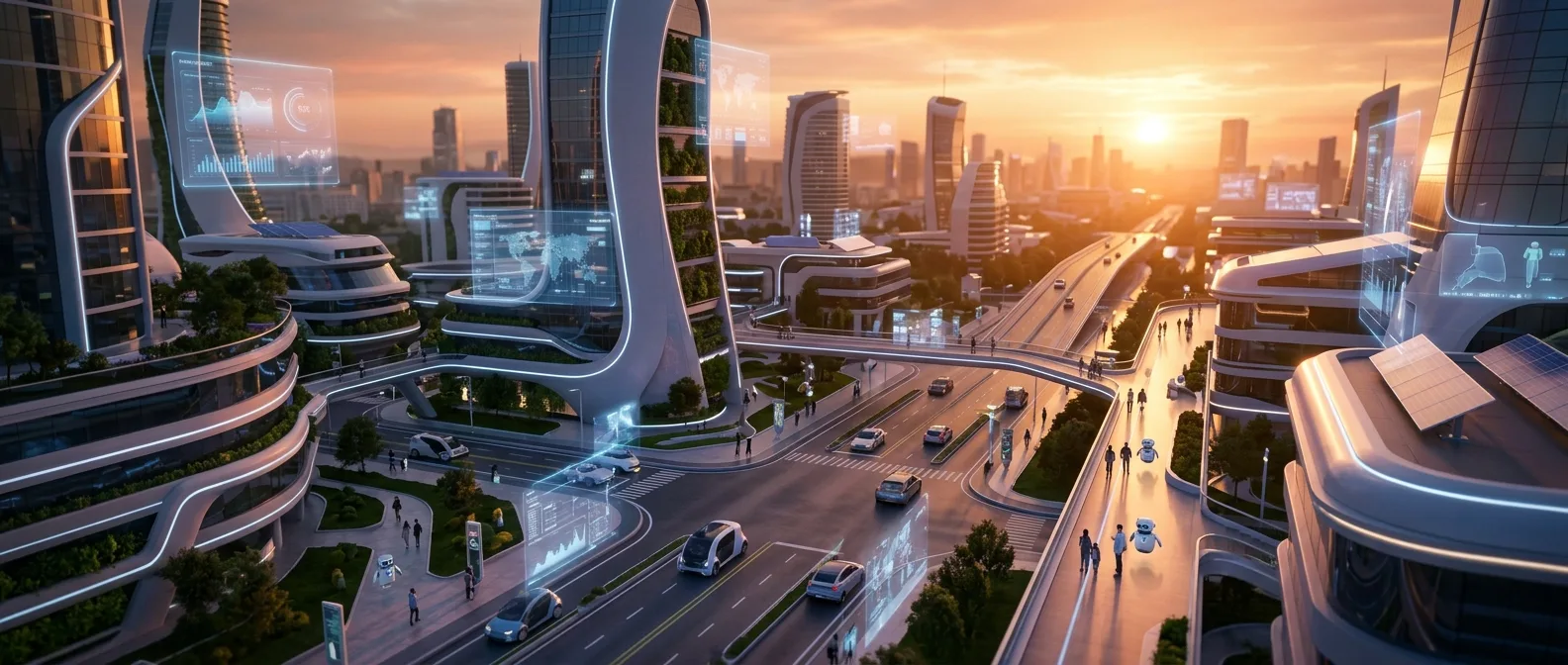
Healthcare costs $4 trillion globally. Education another $6 trillion. Energy? $8 trillion more. By 2040, Vinod Khosla believes artificial intelligence will slash these numbers to nearly zero. The OpenAI investor just dropped his boldest prediction yet: AI will make virtually every service free within 16 years.
Khosla isn't some Silicon Valley dreamer throwing around buzzwords. He's the guy who spotted OpenAI's potential early, pumped millions into the company, and watched his bet pay off spectacularly. When he talks AI 2040, people listen.
🏥 AI Healthcare: Your Personal Doctor Costs Nothing
Picture this: you wake up feeling off. Instead of booking a $200 specialist appointment three weeks out, you open an app. An AI doctor — trained on every medical paper ever published — diagnoses your condition in seconds. It's more accurate than human doctors. And it costs nothing.
Khosla sees AI replacing 80% of medical consultations by 2040. The technology already exists in early forms. Google's Med-PaLM 2 passes medical licensing exams. Microsoft's healthcare AI spots diseases human radiologists miss. Scale this up, and suddenly the $4 trillion healthcare industry becomes a $400 billion one.
Surgery stays expensive — you still need human hands and operating rooms. But diagnosis, treatment planning, and follow-up care? AI handles it all. Your smartphone becomes more powerful than any hospital's diagnostic wing from 2024.
📚 Free Education: Every Child Gets a Personal Tutor
Education follows the same path. Today, hiring a personal tutor costs $50-100 per hour. By 2040, every student gets an AI tutor that never gets tired, never loses patience, and adapts to exactly how that child learns best.
Khan Academy already shows glimpses of this future. Their AI tutor Khanmigo helps millions of students for free. But Khosla envisions something far more sophisticated: AI teachers that know your learning style better than you do, that can explain quantum physics through basketball analogies if that's what clicks for you.
The implications stagger. No more educational inequality based on zip code. No more students falling behind because they learn differently. Every child gets world-class education, personalized to their brain, delivered through their phone.
⚡ Energy Revolution: AI Optimizes Everything
Energy costs plummet through AI optimization, not just renewable generation. Smart grids powered by artificial intelligence will predict exactly when you'll need power, route it efficiently, and eliminate waste. Your house becomes a micro-power plant that generates, stores, and trades energy automatically.
Tesla's already testing this with their virtual power plant in Australia. Thousands of homes with solar panels and Powerwall batteries act as one giant, AI-coordinated energy system. Scale this globally, add fusion power by 2035, and energy becomes abundant enough to give away.
Khosla predicts AI will cut energy waste by 70%. When every device, every building, every city grid runs on AI optimization, the $8 trillion energy market shrinks to a fraction of its current size.
💰 The Economics of Abundance
But wait — if everything's free, how does anyone make money? Khosla has an answer: volume and new business models. When AI healthcare costs pennies per consultation instead of hundreds of dollars, you can serve billions of people profitably.
Think about how Google makes search free by selling ads. Or how WhatsApp serves 2 billion users with a tiny team. AI amplifies this effect across every industry. One AI system can serve millions simultaneously without getting tired or demanding raises.
The winners will be companies that embrace AI early and scale fast. The losers? Traditional service providers clinging to human-only models. A law firm charging $500/hour for document review can't compete with AI that does the same work in minutes for $5.
🚧 The Roadblocks to Free Everything
Khosla's vision faces real obstacles. Regulation tops the list. Medical AI needs FDA approval. Educational AI must meet state standards. Energy AI requires grid operator certification. Each approval process takes years.
Then there's the human factor. People trust human doctors more than AI, even when the AI performs better. Parents want human teachers for their kids. Workers fear AI will eliminate their jobs without creating new ones.
Infrastructure presents another challenge. Rural areas lack the high-speed internet needed for sophisticated AI services. Developing countries can't afford the computing power required. The digital divide could become an AI divide.
🌍 What This Means for Society
If Khosla's right, 2040 brings the biggest economic shift since the Industrial Revolution. Entire industries disappear overnight. New ones emerge just as fast. The concept of scarcity — which drives most economic theory — becomes obsolete for information-based services.
Governments will need universal basic income as AI eliminates millions of jobs. Education systems must teach creativity and emotional intelligence since AI handles analytical tasks. Healthcare becomes preventive rather than reactive when AI monitors your health 24/7.
The geopolitical implications run deep. Countries with advanced AI infrastructure gain massive advantages. Those without get left behind. The AI gap between nations could dwarf today's digital divide.
🔮 Betting on Abundance
Khosla's track record suggests taking his AI 2040 prediction seriously. He spotted the internet's potential in the 1990s. He backed clean energy before it was cool. He invested in OpenAI when most VCs thought AI was overhyped.
Whether services become truly "free" by 2040 remains debatable. But the direction seems clear: AI will dramatically reduce costs across healthcare, education, and energy. The question isn't if, but how fast.
Smart money is already moving. Microsoft poured $13 billion into OpenAI. Google restructured around AI. Amazon built an AI chip empire. They're not betting on incremental improvements — they're betting on Khosla's world of abundance.
The next 16 years will determine if artificial intelligence delivers on its promise of making essential services accessible to everyone. If Khosla's right, 2040 won't just look different — it'll be unrecognizable.