📖 Read more: Apple AI Glasses: Smart Glasses with Artificial Intelligence
Computer Vision: AI's “Eyes” in the Field
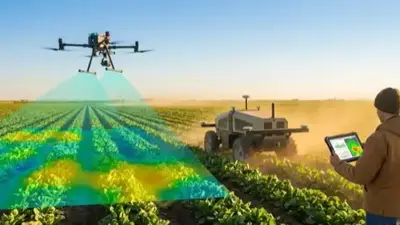
Artificial intelligence can “see” things invisible to the human eye. Drones equipped with multispectral cameras fly over crops and analyze NDVI (Normalized Difference Vegetation Index) — a plant health indicator based on infrared reflection. Stressed plants may appear normal to humans, but multispectral analysis reveals stress, diseases, or nutrient deficiencies before they become visible.
Companies like Blue River Technology (acquired by John Deere) use computer vision for “See & Spray” technology: cameras identify each plant individually and spray only the weeds. This reduces herbicide use by 80% — a significant advantage both economically and environmentally.
🛰️ Satellite Crop Monitoring
Companies like Planet Labs launch small satellites that photograph the entire Earth daily. Combined with AI analysis, this data gives farmers a picture of every square meter of their field — without needing to go on-site. ESA (European Space Agency) provides free data through the Copernicus program.
IoT & Sensors: The “Nerves” of Smart Farming
A modern farm can have hundreds of IoT (Internet of Things) sensors in the field. These measure: soil moisture at different depths, nutrient levels (nitrogen, phosphorus, potassium), soil pH, air and soil temperature, light intensity, and wind speed. Data is transmitted in real time to cloud platforms — and AI analyzes it.
The most impressive application is AI-driven irrigation. Instead of uniformly watering the entire field on a schedule, each zone receives exactly the amount of water it needs — based on soil data, weather forecasts, plant growth stage, and AI evapotranspiration predictions. This reduces water usage by 30% without yield loss.
📖 Read more: AI Cinema: Movies with Artificial Intelligence
Autonomous Machinery & Robots
John Deere, the world's largest agricultural machinery manufacturer, released autonomous tractors using GPS-RTK (2 cm accuracy), cameras, LiDAR, and AI to plow, plant, and spray without a driver. The farmer monitors from their phone. The technology is particularly important in countries facing agricultural workforce crises.
Harvesting robots are another area of intense development. Companies like Agrobot (strawberries), Abundant Robotics (apples), and Root AI (tomatoes) develop robots that recognize ripe fruits, pick them without damage, and sort them by quality — 24 hours a day.
📖 Read more: AI in Medicine: Diagnoses with Artificial Intelligence 2026
Crop Yield Prediction & Risk Management
AI crop yield prediction models combine satellite data, historical production records, meteorological data, soil data, and disease/pest information. They can estimate harvest months before collection — critical information for farmers, traders, insurance companies, and governments planning food policy.
AI also helps with disease management. Smartphone apps use computer vision to identify plant diseases from a photo. Plantix, for example, can recognize over 300 crop diseases and suggest treatment — a particularly useful tool for small farmers in developing countries without access to agronomists.
"Precision agriculture with AI isn't a luxury — it's a necessity. We need to increase food production by 70% by 2050 for 10 billion people, with less water and less land."
— FAO (Food and Agriculture Organization of the UN)AI Agriculture in Greece
Greece, with its particularities (small holdings, mountainous regions, olive trees, vineyards), is beginning to adopt AI solutions. GAIA EPICHEIREIN develops smart farming tools for Greek farmers, while the SMART AGRI-HUBS program funds digitization of small holdings. Mapping drones are already used in olive groves in Crete and vineyards in Macedonia.
The challenge remains adoption: many Greek farmers aged 55+ struggle with new technology. The solution comes through training, simplified user interfaces, and free trial periods. The European Union through the Common Agricultural Policy (CAP) 2023-2027 offers funding for farm digitization.
🌿 Sustainable Farming & AI
AI doesn't just improve yields — it helps the environment. Precision fertilizing reduces water source pollution, fewer pesticides protect bees and biodiversity, and optimized irrigation addresses water scarcity. “Precision agriculture” is simultaneously more productive AND more sustainable.
"Technology in agriculture doesn't replace the farmer's knowledge — it complements it. The farmer knows their land. AI helps them know it even better."
— European Commission, Digital Agriculture Strategy, 2025