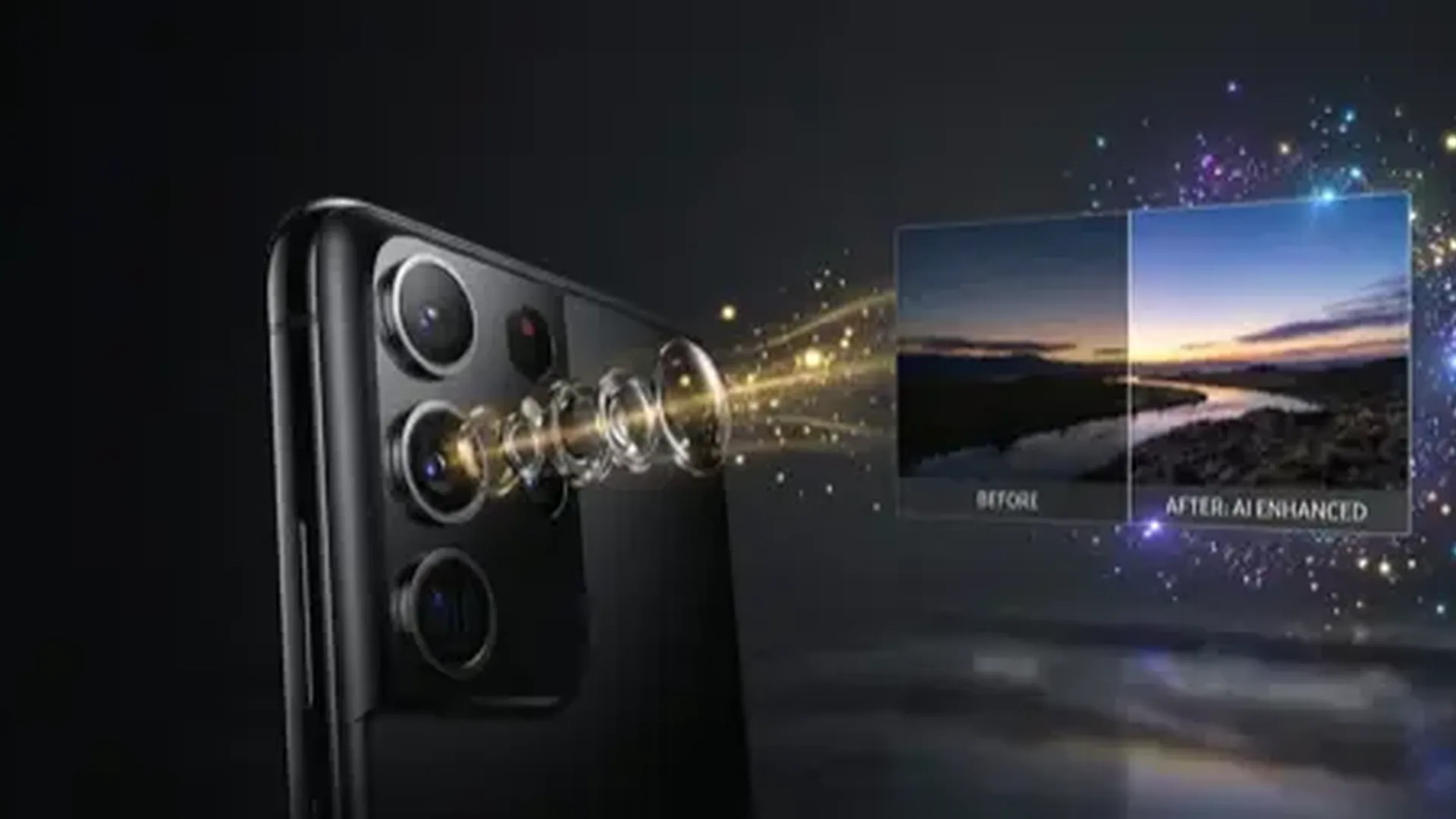
Smartphone cameras now have less to do with lenses and sensors, and more to do with the neural networks behind them. The era of computational photography isn't the future — it's the present. How exactly does AI transform every photo you take into a professional-quality result?
Computational Photography 2026
The term “computational photography” describes the use of AI algorithms and machine learning to enhance photos beyond the physical limits of hardware. Instead of relying on larger sensors or more expensive lenses, your phone captures multiple images, analyzes them with neural networks, and produces a final result impossible with traditional photography.
📖 Read more: NPU Chip: What It Is and How It Changes Smartphones
Night Mode: AI Sees in the Dark
Night Mode was the first killer feature that showed what AI photography can do. Instead of keeping the shutter open for seconds (which would result in a blurry image without a tripod), the phone captures 9-15 frames in rapid succession, aligns them through AI motion compensation, and combines them into one clean image.
How It Actually Works
- Multi-frame capture: 9-15 exposures in 1-3 seconds, each at different settings (ISO, exposure time).
- Frame alignment: AI algorithms align frames compensating for hand movement (OIS + EIS + AI stabilization).
- HDR+ stacking: Frames are combined — bright pixels retain detail, dark ones are enhanced without noise.
- Neural noise reduction: A trained neural network removes noise without eliminating details (texture preservation).
- Local tone mapping: AI recognizes objects (faces, buildings, sky) and applies different brightness adjustments to each region.
Google pioneered this philosophy with Night Sight on the Pixel 3 (2018), and today on the Pixel 9 Pro, Night Sight uses the Tensor G4 chip with on-device ML for real-time multi-frame processing. Apple followed with Night Mode on the iPhone 11, Samsung with Nightography on the Galaxy S series.
Portrait Mode: Art or Algorithm?
Portrait Mode (or Bokeh Effect) is perhaps the most impressive example of AI photography. Traditionally, a blurred background (bokeh) required lenses with large aperture (f/1.2-f/2.0) and large sensors — things impossible in an 8mm-thin phone.
The AI Solution
- Depth mapping: LiDAR scanner (iPhone Pro), ToF sensor (Samsung), or stereo depth estimation (Pixel) calculate the depth of every pixel.
- Semantic segmentation: A neural network identifies what is “subject” (face, body) and what is “background” — including hair, glasses, veils.
- Variable bokeh: AI applies graduated blur — objects closer to the subject blur less, farther ones blur more.
- Lighting effects: Studio lighting, contour light, stage light — AI adds lighting that mimics professional studio setups.
On the iPhone 16 Pro, Apple uses the Photonic Engine — an AI pipeline that applies computational photography at the RAW level before compression even occurs. Samsung Galaxy S25 Ultra adds an AI-powered “Portrait Studio” that transforms selfies into avatars in various art styles.
"The best camera is the one you have with you. And that one is now AI-powered."
— Chase Jarvis, photographer & CreativeLive founder
AI Zoom: 100x Without a 100x Lens
Samsung's “Space Zoom” and Google's “Super Res Zoom” are perhaps the most impressive AI applications in mobile cameras. How do you see detail at 100x zoom when the actual optical zoom is only 5x?
- Optical zoom (physical): Samsung S25 Ultra: 5x (periscope). iPhone 16 Pro Max: 5x (tetraprism). Pixel 9 Pro: 5x (periscope). This is the real zoom.
- AI-enhanced digital zoom: From 5x to 30x, AI uses super-resolution networks — trained on millions of photos — to “fill in” missing pixels.
- Extreme zoom (30-100x): Beyond 30x, quality drops noticeably. Samsung uses reference-based super-resolution — matching stock images to add detail to moons, buildings, etc.
The Google Pixel 9 Pro impressed critics with the ability to zoom at 5,280 feet (1.6 km) and still distinguish clothing colors, thanks to the Super Res Zoom AI pipeline.
HDR & AI Scene Recognition
HDR (High Dynamic Range) technology in mobile phones relies entirely on AI. Google was a pioneer with HDR+ (2014), which captured burst images in milliseconds, selected the best frames, and combined them.
Scene Recognition & Optimization
- Samsung Scene Optimizer: Recognizes 32+ scenes (food, landscape, pet, sunset) and automatically adjusts color, saturation, contrast.
- Apple Photonic Engine: Deep fusion + semantic rendering at the RAW level. Applies more sharpening to hair and fabric, less to skin.
- Pixel AI: With the Tensor G4 chip, the Pixel 9 runs on-device ML models that recognize faces, sky, grass, water — and optimize each region separately.
The AI Chips Behind the Camera
Computational photography demands massive processing power in real-time. Each manufacturer develops specialized AI chips:
- Apple Neural Engine: 16 cores, ~17 TOPS on the A18 Pro. Runs Photonic Engine, Portrait segmentation, 4K Cinematic Mode in real-time.
- Google Tensor G4: Designed specifically for ML workloads. Runs Gemini Nano on-device, Night Sight, Magic Eraser, Best Take, Add Me — all on-device.
- Samsung Exynos 2500 / Snapdragon 8 Elite: NPU with 45+ TOPS. Runs Nightography, Scene Optimizer, Object Eraser, AI Portrait Studio.
- Qualcomm Hexagon NPU: On non-Samsung flagships, provides dedicated AI processing for camera features. 45 TOPS on the Snapdragon 8 Elite.
On-Device vs Cloud AI
In 2026, nearly all computational photography happens on-device — no internet required. This means instant results, privacy (data never leaves the device), and functionality even in airplane mode. Only advanced generative AI features (Magic Editor, AI Object Generation) may require cloud processing.
AI Video: The Next Revolution
What AI did for photos, it's now beginning to do for video:
- Cinematic Mode: Apple introduced rack focus (real-time focus changes) with AI depth estimation on the iPhone 13. On the iPhone 16, it works at 4K 30fps.
- Action Mode / Video Stabilization: AI-powered crop + stabilization that transforms handheld shooting into gimbal-quality video.
- Log/ProRes recording: For professionals, AI-assisted color grading suggestions on the iPhone 16 Pro.
- 8K recording: Pixel 9 Pro & Samsung S25 Ultra shoot 8K video — AI performs real-time noise reduction and HDR tone mapping on 33 million pixels per frame.
- Audio AI: Google introduced “Audio Magic Eraser” — AI that removes car noise, wind, crowd sounds from video. Apple added Audio Mix modes (Studio, Cinematic, In-Frame) on the iPhone 16.
Generative AI: Beyond Photography
In 2026, phones don't just improve photos — they create them:
- Magic Editor (Google): Moves, resizes, or removes objects. Fills backgrounds with generative AI. Changes lighting after the shot.
- Clean Up (Apple): Intelligence-powered object removal — more subtle than Google Magic Eraser, with contextual understanding.
- Galaxy AI Sketch to Image: Samsung transforms sketches into realistic images on top of existing photos.
- Reimagine (Pixel): Tap an area of a photo, type what you want, and AI changes the background — e.g., “tropical beach” or “snowy mountains.”
Samsung vs iPhone vs Pixel: Which Phone for Photos?
- Samsung Galaxy S25 Ultra: The most “aggressive” AI processing. Vivid colors, sharpening, 200MP sensor, 100x Space Zoom. Ideal if you want impressive photos straight-out-of-camera.
- iPhone 16 Pro Max: More “natural” color, Photonic Engine at RAW level, superior video (4K 120fps, ProRes, Log). Ideal for videographers and natural look fans.
- Google Pixel 9 Pro: Best night photography (Night Sight), most accurate HDR+, magic editing tools. Ideal for casual photographers who want point-and-shoot perfection.
What's Coming Next?
- Under-display cameras: AI will compensate for lower image quality due to semi-transparent pixels in front of the sensor.
- Stacked sensors: Sony IMX 9xx series — sensors with integrated AI processing layers, reducing latency to milliseconds.
- Real-time AI filters: On-device LLMs that understand what you want to achieve: “make the photo warmer” or “mimic Fuji Velvia film.”
- 3D photography: LiDAR + AI depth mapping for NeRF-quality 3D captures from your phone. Already experimental on the iPhone 16 Pro.
- AI composition assistant: Real-time suggestions: “move left,” “lower the angle,” “wait 3 seconds for better light.”
"The AI camera doesn't replace the photographer — it makes them better. Every frame is now the result of human-machine collaboration."
— Marc Levoy, former VP Computational Photography, Google