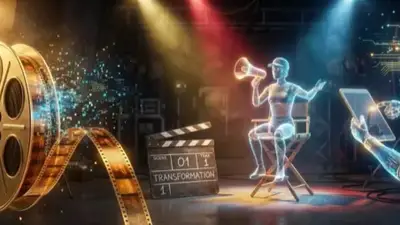
AI Is Transforming Cinema
Cinema is undergoing its greatest technological shift since digital replaced film. Artificial intelligence is no longer a future scenario — it already affects every stage of production, from screenwriting to visual effects and post-production. In 2026, Hollywood faces tremendous opportunities and existential threats simultaneously.
The debate was ignited by the 2023 strikes, escalated with The Brutalist, and reached its climax when Disney invested $1 billion in OpenAI for access to Sora 2. Let's examine how AI is changing every aspect of the big screen.
AI in Screenwriting
The use of AI in screenwriting was one of the central issues of the Writers Guild of America (WGA) strike in 2023. The strike lasted 148 days (May 2 - September 27, 2023) and resulted in historic protections: studios cannot replace screenwriters with AI, nor use AI-generated text as a basis for scripts without full compensation.
Nevertheless, tools like ChatGPT and Sudowrite are widely used as brainstorming aids. Screenwriters use them for initial drafts, structure analysis, and creating dialogue variations. The fundamental concern remains: if an AI writes 90% of the script, who deserves the credits?
VFX and De-Aging: The Great Revolution
Visual effects represent the area where AI has made the greatest progress in cinema. De-aging technology — making actors appear decades younger — has evolved rapidly thanks to neural networks.
The Irishman (2019)
Martin Scorsese's film used ILM technology for de-aging De Niro, Pacino, and Pesci. It cost $159 million — today the same work would cost a fraction of that amount.
Indiana Jones 5 (2023)
ILM developed Flux technology to present Harrison Ford 40 years younger in the first 25 minutes, using machine learning on footage from Raiders of the Lost Ark.
The Mandalorian (2020-23)
Young Luke Skywalker was brought to life with deepfake-style technology on a body double. The original version was dramatically improved after Season 2 through AI upscaling.
AI Background Extras
Studios now use AI-generated crowds instead of real extras. SAG-AFTRA fought to ensure digital clones of actors require explicit consent.
The 2023 Strikes: AI at the Center
In 2023, Hollywood shook the entertainment industry with two historic strikes. The WGA (Writers Guild of America) went on strike from May 2 to September 27 — 148 days. A few weeks later, SAG-AFTRA (Screen Actors Guild) followed on July 14, with the strike ending on November 9 — 118 days.
In both cases, AI was a central issue. Screenwriters feared studios would use chatbots to write first drafts and pay humans only for “polish.” Actors feared studios would scan their faces once and use them forever without compensation.
2023 Strikes - Key AI Points
| Issue | WGA (Writers) | SAG-AFTRA (Actors) |
|---|---|---|
| Duration | 148 days | 118 days |
| Main AI issue | AI doesn't replace writers | Digital clones with consent |
| Outcome | AI doesn't write scripts | Payment for digital likeness |
| Review cycle | Every 3 years | Every 3 years |
| Implementation | In effect since Oct 2023 | In effect since Nov 2023 |
The Brutalist: The Great Controversy
In January 2025, Brady Corbet's The Brutalist — a 3.5-hour epic drama starring Adrien Brody — ignited a massive debate about AI use in cinema. The film won 3 Oscars (Cinematography, Score, Best Actor), the Golden Globe for Best Drama, and scored 93% on Rotten Tomatoes.
The revelation came from editor David Jancso: Respeecher technology (a Ukrainian AI company) was used to improve Brody's and Felicity Jones's Hungarian pronunciation. Corbet clarified that “the performances are entirely their own” and AI was used “only for Hungarian dialogue, to refine vowels and letters.”
Sora, Runway, and the New AI Video Era
In February 2024, OpenAI unveiled Sora — a text-to-video model that shocked the industry. The first public access was granted in December 2024 (ChatGPT Plus/Pro, US/Canada), and in September 2025 Sora 2 launched with an iOS app. The impact was explosive.
Tyler Perry, director and producer, announced he was freezing the $800 million expansion of his Atlanta studio after seeing Sora demos: “I just don't see how we survive,” he stated. Meanwhile, Lionsgate signed a deal with Runway in September 2024 to train AI models on its film library.
Sora 2 (Sep 2025)
Second-generation text-to-video with a TikTok-style iOS app. Hank Green called it “SlopTok.” Built-in watermark, but removers appeared within a week.
Disney + OpenAI
In December 2025, Disney invested $1 billion in OpenAI. Over 200 characters (Disney, Pixar, Marvel, Star Wars) available on Sora 2.
Copyright Wars
The MPA (Motion Picture Association) criticized OpenAI. Studio Ghibli demanded through CODA to stop using copyrighted content. Robin Williams's and George Carlin's families requested deepfake removal.
Runway Gen-3
Runway, an AI video pioneer behind Stable Diffusion, released Gen-3 Alpha. The Lionsgate deal marks the first major official studio-AI collaboration.
AI Films: First Complete Productions
Beyond using AI in individual production stages, films created almost entirely with AI have already appeared:
- generAIdoscope (2024): Japanese film directed by Hirotaka Adachi, Takeshi Sone, and Hiroki Yamaguchi. All video, audio, and music were created with AI — the first feature-length film made exclusively with generative AI.
- Twins Hinahima (2025): Japanese anime series that used AI for cutting, converting photographs into anime illustrations, and retouching. Characters and logos were hand-drawn.
- Secret Invasion intro (2023): Marvel used AI-generated art for the opening credits of Secret Invasion on Disney+, sparking fierce backlash.
- South Park “Sora Not Sorry” (2025): A satirical episode critiquing AI deepfakes and copyright issues — the title references Sora.
Copyright and Legal Battles
Creating films with AI raises serious legal issues. OpenAI adopted an opt-out model for Sora 2 — meaning it uses copyrighted material unless the rights holder explicitly requests removal. This provoked reactions:
In November 2024, a group of testers leaked Sora API keys on Hugging Face as a protest against “art washing” — OpenAI revoked access within 3 hours. The group stated: “We are not your PR puppets.”
The film generAIdoscope raises yet another question: if an entire film was created with AI, who owns the intellectual property? The directors or the AI model? Courts have not yet provided a definitive answer.
How Film Production Is Changing
Traditional vs AI-Enhanced Production
| Stage | Traditional | With AI (2026) |
|---|---|---|
| Pre-production | Storyboard artists, concept art team | AI concept art + human refinement |
| Screenplay | Writers room, multiple drafts | AI brainstorming + human writing |
| VFX | Thousands of hours of manual work | AI de-aging, background generation |
| De-aging | $159M (The Irishman) | Fraction of cost with neural nets |
| Extras | Hundreds of background actors | AI-generated crowds |
| Post-production | Months of editing and color grading | AI-assisted editing, auto color |
| Music | Orchestra, months of composition | AI temp scores, human orchestration |
Industry Reactions
The industry did not react unanimously. There are two clear "camps":
Pro (measured adoption): Disney, Lionsgate, and several indie studios see AI as a cost-reduction tool. The Disney-OpenAI deal ($1 billion) signals the largest corporate commitment to AI entertainment. Adobe integrated Firefly into Premiere Pro, Photoshop, and Illustrator for creative professionals.
Against (worker protection): Tyler Perry froze $800 million in studio expansion. The WGA and SAG-AFTRA secured historic protections. VFX artists fear mass layoffs, and concept artists are already seeing reduced work due to Midjourney and DALL-E.
AI and Artistic Integrity
The use of AI in cinema raises fundamental questions about the nature of art. When AI improves an actor's language pronunciation (as in The Brutalist), is it a technical tool or an alteration of the performance? When visual effects are automatically generated, does the value of craftsmanship diminish?
The truth is that cinema has always adopted new technologies — from sound (1927) to CGI (1990s). AI is the newest, but perhaps the most controversial, because it touches the core of creativity: thinking, writing, and performing.
A telling example: In November 2024, the Sora testing team published a manifesto on Hugging Face, stating they protested being used as PR tools. The phrase “We are not your PR puppets” became a symbol of resistance in the industry.
What Lies Ahead: 2026 and Beyond
The future of AI in cinema is being shaped around three axes:
Licensed AI Models
After the backlash, the trend is shifting toward models trained on licensed material. The Lionsgate-Runway deal shows the way forward.
Real-Time VFX
AI-powered VFX in real-time on set, with virtual production (LED walls) already using Unreal Engine technology. AI will make virtual sets more realistic.
New Regulations
The EU AI Act, American laws, and new WGA/SAG contracts (2026 review) will establish stricter usage frameworks.
Indie Filmmaking Revolution
Independent filmmakers gain access to VFX that previously cost millions. A director with a laptop can now create epic visual effects.
Cinema will change dramatically in the coming years. But if history teaches us anything, it's that technology doesn't kill art — it transforms it. The question isn't whether AI will become part of cinema, but how we'll ensure that creators remain at the center of the process.