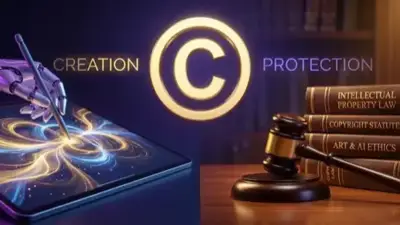
The Fundamental Question: Who Is the “Creator”?
The foundation of every copyright law is simple: rights belong to the creator. But what happens when the “creator” is an algorithm?
In the US, the Copyright Office has made clear that copyright requires human authorship. In Thaler v. Perlmutter (2023), the court refused to grant copyright to a work created solely by AI, confirming that a “natural person” is required. In March 2025, the D.C. Circuit Court of Appeals upheld this decision.
Key Copyright and AI Principles (US)
- AI-only works: CANNOT be copyrighted — no “human author” exists
- AI-assisted works: CAN be copyrighted if human creativity is evident (Jan 2025 guidance)
- First registration: “A Single Piece of American Cheese” — first purely AI visual work with copyright (Jan 2025)
- Patents: AI cannot be listed as an inventor on a patent (USPTO, Feb 2024)
United Kingdom
The UK Copyright, Designs and Patents Act 1988 recognizes rights in “computer-generated works” — the creator is considered the person who arranged for the creation. This provides a more flexible approach compared to the US.
China
In November 2023, the Beijing Internet Court recognised copyright in AI-generated images — a groundbreaking decision showing a more open stance from Chinese courts.
Training Data: The Great Legal Battle
The most controversial aspect of AI copyright isn't about outputs — it's about inputs. Generative AI models are trained on billions of texts, images, music tracks, and code, much of which is copyrighted.
AI companies argue this constitutes fair use — a US legal doctrine allowing “transformative” use of copyrighted material. They cite Authors Guild v. Google (2015), where Google's scanning of books was deemed legal.
But creators counter: "You're using our works to build products that replace us — that's not fair use, it's theft."
The Major Lawsuits: Who's Suing Whom
Since 2022, dozens of lawsuits have been filed against AI companies. Here are the most significant:
New York Times vs OpenAI/Microsoft (Dec 2023)
The highest-profile case. The NY Times claims models were trained on entire articles without permission. In March 2025, the judge rejected OpenAI's motion to dismiss, allowing the case to proceed.
Artists vs Stability AI/Midjourney (Jan 2023)
Sarah Andersen, Kelly McKernan, and Karla Ortiz filed a class action over training on 5 billion images without consent. In August 2024, Judge William Orrick allowed additional copyright and trademark infringement claims.
Disney/NBCUniversal vs Midjourney (Jun 2025)
Disney and NBCUniversal sued Midjourney, calling it a "bottomless pit of plagiarism" — accusing it of training on Star Wars, Simpsons characters and more. Warner Bros. filed a similar suit in September 2025.
Anthropic: The Failed $1.5B Settlement (Sep 2025)
Anthropic (creator of Claude) proposed a $1.5 billion settlement — the largest copyright payout in US history. Judge William Alsup rejected the deal, ruling it would be forced “down the throat of authors” without fair terms.
More Cases
- Getty Images vs Stability AI: Lawsuit in London and US over use of 12M photos — including reproduction of the Getty watermark
- RIAA vs Suno AI/Udio: Music industry sued AI music generators in June 2024
- GEMA vs OpenAI: Victory in Munich (Nov 2025) — lyrics were reproduced nearly verbatim
- Canadian media vs OpenAI: Seeking CA$20,000 per article (Nov 2024)
- Apple Intelligence: Sued over use of the Pile dataset (Sep 2025)
- Encyclopaedia Britannica vs Perplexity AI: Allegations of content copying (Sep 2025)
- Authors Guild + George R.R. Martin vs OpenAI: 17 authors combined (Sep 2023)
- GitHub Copilot: Class action vs Microsoft/GitHub/OpenAI (Nov 2022)
Ghiblification: The Viral Moment
In March 2025, a ChatGPT update enabled creation of images in Studio Ghibli and Hayao Miyazaki's style. Millions of users created “Ghibli-fied” versions of memes. But the backlash was fierce — Miyazaki has publicly expressed negative views about AI, and OpenAI was forced to limit the ability to reproduce living artists' styles.
This raised a crucial question: An artist's style is generally not protected by copyright. But does mass reproduction of a recognisable style through AI — cross legal boundaries?
European Union: AI Act and TDM
The EU follows a different approach through the AI Act (2024) and the Directive on Copyright in the Digital Single Market (2019):
- Text and Data Mining (TDM): Permitted for commercial purposes, UNLESS the creator has opted out
- AI Act requirements: General-purpose AI providers must publish detailed summaries of training data (Aug 2025)
- Opt-out mechanism: Creators can technically exclude their works from AI training
- Germany: Landmark ruling (Sep 2024) — Hamburg court ruled in favour of LAION in TDM case
Music, Images, Code: What's Changing in Each Sector
Music
The RIAA (US) and GEMA (Germany) are leading lawsuits. GEMA won against OpenAI in November 2025 — it was proved that lyrics were reproduced nearly verbatim. AI music tools Suno and Udio face lawsuits from major labels (Sony, UMG, Warner).
Visual Arts/Images
Artists, photographers, and studios are suing Stable Diffusion, Midjourney, and Hailuo AI. Getty Images is pursuing Stability AI over the use of 12M images. Disney, NBCUniversal, and Warner Bros. have opened a front against AI image generators.
Code
GitHub Copilot was the first target (2022). The class action claims it reproduces code from public repositories without attribution — raising questions about whether open-source licences are being honoured.
News/Journalism
New York Times, Tribune Publishing, Canadian media — all suing AI companies for using news content in training. Perplexity AI also faces a lawsuit from Encyclopaedia Britannica.
What This Means for Creators
Practical Advice for Creators
- Opt-out: Use robots.txt, ai.txt, or meta tags to block AI crawlers
- Watermark: Add digital watermarks to your works
- Documentation: Keep records of your creative process
- Stay informed: Follow developments in lawsuits relevant to your field
- Licensing: Some platforms (Shutterstock, Adobe Stock) offer AI licensing deals
What to Expect: 2026 and Beyond
The legal landscape is evolving rapidly:
- NY Times vs OpenAI: Trial expected in 2026 — potentially a landmark fair use ruling
- EU Code of Practice: Expected to set practical standards for AI training transparency
- US legislation: Generative AI Copyright Disclosure Act (proposed Apr 2024) — expected to return
- Licensing models: New licensing models expected, similar to the music industry — royalties per training use
- Supreme Court: Possible referral of a fair use case to the US Supreme Court within 2-3 years
Conclusion
The clash between AI and copyright is still in its early stages. Court decisions over the next 2-3 years will determine whether AI companies pay billions in royalties or whether fair use covers their practices. One thing is certain: the world of creation will never be the same again.