DeepMind & Google: The Example That Changed Everything
In 2016, DeepMind (Google) applied AI to Google's data centers. The result: 40% cooling energy reduction, meaning 15% total consumption decrease (PUE — Power Usage Effectiveness). AI models analyze hundreds of variables in real time: server temperatures, outdoor temperature, load, fan speeds, coolant pumps, and automatically optimize settings every 5 minutes.
Google now uses this method across all data centers worldwide. Savings are estimated at hundreds of GWh annually — equivalent to a small city's consumption. Microsoft followed with Project Natick (undersea data centers cooled by the ocean) and AI-driven cooling.
⚡ PUE: The Efficiency Metric
PUE (Power Usage Effectiveness) measures how efficiently a data center uses energy. PUE 1.0 = perfect (all energy goes to servers). Industry average: ~1.58. With AI: 1.06-1.12. Google reached 1.10 — nearly the theoretical minimum.
Smart Grids: Intelligent Electrical Networks
Electrical grids face a massive challenge: renewable sources (solar, wind) produce unstable energy — the sun doesn't shine at night, wind doesn't always blow. AI addresses this with: renewable production forecasting (weather-based), demand forecasting, battery storage optimization, real-time grid balancing, and anomaly detection for fault prevention.
Tesla Autobidder, for example, uses AI in large battery installations (like the Hornsdale Power Reserve in Australia — 150 MW) for real-time energy trading. AI decides when to store energy (low prices) and when to sell it (high demand).
Smart Buildings & HVAC Optimization
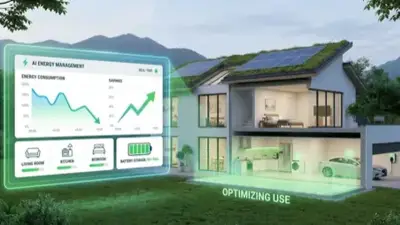
Buildings represent 40% of global energy consumption. AI transforms Building Management Systems (BMS). Instead of fixed heating/cooling schedules, AI uses: movement data (occupancy sensors), weather forecasts, building thermal inertia, real-time electricity prices, and personal comfort preferences via smartphone apps.
BrainBox AI claims 25% HVAC energy savings in commercial buildings. Google Nest and Amazon Alexa use AI at the residential level: learning user habits, adjusting temperature, turning off lights in empty rooms, and optimizing water heater operation.
AI in Renewable Energy
AI also optimizes renewable energy production. In solar: maximum power point tracking (MPPT) with machine learning increases efficiency by 5-15%, computer vision detects dirty or damaged panels, and predictive maintenance reduces downtime. In wind: AI predicts speed/direction 48-72 hours ahead, yaw systems optimize turbine orientation, and wake effect optimization increases entire wind farm production by 3-5%.
Siemens Gamesa, Vestas, and GE Renewable Energy integrate AI into every new turbine. Ørsted (Denmark) uses AI for predictive maintenance in offshore wind farms — reducing maintenance costs by 20%.
"AI could reduce global CO₂ emissions by 5-10% by 2030 — equivalent to eliminating all of Japan's emissions."
— BCG & Google Research, 2023Electric Vehicles & AI Charging
The rise of electric vehicles (EVs) creates a new challenge: when and where will millions of cars charge without crashing the grid? AI answers with smart charging: charging during low-demand hours, Vehicle-to-Grid (V2G) — EVs as storage devices, dynamic charging pricing, charging demand prediction per station, and route optimization for EV fleets.
Tesla, BMW, and Mercedes integrate AI charging into every new EV. The Tesla app automatically decides when to charge based on electricity prices, solar production, and commuting needs.
🔋 Energy Storage & AI
AI helps develop new batteries. Microsoft and PNNL (Pacific Northwest National Laboratory) used AI to discover a new battery material in weeks — instead of years of experimentation. Toyota uses AI for solid-state battery development. Discovering new materials through AI (materials informatics) is expected to revolutionize energy storage.
Future: Autonomous Energy Systems
The ultimate ambition is fully autonomous energy systems: AI managing an entire country's energy network, optimizing production, storage, transmission, and consumption in real time. Denmark is already testing AI-managed grid sections, Singapore implements AI urban energy management, and China is building “intelligent” energy networks in new cities.
In Greece, DEDDIE is implementing smart metering across millions of households. Combined with AI analytics, this will enable dynamic pricing, demand response, and more effective solar integration. Greece, with 300 days of sunshine, is an ideal candidate for AI-optimized solar energy.
"The energy transition without AI is like trying to solve a billion-piece puzzle in the dark. AI turns on the light."
— Fatih Birol, IEA Executive Director