📖 Read more: AI Trading: Stock Market with Artificial Intelligence
The AI Revolution in Medical Imaging
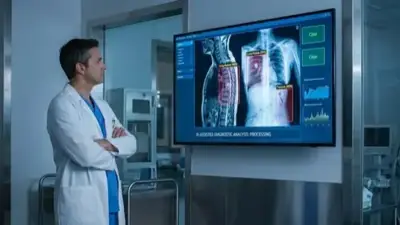
Radiology stands at the forefront of AI adoption in medicine. Of the 1,247 FDA-approved artificial intelligence devices (as of 2025), 967 — or 77% — are in radiology. Deep learning algorithms analyze CT scans, MRI scans, and mammograms with speed and accuracy that approaches — and sometimes surpasses — that of human experts.
Deep learning systems aren't limited to diagnosis alone. They offer non-interpretive benefits to radiologists: noise reduction in images, creation of high-quality images from lower radiation doses, MRI quality improvement, and automatic image quality assessment. AI in nuclear medicine focuses on image reconstruction, anatomical landmarking, and dose reduction in imaging studies.
Breast Cancer Detection
In January 2020, Google DeepMind announced an algorithm capable of surpassing human experts in breast cancer detection on screening mammograms. AI is also used in breast imaging for analyzing screening mammograms and can contribute to improving breast cancer detection rates while reducing radiologists' reading workload.
💡 Digital Pathology
Implementing digital pathology is projected to save over $12 million for a university center within five years. AI-assisted pathology tools help diagnose breast cancer, hepatitis B, gastric cancer, and colorectal cancer, while predicting genetic mutations and prognosticating disease outcomes.
Disease Diagnosis Through Machine Learning
Accurate and early disease diagnosis remains a challenge in healthcare. AI can assist clinicians with data processing capabilities that save time and improve accuracy. Through machine learning, artificial intelligence analyzes massive electronic health records (EHRs) — data that doubles every five years.
A characteristic example is Alzheimer's disease prediction. Algorithms examine large numbers of similar cases and possible treatments, enabling early prediction of neurodegenerative diseases. Convolutional neural networks (CNNs) on structural MRI images achieve improved diagnostic accuracy, while generative adversarial networks (GANs) have proven particularly effective in diagnosing Alzheimer's.
Cardiology and AI
In cardiology, machine learning models for predicting cardiac events reach 90% accuracy. AI proves non-inferior to humans in interpreting cardiac echocardiograms and can diagnose heart attacks better than physicians in the emergency department, reducing both low-value testing and missed diagnoses.
AlphaFold: The Drug Discovery Revolution
DeepMind's AlphaFold represents a milestone in biomedicine. It can predict protein structures based on amino acid sequences — a problem that occupied scientists for decades. Nobel laureate Venki Ramakrishnan called the result “a stunning advance on the protein folding problem.”
In 2023, Demis Hassabis and John Jumper won the Breakthrough Prize in Life Sciences, and in 2024 they were awarded the Nobel Prize in Chemistry alongside David Baker for their work on “protein structure prediction.” AlphaFold is expected to dramatically accelerate drug discovery and enhance understanding of diseases.
Drug Interactions
Improvements in natural language processing (NLP) led to the development of algorithms that identify drug-drug interactions in medical literature. These interactions pose a serious threat to patients taking multiple medications simultaneously. Deep neural networks analyze adverse event reports from the FDA Adverse Event Reporting System (FAERS) and the WHO's VigiBase, detecting patterns of drug interactions.
Oncology: AI Against Cancer
AI is being extensively explored in cancer diagnosis, molecular characterization of tumors, risk stratification, and anticancer drug discovery. A particular challenge AI addresses is predicting which treatment protocols will be best suited for each patient based on their genetic, molecular, and tumor characteristics.
In July 2020, an AI algorithm developed by the University of Pittsburgh achieved the highest accuracy in identifying prostate cancer: 98% sensitivity and 97% specificity. In 2023, a study showcased AI use in CT-based radiomics for classifying retroperitoneal sarcoma aggressiveness, with 82% accuracy — nearly double that of biopsy analysis (44%).
Dermatology and AI
In dermatology, convolutional neural networks (CNNs) achieved 94% accuracy in identifying skin cells from microscopic Tzanck smear images. Esteva et al. demonstrated dermatologist-level skin cancer classification. However, concerns arise about the limited diversity of datasets — particularly the underrepresentation of darker skin tones — which may reduce generalizability across populations.
Telemedicine and Wearables
The rise of telemedicine has driven new AI applications. Wearable devices enable continuous patient monitoring through sensors, detecting changes that may be less noticeable to the human eye. Data is compared in real-time with previously collected information, alerting physicians to potential issues.
A 2025 study (systematic review of 15 studies) showed that AI chatbots are rated as more empathetic than clinicians in text-based consultations. In a parallel 2023 study, evaluators preferred ChatGPT responses over physician responses in 78.6% of 585 evaluations, noting better quality and empathy.
🏥 AI in Mental Health
AI chatbots are being studied as therapeutic tools for anxiety and depression. However, their use raises serious concerns: the National Eating Disorders Association in the US replaced its human helpline staff with a chatbot in 2023 but was forced to take it offline after users reported receiving harmful advice. Legislative efforts in US states seek to regulate or ban AI therapies.
Ethical Challenges and Regulatory Framework
Algorithm Bias and Discrimination
Since AI bases decisions solely on input data, the representativeness of that data is critical. A widely used healthcare cost prediction algorithm introduced bias against Black patients — who had lower costs even when equally sick as white patients. Addressing this “label choice bias” requires models to align their target variable with actual health needs rather than costs.
Data Privacy
Training machine learning systems requires massive volumes of patient data. A UK survey estimated that 63% of the population feels uncomfortable sharing personal data to improve AI technologies. Swiss company Roche purchased health data of approximately 2 million cancer patients at an estimated cost of $1.9 billion — raising ethical questions about the fairness of selling patient data.
FDA and EU AI Act Regulatory Landscape
In January 2021, the FDA published an action plan for regulating AI/ML-based medical device software (SaMD). The European Union approved the landmark AI Act in March 2024, where AI-enabled medical products are classified in the “high-risk” category — the highest category of permitted uses. However, healthcare AI remains “severely under-regulated worldwide” according to The Lancet (2025).
From MYCIN to the Future: Historical Evolution
The history of AI in medicine began in the 1960s with the expert systems DENDRAL and MYCIN — cornerstones that never managed to integrate into everyday clinical practice. In the 1980s-1990s, fuzzy logic, Bayesian networks, and early neural networks were applied to medicine. Today, the convergence of big data, genomics, electronic health records, NLP, computer vision, and robotic surgery creates an unprecedented explosion of AI applications in healthcare.
Companies like Siemens Healthineers, Microsoft (Project Hanover), Philips Healthcare, and Intel Capital are investing heavily in health AI algorithms. Startups like Heidi Health (AI medical scribe), Suki AI (ambient documentation), and Optellum (lung cancer diagnosis) are developing specialized solutions already in use at hospitals.
2026 Outlook and Beyond
2026 marks a critical turning point. AI in healthcare is transitioning from pilot programs to routine clinical applications. Personalized medicine — algorithms that consider each patient's genetic, molecular, and individual characteristics — is becoming reality. However, critical challenges remain: the need for randomized, multicenter clinical trials, addressing algorithmic bias, and establishing clear regulatory frameworks.
Artificial intelligence doesn't weaken the doctor-patient relationship — it strengthens it. By automating administrative tasks, prioritizing patient needs, and facilitating communication within medical teams, AI frees up time for what truly matters: human care.