2026 marks the full integration of artificial intelligence into smartphones. We're no longer talking about simply “smart” phones, but about personal AI assistants that understand, predict, and enhance every aspect of our digital lives. In this guide, we'll explore how AI has fundamentally changed the way we use our phones.
📊 AI Dominance: Numbers That Impress
The growth of AI capabilities in smartphones has been explosive. According to the latest market data, 87% of new premium smartphones feature dedicated AI processors (NPUs - Neural Processing Units) that accelerate machine learning tasks up to 12 times compared to traditional CPUs. Sales of AI-powered smartphones are expected to reach 5.2 billion units worldwide in 2026, representing 42% of the total market share.
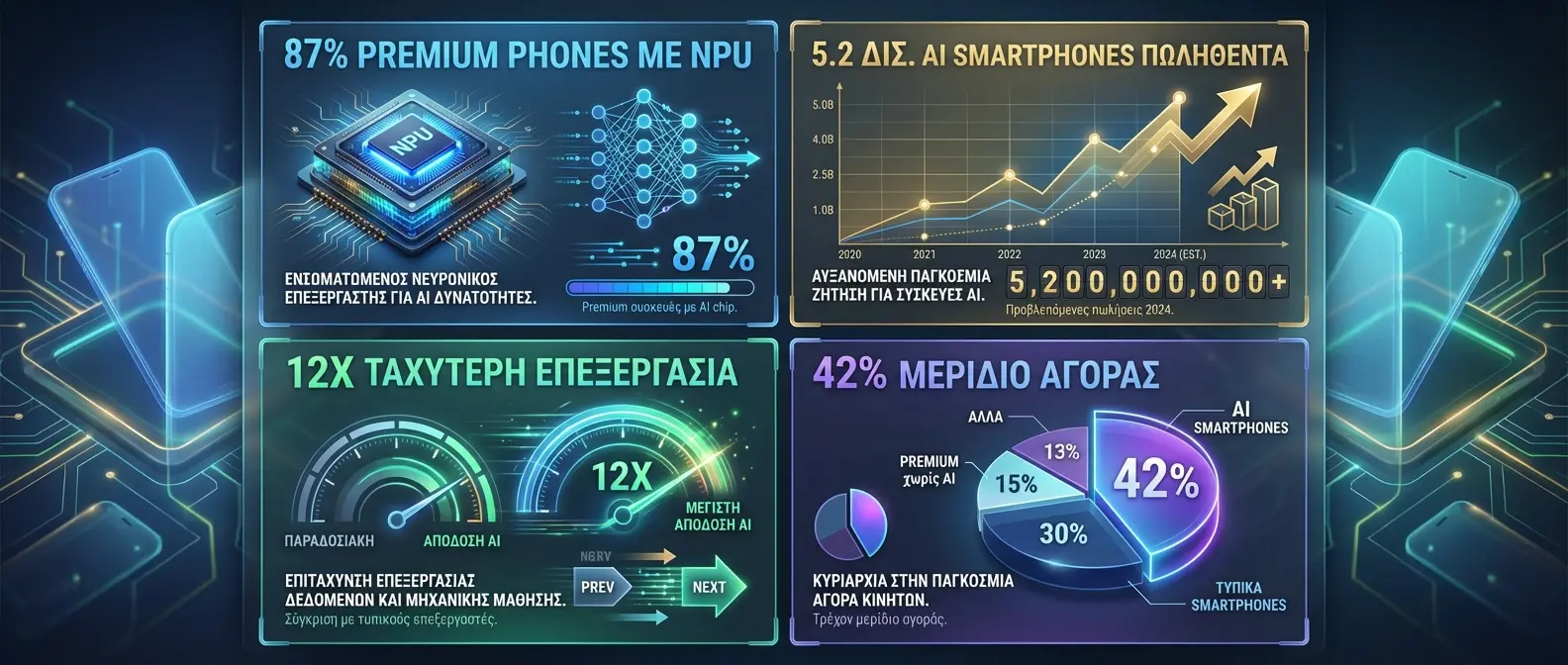
But what do these numbers actually mean in practice? They mean your smartphone has evolved from a simple communication tool into a personal AI assistant that learns your habits, anticipates your needs, and optimizes every aspect of its operation to offer you the best possible experience.
📸 AI Photography: The Camera That Thinks
Smartphone photography has been transformed thanks to artificial intelligence. Today's AI cameras don't just capture images - they understand, analyze, and enhance them in real time in ways that were unimaginable just a few years ago.
Computational Photography at a New Level
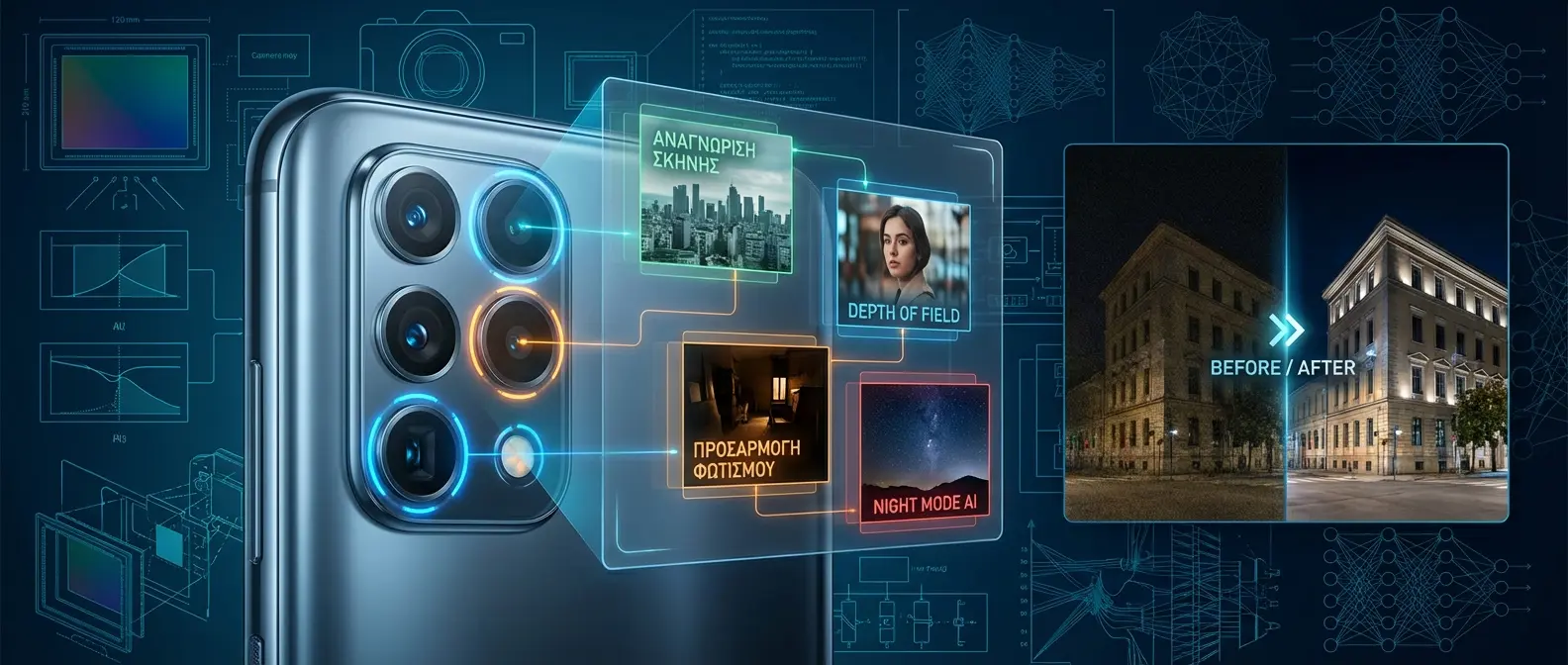
Computational photography in 2026 uses deep learning models trained on millions of images to recognize scenes, faces, objects, and even emotions. When you raise your phone to take a photo, the AI instantaneously analyzes:
- Scene type: Portrait, landscape, night photography, macro, sports, etc.
- Lighting conditions: Automatically adjusts ISO, shutter speed, and aperture
- Photo subject: Applies scene-specific optimizations
- Motion: Activates motion compensation for blur-free results
- Depth of field: Creates professional bokeh effect without optical tricks
The most impressive part? All of this happens in less than 50 milliseconds, before you even press the button. The AI “sees” the image and makes thousands of micro-adjustments to give you the perfect photo.
Night Mode: Light from Nowhere
Night photography has always been the weak point of smartphones. In 2026, AI night mode has reached a point where it can produce clear, bright photos even in near-total darkness. How? By combining multiple exposures (up to 30 frames) in less than a second, using AI to:
- Align frames with pixel-level precision
- Remove noise without losing detail
- Restore colors that are lost in darkness
- Boost dynamic range by 400%
🔋 Intelligent Battery Management: More Hours, Less Charging
One of the most significant problems with smartphones - battery life - has found its solution in artificial intelligence. Modern AI-powered battery management systems don't just close apps you're not using. They learn your habits and predict your needs.
Predictive Energy Management
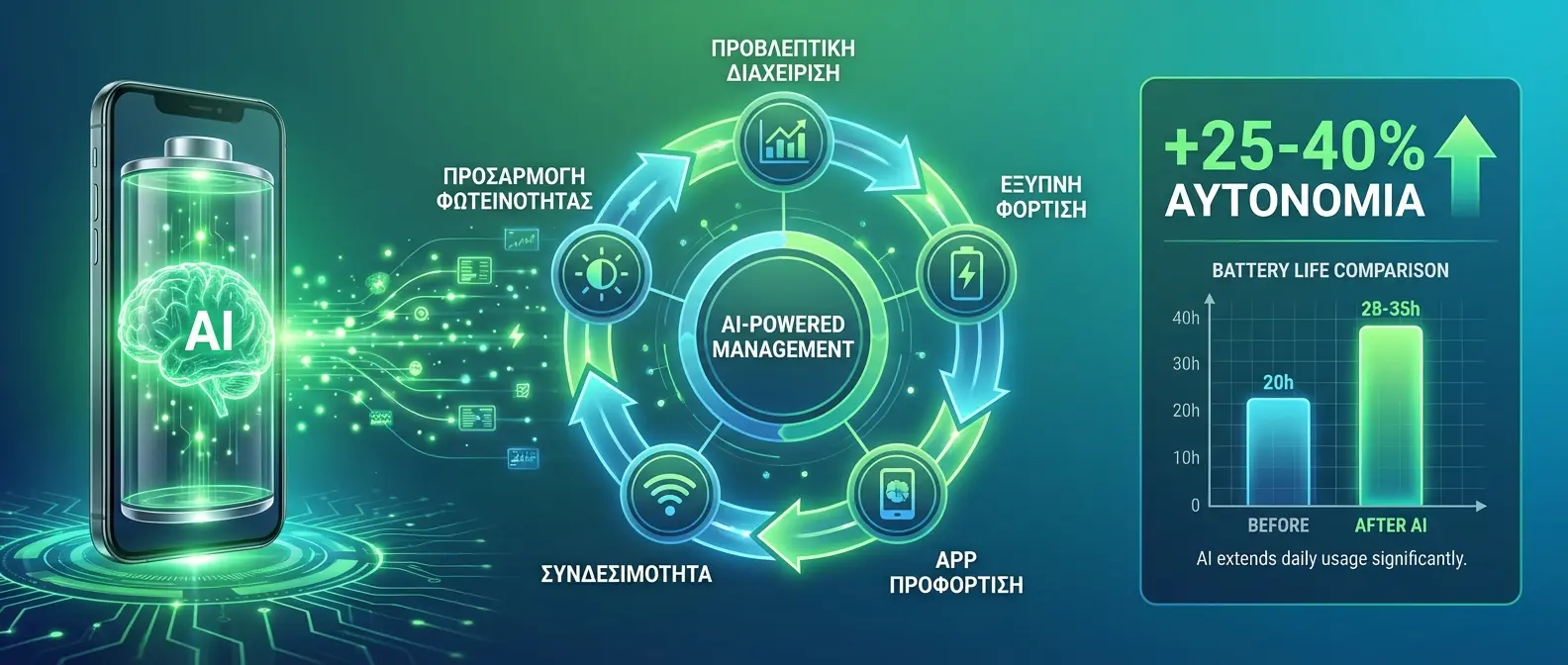
The AI monitors and analyzes thousands of parameters daily: When you wake up, when you charge, which apps you use at each hour of the day, where you are, what you're doing. Based on this data, it creates a usage profile and:
- Pre-loads apps you're about to use into memory
- Closes processes you won't need anytime soon
- Adjusts brightness based on ambient light and content type
- Manages connectivity (WiFi, 5G, Bluetooth) intelligently
- Optimizes charging to extend battery lifespan
The result? A 25-40% increase in battery life with zero compromise on performance. A smartphone that previously needed charging every night can now last up to a day and a half with normal use.
🗣️ Voice Assistants: From Bot to Personal AI Companion
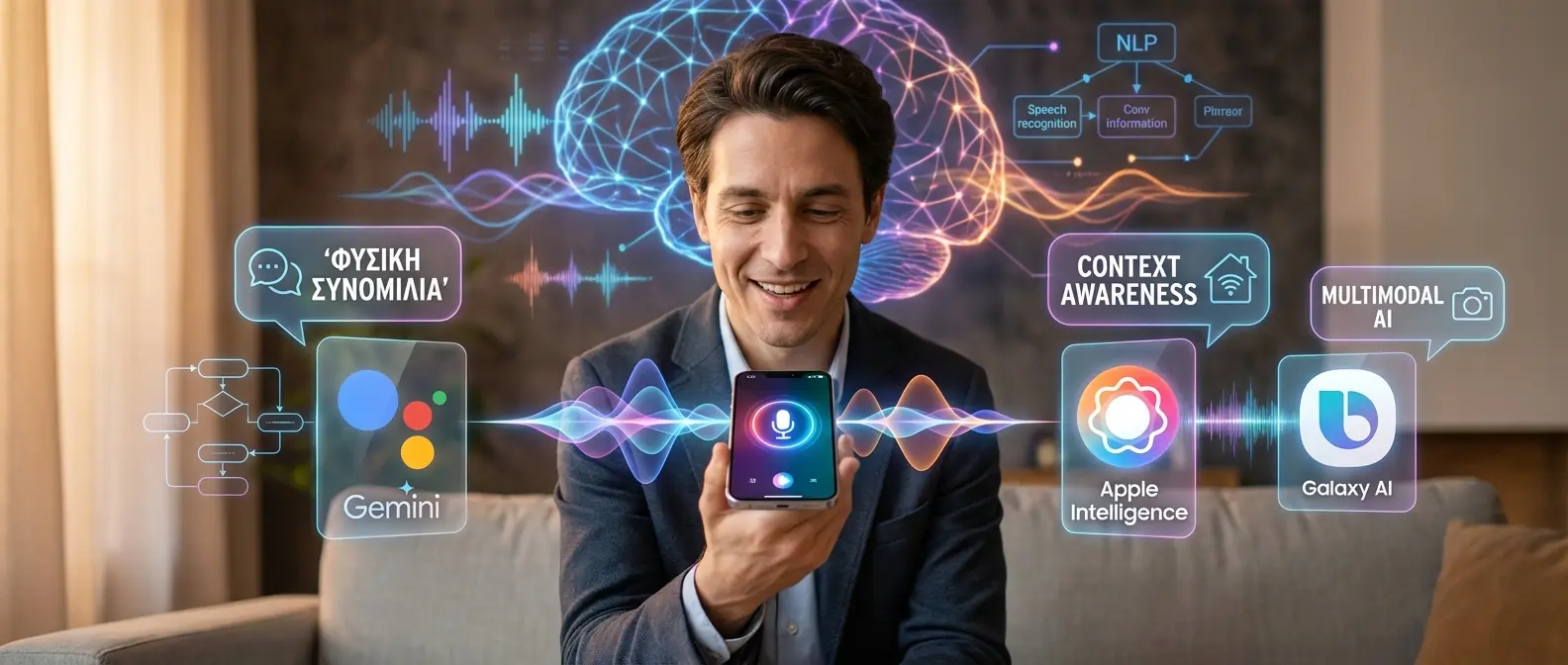
Voice assistants have evolved from simple command-and-response systems into true AI companions that understand context, your mood, and even humor. In 2026, voice assistants like Google Assistant with Gemini, Siri with Apple Intelligence, and Samsung Bixby with Galaxy AI have become so advanced that they can carry on natural conversations.
Natural Language Understanding
Modern AI language models running on-device understand not only what you say, but what you mean. You can say “Remind me to buy milk when I pass by a supermarket” and the AI will:
- Understand that it needs to remind you of something (task creation)
- Recognize the location-based trigger ("when I pass by")
- Locate supermarkets in your area
- Create a location-based reminder
- Alert you at the exact moment you're near a supermarket
And all of this without needing to say magic phrases or follow specific syntax. You speak naturally, just as you would to a friend.
🔒 AI Security: Security in the Smartphone's DNA
Smartphone security has become more critical than ever, and artificial intelligence plays a decisive role in protecting our data. The AI security systems of 2026 are proactive, not reactive - they detect threats before attacks even happen.
Behavioral Biometrics
Beyond face unlock and fingerprint, modern smartphones use behavioral biometrics - they learn how you hold your phone, how you type, how you swipe across the screen, even your walking pattern. If someone else tries to use your phone, the AI will immediately detect it and request additional authentication.
Additionally, AI antivirus systems scan apps in real time, analyzing their behavior for suspicious activity. If an app tries to access data it shouldn't have access to, or communicate with suspicious servers, the AI blocks it immediately.
📈 Comparing the Leading AI Smartphones of 2026
Let's see how the top AI-powered smartphones on the market compare in key artificial intelligence parameters:
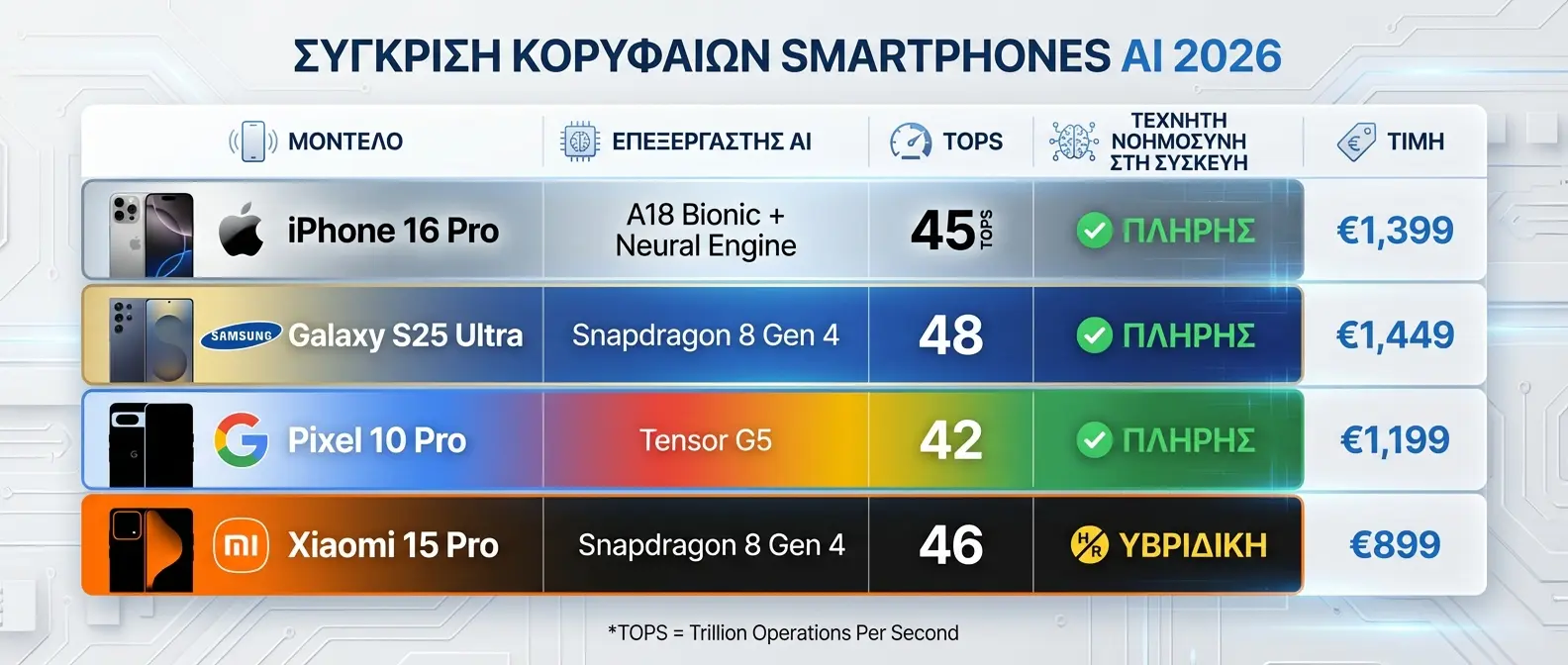
| Model | AI Processor | TOPS | On-Device AI | Price |
|---|---|---|---|---|
| iPhone 16 Pro | A18 Bionic + Neural Engine | 45 | Full | €1,399 |
| Galaxy S25 Ultra | Snapdragon 8 Gen 4 | 48 | Full | €1,449 |
| Pixel 10 Pro | Tensor G5 | 42 | Full | €1,199 |
| Xiaomi 15 Pro | Snapdragon 8 Gen 4 | 46 | Hybrid | €899 |
TOPS = Trillion Operations Per Second - Measures AI processing speed. The higher the number, the faster the AI functions.
🌟 The Future: What Comes After 2026
As AI technology evolves at exponential rates, the future of smartphones looks even more exciting. Researchers and manufacturers are already working on technologies that will bring revolution in the years to come:
Multimodal AI
Future AI will be able to simultaneously process text, images, audio, and video, creating a fully immersive experience. Imagine pointing your smartphone at a monument and having it explain its history, or scanning the ingredients in your fridge and getting recipe suggestions.
Ambient AI
The smartphone will evolve into an “invisible” assistant that works in the background, predicting and fulfilling your needs before you even realize them. Need directions home? The AI will already have them ready. Forgot to reply to an important email? It will remind you at just the right moment.
AR/AI Integration
The combined power of Augmented Reality and artificial intelligence will create experiences that today seem like science fiction. Your smartphone will recognize objects, people, and spaces, providing instant information and contextual assistance.
💡 Conclusions
2026 marks the beginning of a new era in mobile technology. Artificial intelligence is no longer a “nice to have” feature - it's the DNA of modern smartphones. From the photos we take to the way we manage our time, AI has become an inseparable part of our daily lives.
The progress made in recent years is impressive, but the journey is just beginning. As AI models become more advanced, NPUs more powerful, and developers more creative, we can expect smartphones that not only understand our needs, but also anticipate our desires.
The future of smartphones is here, and it's powered by AI. Whether you choose an iPhone 16 Pro, a Galaxy S25 Ultra, a Pixel 10 Pro, or any other flagship device, artificial intelligence will be there to make your life easier, more productive, and a lot more interesting.