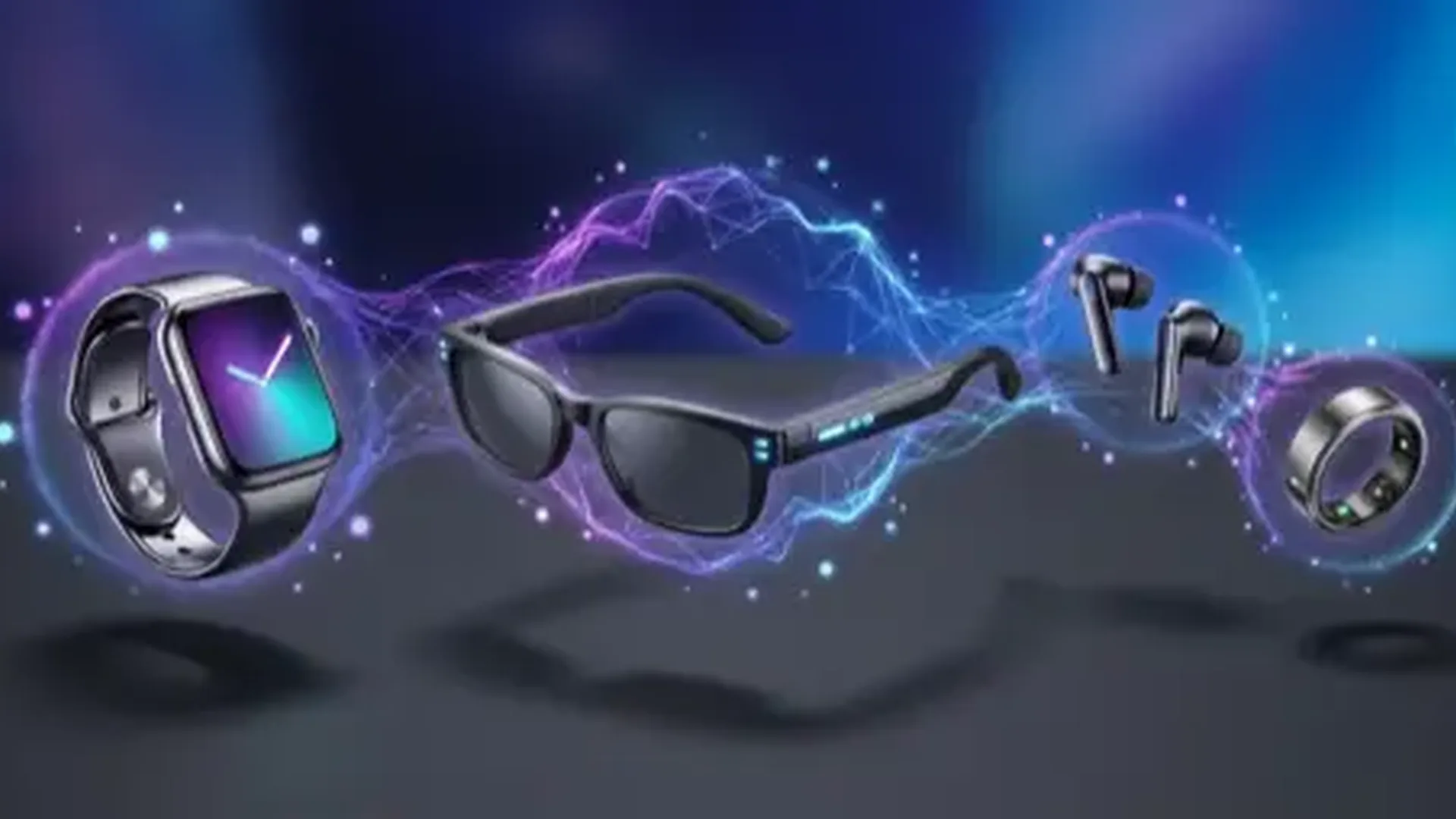
Wearable devices are no longer just gadgets — in 2026, they are full-fledged artificial intelligence platforms we wear on our bodies. From smartwatches with on-device AI and health detection, to smart glasses with multimodal AI assistants and AI earbuds that function as genuine personal assistants, the AI wearables market is worth over $50 billion. Here is what is actually worth buying.
The AI Wearables Market in Numbers
According to Statista data, smartwatch revenue alone reached $44.15 billion in 2023, with projections of $62.46 billion by 2028. When you add smart glasses, AI earbuds, smart rings, and other AI wearables, the total market exceeds $80 billion by 2028.
AI Smartwatches: Your Personal Doctor on the Wrist
Smartwatches have evolved dramatically since the first digital watches. The Pulsar (1972) was the first digital watch, while the Seiko Data-2000 (1984) could store data. The real revolution began with Pebble (2012), which raised $10.3 million on Kickstarter, and was cemented by the Apple Watch (April 2015), which established smartwatches as mainstream devices.
Today, AI-powered smartwatches do not just count steps — they use on-device machine learning to analyze health data in real time:
- Apple Watch Series 10: Sleep apnea detection through AI analysis of breathing patterns during sleep
- Google Pixel Watch 3: Pulse loss detection — automatically alerts emergency services
- Huawei Watch: AI cough pattern analysis for pulmonary issues
- Samsung Galaxy Watch 7: BioActive sensor with AI-powered body composition analysis
Medical Approvals & Health AI
The most significant development in recent years is FDA-approved AI in wearables. The Apple Watch Series 4 (2018) was the first consumer device with an approved electrocardiogram (EKG). Particularly noteworthy is the NightWare app (2020), the first FDA-approved application that uses Apple Watch sensors to detect nightmares in PTSD patients and gently wake them via haptic feedback before the dream worsens.
The main smartwatch operating systems today are: watchOS (Apple), Wear OS (Google/Samsung), HarmonyOS (Huawei). Samsung transitioned from Tizen to Wear OS, while Huawei is independently developing its own ecosystem.
"AI in wearables does not replace doctors — it gives them data they never had before. A watch monitoring heart rate 24/7 can detect atrial fibrillation long before the patient notices symptoms."
— Apple Heart Study Research Team, Stanford MedicineWhat is Worth Buying (2026)
For most users, the top AI smartwatches in 2026 are:
- Apple Watch Ultra 3: Best for health tracking, diving, extreme sports. On-chip Neural Engine for real-time AI analytics
- Samsung Galaxy Watch 7 Ultra: Excellent BioActive sensor, Galaxy AI integration, ideal for Android users
- Google Pixel Watch 3: Best-in-class Fitbit integration, AI health insights, pulse loss detection — best value
- Garmin Enduro 3: Perfect for athletes, AI training load analysis, solar charging, months of battery life
- Huawei Watch GT 5 Pro: Premium build, exceptional battery, AI health monitoring — outside the Google ecosystem
Smart Glasses: The Most Exciting Category
Smart glasses represent perhaps the biggest shift in wearables. After the failure of Google Glass (2013), which was rejected over privacy concerns and social acceptance issues, the category was reborn thanks to Meta.
Meta Ray-Ban Smart Glasses
In 2021, Ray-Ban Stories — a collaboration between Facebook Reality Labs and Ray-Ban — introduced the concept of smart glasses without an AR display: cameras, speakers, microphones, and a Qualcomm Snapdragon processor packed into a classic Ray-Ban frame. But the real revolution came with the Meta Ray-Ban (2023-2024), which added:
- Meta AI Assistant: Ask “Hey Meta, what am I looking at?” and the AI recognizes objects, text, and landscapes
- Multimodal AI: The 12MP camera sends images to the AI, which analyzes and responds verbally in real time
- Live Translation: Real-time translation via AI — hear the translation through built-in speakers
- Live Streaming: Stream directly to Instagram/Facebook from the glasses
In September 2025, Meta announced the Meta Ray-Ban Display — the first Ray-Ban smart glasses with a built-in AR display, marking a new era. The company also prototyped Orion, a full AR glasses prototype. A new partnership with Oakley brings AI glasses specifically designed for athletes (running, cycling, skiing).
Smart Glasses for Accessibility
Smart glasses have a tremendous impact on accessibility. Devices like OrCam MyEye, Envision Glasses, and eSight use OCR (Optical Character Recognition) and AI to recognize text, objects, and faces, converting them to audio for users with low vision or blindness.
Apple Vision Pro & Spatial Computing
Although technically not “glasses” but a mixed reality headset, Apple Vision Pro ($3,499, February 2024) introduced the concept of spatial computing. With the powerful M2 chip and the dedicated R1 chip for real-time sensor processing, it represents a future where digital content blends seamlessly with the physical world. The second generation (2026) is expected to be lighter and more affordable.
AI Earbuds: Far More Than Music
Earbuds have evolved into full AI platforms. The category is led by the AirPods Pro 2, which earned FDA approval in September 2024 as hearing aids — the first time a mainstream consumer device received such certification.
AirPods Pro 2: AI Hearing Features
- Hearing Aid Mode: FDA-approved hearing boost for mild to moderate hearing loss
- Hearing Test: Complete audiogram in 5 minutes, no ENT visit required
- Adaptive Audio: Automatic adjustment of transparency mode and noise cancellation via AI
- Conversation Awareness: AI detects when you start speaking, lowers music, and enables transparency
- Personalized Spatial Audio: AI head-tracking for 3D audio personalized to your head shape
The Competitors
Samsung with the Galaxy Buds 3 Pro integrates Galaxy AI features: real-time translation, AI-powered noise optimization, and voice command integration. Sony (WF-1000XM6) focuses on top-tier audio quality with AI-enhanced LDAC codec, while Bose (Ultra Open Earbuds) pioneers open-ear AI earbuds.
Emerging players like Nothing (Ear 3) with ChatGPT integration and JBL with AI-powered personalized EQ are reshaping the mid-range segment.
Smart Rings: The Silent Revolution
Smart rings embody a new philosophy: invisible tech. No screen, no speaker — just sensors. The category took off when Samsung entered the game.
Samsung Galaxy Ring
Launched in July 2024, the Galaxy Ring uses Galaxy AI for:
- Sleep Analysis: Multi-factor AI sleep analysis (stages, movements, heart rate, SpO2)
- Energy Score: How “ready” you are based on sleep, activity, and heart rate variability
- Cycle Tracking: AI-powered period estimation via skin temperature
- Gesture Control: Squeeze gestures for alarm snooze, camera shutter, and more.
Oura Ring Gen 3
The Oura Ring Generation 3 remains the undisputed king of sleep tracking. With 7+ days of battery life, skin temperature accuracy of plus or minus 0.1 degrees Celsius, SpO2, 24/7 heart rate monitoring, and an AI Readiness Score, it is used by professional athletes, sleep researchers, and biohackers as the gold standard.
On-Device AI: What Runs Locally
The biggest technological shift in wearables is the transition to on-device AI. Instead of sending data to the cloud, new wearables run machine learning models locally on their processors:
- Apple S9/S10 chip: 4-core Neural Engine on the watch, runs health ML models locally — double tap gesture recognized on-device
- Qualcomm Snapdragon W5+ Gen 1: AI Engine for Wear OS devices, 50% lower power consumption vs W5
- Samsung Exynos W1000: 3nm chipset, on-device Galaxy AI, 3x faster CPU vs W930
- Google Tensor G4 (Pixel Watch): Custom ML cores, optimized for Google AI tasks
The advantages of on-device AI in wearables are critical: instant response (no network latency), privacy (health data never leaves the device), battery efficiency (no radio needed for cloud calls), and offline capability (works without a connection).
Privacy & Wearable Security
AI wearables collect the most personal data imaginable: heart rate, sleep patterns, location, voice, video. Security concerns are extremely serious:
- Data Privacy: Studies show that ultra-cheap smartwatches can transmit data without encryption
- Health Data: HIPAA compliance is critical — who has access to your medical data?
- Camera Concerns: Smart glasses with cameras raise surveillance issues — China is already using facial recognition smart glasses worn by police officers (Zhengzhou, Beijing, 2018)
- PFAS in Straps: A 2024 Notre Dame study detected PFAS (forever chemicals) in fluoroelastomer smartwatch straps
"Wearable data security is not just a technical issue — it is a human rights issue. Health data is the most sensitive type of personal information."
— Electronic Frontier Foundation (EFF), Report on Wearable PrivacyWhat is Coming: 2026-2028
The evolution of AI wearables over the next few years will be remarkable:
- On-Device LLMs: Small language models (1-3B parameters) will run on-device in smartwatches, enabling natural AI assistants without internet
- Non-Invasive Glucose: Apple, Samsung, and Rockley Photonics are developing needle-free blood sugar sensors — the biggest breakthrough for 400+ million diabetics
- Neural Interfaces: Companies like CTRL-Labs (acquired by Meta) are developing EMG wristbands that read neural signals from the wrist
- Mainstream AR Glasses: Meta Ray-Ban Display (2025) paves the way — by 2028, expect Apple AR glasses and Samsung Project Haean
- Predictive Health AI: AI that alerts you days before a crisis (fall, atrial fibrillation, hypoglycemia)
- Federated Learning: Wearables will train ML models locally, sharing only weights — privacy-preserving AI
Failures & Lessons Learned
Not every AI wearable succeeds. Some notable failures:
- Humane AI Pin: Launched in April 2024 at $699 — laser projector on the palm, voice AI, camera. Turned out to be slow, ran hot, had terrible battery life, with no real utility. Called “the worst product ever reviewed” by MKBHD
- Rabbit R1: $199 AI companion device (2024) — claimed to use a “Large Action Model” but was essentially a repackaged Android app. Claims were widely disputed
- Google Glass: The original version (2013) failed in the consumer market due to privacy issues, social stigma ("Glassholes"), and its $1,500 price tag
The lesson? AI wearables succeed when they are invisible, useful without effort, and respect social norms. Nobody looks twice at a watch or a pair of glasses — a green laser on your chest, however, gets noticed.
Buying Guide: What Is Actually Worth It
To choose wisely, you need to know what you want:
- For Health & Fitness: Apple Watch Ultra 3 or Samsung Galaxy Watch 7 — most comprehensive AI health features
- For Sleep: Oura Ring Gen 3 — undisputed king, 7+ day battery, most accurate sleep staging
- For AI Assistant: Meta Ray-Ban — unique multimodal AI experience in regular-looking glasses
- For Hearing/Music: AirPods Pro 2 — FDA hearing aid + top ANC + spatial audio
- For Budget: Xiaomi Smart Band 9 — reliable AI health tracking under 50 euros
- For Athletes: Garmin Enduro 3 + Oura Ring combo — ultimate training + recovery stack
Buying Tip
Do not buy a wearable just for the AI features — first consider what problem it solves. If you want health monitoring, a smartwatch will suffice. If you want a hands-free AI assistant, Meta Ray-Ban glasses are the best choice. If you sleep poorly, a smart ring will transform your routine. Do not pay a premium for features you will never use in practice.