The Top AI Weather Prediction Models
GraphCast — Google DeepMind's Breakthrough
GraphCast, introduced by Google DeepMind in 2023, was one of the first AI models to outperform the leading numerical weather prediction systems in accuracy. It uses Graph Neural Networks (GNNs) to represent the Earth as a network of nodes, learning the relationships between temperature, pressure, humidity, and winds at different altitudes. It can generate a 10-day forecast in less than a minute — compared to hours required by traditional supercomputer-based models.
GenCast — The Probabilistic Revolution
In December 2024, the DeepMind team published GenCast in Nature, a machine learning model that delivers probabilistic forecasts. Instead of producing a single prediction, GenCast creates multiple scenarios (ensembles), showing the probability of each outcome. In testing, it outperformed ECMWF's ENS — the world's leading forecasting system — in 97.4% of evaluation metrics over a 15-day horizon.
💡 What Makes GenCast Unique?
GenCast is built on diffusion models — the same technology behind AI image generation — adapted for meteorological data. It was trained exclusively on ECMWF ERA5 data (40+ years of global weather records). It uses no physics equations — it learns patterns directly from data.
Pangu-Weather & FourCastNet
Huawei introduced Pangu-Weather in 2023, a 3D deep learning model that uses Vision Transformers for atmospheric prediction. It handles 13 atmospheric pressure levels simultaneously, achieving competitive accuracy in medium-range forecasts of 1-7 days. NVIDIA developed FourCastNet, using Adaptive Fourier Neural Operators (AFNOs) — an architecture inspired by spectral analysis — for exceptionally fast and accurate short-term predictions.
How AI Meteorology Works
Unlike traditional numerical weather prediction (NWP) models that solve fluid dynamics equations, AI models learn exclusively from data. They are trained on decades of historical meteorological observations — primarily from ECMWF's ERA5 dataset, which includes data from 1979 to the present. The models recognize patterns: how the state of the atmosphere at a given point in time evolves into the future.
Remarkably, they use no physics equations or large language models. They rely on deep learning architectures — graph networks, transformers, Fourier operators — that treat weather as gridded data. This makes them extraordinarily fast: a 10-day forecast takes less than 1 minute on a single GPU, instead of hours on a supercomputer.
ECMWF AIFS & Microsoft Aurora
Even the ECMWF itself — the world's leading numerical prediction organization — has developed its own AI system, AIFS (Artificial Intelligence/Integrated Forecasting System). Since 2024, AIFS has been publishing real-time forecasts, demonstrating particular skill in predicting hurricane tracks, though it underperforms in intensity prediction compared to physics-based models.
Microsoft introduced Aurora — a foundation model for atmospheric prediction trained on over 1 million hours of data from 6 weather and climate models. Aurora offers 10-day weather forecasts as well as 5-day air pollution predictions (CO₂, NO, NO₂, SO₂, O₃, and particulates). Microsoft claims accuracy comparable to physics-based models, but at orders-of-magnitude lower computational cost.
🌍 WindBorne WeatherMesh
WindBorne Systems is developing WeatherMesh — another AI model that leverages data from a specialized network of weather balloons. These balloons provide in-situ data from regions (oceans, polar zones) where there has traditionally been a significant observational gap.
AI vs Traditional Models: The Comparison
Traditional NWP models are based on primitive equations — fluid dynamics and thermodynamics equations describing atmospheric behavior. They require enormous computing power: ECMWF uses some of the world's most powerful supercomputers. Forecast errors double every 5 days, according to Edward Lorenz's chaos theory (1963).
AI models don't solve equations — they learn statistical patterns. This gives them a massive advantage in speed and cost. However, they still cannot explain “why” they make a prediction (the black box problem) and underperform on phenomena without historical precedent — such as unprecedented extreme events driven by climate change.
Real-World Applications
Hurricanes & Extreme Weather
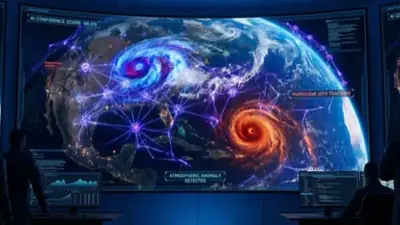
One of the most critical applications of AI meteorology is hurricane prediction. ECMWF's AIFS shows exceptional skill in predicting cyclone tracks, while GenCast can provide probabilistic estimates for multiple evolution scenarios. This is crucial for evacuations: knowing earlier where a hurricane will strike saves lives and reduces economic damage.
However, intensity prediction remains a challenge for AI models. The rapid intensification of hurricanes — a phenomenon amplified by climate change — still challenges even traditional physics-based models.
Agriculture & Energy
Farmers depend on accurate weather forecasts to protect their crops — from frost, drought, or flooding. AI models, with their faster and more accurate predictions, significantly improve agricultural decision-making. In energy, power companies use weather forecasts to estimate heating and cooling demand, while renewables (wind and solar) require accurate wind and sunshine predictions.
"AI models don't replace meteorological science — they expand it. They learn patterns that we may not yet recognize."
— ECMWF, Machine Learning in Weather Forecasting, 2024Challenges & Future
Despite impressive performance, AI models face significant challenges. First, explainability: unlike physics-based models, they cannot explain the reasoning behind a prediction. Second, generalization: trained on historical data, they may fail with unprecedented climate change phenomena. Third, spatial resolution: most operate at relatively low resolution (~25 km), insufficient for local forecasts in urban centers.
In 2026, the trend is clear: hybrid models combining AI with physics equations. ECMWF is already integrating AI components into its system. Competition between Google, Microsoft, Huawei, NVIDIA, and WindBorne is accelerating progress. Within the next 2-3 years, AI is expected to improve 15-day forecasts to the accuracy level currently achieved by 5-day forecasts.
"Every 10 years, forecast accuracy improved by 1 day. AI can compress decades of progress into just a few years."
— Peter Bauer, Former Deputy Director-General, ECMWF