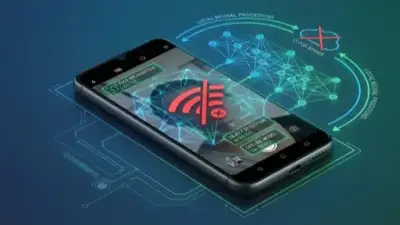
Artificial intelligence doesn't always need a cloud connection. Edge AI (artificial intelligence at the “edge” of the network) runs models locally — on your phone, smartwatch, security camera, even on thumbnail-sized microcontrollers. No internet, no latency, no data leaving your device. Let's explore how it works, what hardware powers it, and why it's changing everything.
What Exactly Is Edge AI?
Instead of sending data to a server (cloud AI), Edge AI performs inference locally on the device. The concept originated from edge computing — computational resources near the user instead of remote data centers. According to Gartner, by 2025 75% of enterprise data will be created and processed outside the traditional cloud. Edge AI brings intelligence exactly where data is generated.
Cloud AI vs Edge AI: Key Differences
With Cloud AI, data (images, audio, text) is sent to remote GPU/TPU servers, processed, and the result returned. Advantage: massive computational power. Disadvantage: latency, internet dependency, bandwidth costs, privacy concerns.
With Edge AI, processing happens locally on-device. No connection required. Data stays on the device. Response is nearly instant (1-10ms vs 100-500ms). The trade-off: smaller models, fewer resources, need for model optimization.
"The best I can do is this: Edge is anything that's not a 'data center cloud'."
— Alex Reznik, Chair of ETSI MEC ISG Standards CommitteeHow Edge AI Works
Model Compression: Shrinking Models for Local Execution
A GPT-4 model requires terabytes of memory and GPU clusters. On edge devices, it must fit in megabytes. This is achieved through:
- Quantization: Converting weights from FP32 (32-bit float) to INT8 or INT4 — a 4-8x size reduction with minimal accuracy loss. Google's Edge TPU only accepts 8-bit quantized models.
- Pruning: Removing less important neurons/weights — resulting in a smaller, faster model.
- Knowledge Distillation: A large “teacher” model trains a smaller “student” model that reproduces its behavior at a fraction of the size.
- Neural Architecture Search (NAS): Algorithms that automatically find the optimal neural network architecture for specific hardware — Google used NAS for MobileNet and EfficientNet.
On-Device Inference Pipeline
The process: sensor → preprocessing → NPU/Edge accelerator → postprocessing → result. For example, face recognition on a smartphone: the camera captures a frame, the ISP handles image preprocessing, the NPU runs the face detection model in <5ms, and the result appears without any internet connection.
Hardware: The Chips Powering Edge AI
Smartphone NPUs
Modern smartphones embed dedicated Neural Processing Units (NPUs) optimized for local AI inference:
- Apple Neural Engine: Started with 2 cores on the A11 (2017, 0.6 TOPS). Today the A18 Pro has 16 cores at 35 TOPS. Powers Face ID, Live Text, and Apple Intelligence locally.
- Qualcomm Hexagon NPU: The Snapdragon 8 Elite reaches 75 TOPS. Enough power for on-device Gemini Nano, real-time translation, AI photography.
- Google Tensor: Custom SoC with integrated Edge TPU. “Extremely large performance advantages in ML benchmarks” (AnandTech). Runs Magic Eraser and real-time translation without internet.
- MediaTek APU: The Dimensity 9400 with APU 890 exceeds 50 TOPS. Supports on-device generative AI.
Dedicated Edge Accelerators
Google Coral & Edge TPU
Google launched the Edge TPU in July 2018 — an ASIC designed exclusively for local ML inference. It achieves 4 TOPS at just 2 Watts power consumption. Runs TensorFlow Lite models with 8-bit quantization. Available as Dev Board, USB Accelerator, M.2, SoM, and mini PCI-e card through the Coral product line. ASUS released the Tinker Edge T/R boards with built-in Edge TPU.
- NVIDIA Jetson: The Jetson series (Nano, Xavier NX, Orin) is the most popular edge AI platform. The Jetson Orin NX reaches 100 TOPS. Used in autonomous robots, drones, security cameras, and medical devices.
- Intel Movidius Myriad / OpenVINO: VPU chips for low-power vision AI. Used in smart cameras, industrial inspection, drones. Runs models through the OpenVINO framework.
- Hailo-8: Specialized AI accelerator (26 TOPS, 2.5W) integrated in the Raspberry Pi 5 AI Kit. Exceptionally efficient (>10 TOPS/W).
TinyML: AI on Microcontrollers
TinyML goes even further — running ML models on microcontrollers like Arduino Nano 33 BLE Sense, ESP32-S3, or STM32 with just a few KB of RAM. Applications: keyword spotting ("Hey Google"), anomaly detection in machinery, predictive maintenance, smart agriculture sensors. They run on battery for months or years.
Frameworks & Tools
Beyond these, other important tools include:
- Intel OpenVINO: Optimization for Intel CPUs, GPUs, VPUs. Model Optimizer + Inference Engine.
- Qualcomm SNPE/QNN: Neural Processing SDK for Snapdragon NPU. Supports quantized models.
- MediaPipe (Google): Ready-made pipelines for face detection, hand tracking, pose estimation running in real-time on-device.
- TensorFlow Lite Micro: Specialized version for microcontrollers — ARM Cortex-M, ESP32, Arduino.
- Apache TVM: Open-source compiler framework that optimizes models for any hardware target.
Real-World Edge AI Applications
Smartphones
The most widespread application. Every modern smartphone runs dozens of AI tasks locally: Face ID (Apple Neural Engine), computational photography (AI-enhanced night photos, HDR, portrait mode), speech recognition (on-device Siri, Google Assistant), predictive keyboard, Live Text/Visual Look Up, real-time translation without internet. On-device speech recognition sends only text instead of audio recordings, dramatically reducing bandwidth requirements.
Smart Home & IoT
Smart security cameras with Edge AI recognize faces, animals, and vehicles locally without cloud uploads. Voice assistants (Alexa, Google Home) can execute basic commands even during internet outages. Robot vacuum cleaners use on-device computer vision for navigation.
Autonomous Driving
Perhaps the most critical application. An autonomous vehicle generates ~4 TB of data per hour. Impossible to send to servers for real-time decisions. NVIDIA DRIVE Orin (254 TOPS) and Tesla FSD computer process data from cameras, LiDAR, and radar locally in milliseconds. A cloud request failure means an accident — that's why autonomous driving is 100% edge AI.
Industry & Healthcare
Predictive maintenance: Edge AI sensors in factory machines detect anomalies before failures occur. Quality inspection: AI cameras check products on production lines in milliseconds. Healthcare: Wearables analyzing ECG, SpO2, and sleep locally — health data stays on the device. Portable ultrasound devices with AI analysis without internet in remote areas.
Edge AI Advantages
- Privacy & Security: Data is processed locally. No transmission of sensitive information to cloud servers. Critical for healthcare, banking, and enterprise applications.
- Ultra-Low Latency: No network round-trip. Face unlock in 3ms, autonomous braking in <10ms.
- Offline Operation: Works without internet. Vital for rural areas, underwater systems, satellites, military applications.
- Reduced Cost: No cloud compute billing per request. Less bandwidth = lower operational costs.
- Scalability: Each device handles its own processing. No server scale-up needed as users increase.
Challenges & Limitations
Edge AI is no panacea. Models must be much smaller (MBs instead of GBs) — meaning accuracy trade-offs. A GPT-4 won't fit on a phone, but a Gemini Nano (3.25B parameters) will. Power consumption is critical for battery-powered devices. Model updates must be handled carefully — over-the-air updates without breaking anything. And there's the hardware fragmentation issue: each chip architecture (ARM, RISC-V, x86, custom NPU) requires different optimization.
"An autonomous vehicle generates ~4 TB of data per hour. Sending it to servers for real-time decisions is impossible — that's why autonomous driving is by definition Edge AI."
— IEEE Proceedings, Edge Computing for Autonomous Driving, 2019The Future: 2026-2028
Edge AI evolution is accelerating rapidly:
- 100+ TOPS in Smartphones (2026-2027): The Snapdragon 8 Elite already reaches 75 TOPS. Soon on-device LLMs with 7B+ parameters will run smoothly on phones.
- Generative AI On-Device: Stable Diffusion, language models, AI art generation without cloud. Gemini Nano is already showing the way.
- Federated Learning at Scale: Training models across millions of devices without data ever leaving them — Google already uses federated learning in Gboard.
- Edge AI + 5G/6G: Hybrid architectures where small models run on-device and larger ones on nearby edge servers (multi-access edge computing).
- RISC-V AI Accelerators: Open-source hardware architectures with built-in AI extensions for ultra-low-cost edge devices.
- Satellite Edge AI: Processing satellite imagery directly in orbit without downlink — already in experimental stages.
Conclusion
Edge AI doesn't replace the cloud — it complements it. The ideal 2026 architecture is hybrid: small, fast on-device models for real-time decisions + large cloud models for complex tasks. With NPUs exceeding 75 TOPS in smartphones, Edge TPUs running at 2 Watts, TinyML on thumbnail-sized microcontrollers, and 175 ZB of data that can't possibly be sent to the cloud — intelligence “at the edge” isn't the future. It's the present.