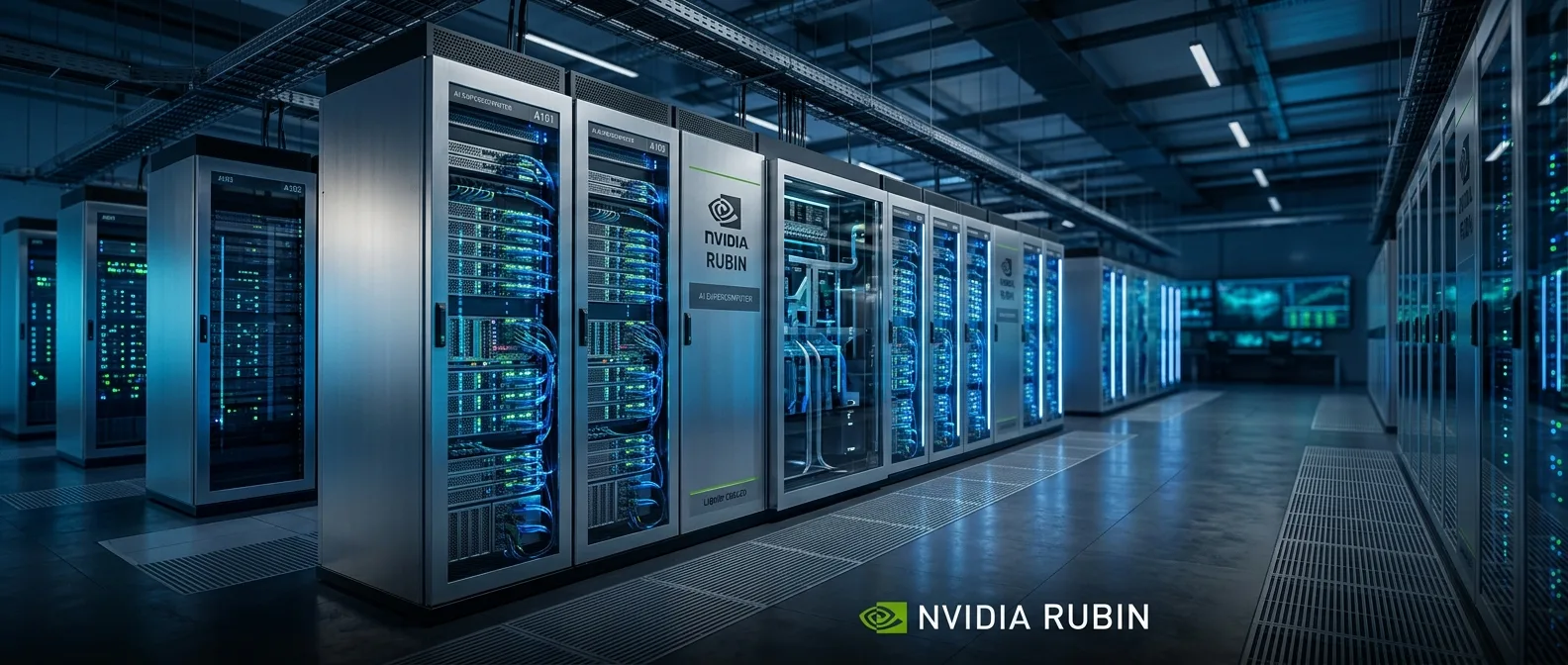
Sixty-two GPUs in a single rack. Four times the performance with fewer chips. Ten times lower inference costs — if NVIDIA delivers on these promises, 2026 will bring a real revolution in AI hardware. The Rubin Platform was announced at CES 2025 as Blackwell's successor, but it looks more like an entirely new approach than a simple upgrade.
NVIDIA is completely changing how it thinks about AI hardware. Instead of selling individual chips that others put into servers, it's building integrated systems. Six chips working together — not just side-by-side — to create a unified supercomputer.📖 Read more: Nvidia AI Chips: Why It Dominates the 2026 Market
🔬 Six Chips, One Philosophy
Rubin isn't a GPU plus some peripherals. It's six specialized chips designed from the ground up to function as one: - **Vera CPU**: 88 custom ARM cores for system-level operations - **Rubin GPU**: The main AI engine with 288GB HBM4 - **NVLink 6 Switch**: Connects GPUs with 3.6TB/s bandwidth - **ConnectX-9 SuperNIC**: Accelerates network communication - **BlueField-4 DPU**: Handles networking, security and storage - **Spectrum-6 Ethernet Switch**: Optimizes overall performanceNVIDIA calls it "extreme codesign" — all components designed simultaneously, not independently. If it works, it's like going from Lego blocks to a finished house.
What's interesting is that we're seeing a specialized inference accelerator for the first time. The Rubin CPX GPU has 128GB GDDR7 (not the more expensive HBM4) and handles the "front-end" work of LLMs — understanding context. The main GPUs handle text generation.⚡ Performance Numbers That Raise Eyebrows
The numbers NVIDIA is promising are impressive — and that's exactly what's concerning. Ten times lower inference costs? Four times fewer GPUs needed for training? Either they're overselling or they've cracked something fundamental.50 PetaFLOPS FP4 per GPU
260 TB/s rack bandwidth
1.8 kW per GPU
2026 Expected release
The Power Consumption Problem
Of course, all that power has to go somewhere. Each GPU consumes 1.8kW — a 400W increase from Blackwell. A full rack will draw about 130kW. For perspective: that's more energy than a hundred homes use simultaneously. But NVIDIA argues the increased consumption is negligible compared to the benefits. If you really get 1.6X to 3.3X better performance, the extra 400W doesn't sound tragic.📖 Read more: NVIDIA Rubin: 6 New Chips for AI Supercomputers
🧬 Agentic AI and the Future of Hardware
Rubin was designed specifically for agentic AI — systems that can think step-by-step, maintain long conversations, and operate autonomously. This requires completely different architecture from today's LLMs. Enter the new Inference Context Memory Storage Platform. Instead of forgetting everything after each response, the system maintains a "key-value cache" in specialized storage. NVIDIA claims 50-60% hit rates — something that would dramatically reduce processing time.But the real innovation might be NVIDIA Confidential Computing — the first rack-scale system that protects data across CPU, GPU and NVLink domains simultaneously. This would allow companies to run proprietary models without worrying about data leaks."Intelligence scales with compute. When we add more compute, models get more capable and make a bigger impact for people."
Sam Altman, CEO OpenAI
📖 Read more: AI Resume & Job Applications: The Complete 2026 Guide
📊 The Competitive Ecosystem
NVIDIA's strategy directly challenges Google, Amazon and other hyperscalers building their own chips. Google TPUs connect up to 9,216 chips in a pod. AWS Trainium3 promises four times the speed with 40% less power consumption. But these rivals focus on single-chip performance. NVIDIA is playing a different game — complete systems that compete on end-to-end efficiency.Google TPUs
30x better energy efficiency since 2018, 9,216 chips per pod
AWS Trainium
4x faster, 4x more memory, 40% less power consumption
NVIDIA Rubin
Integrated system, extreme codesign, agentic AI focus