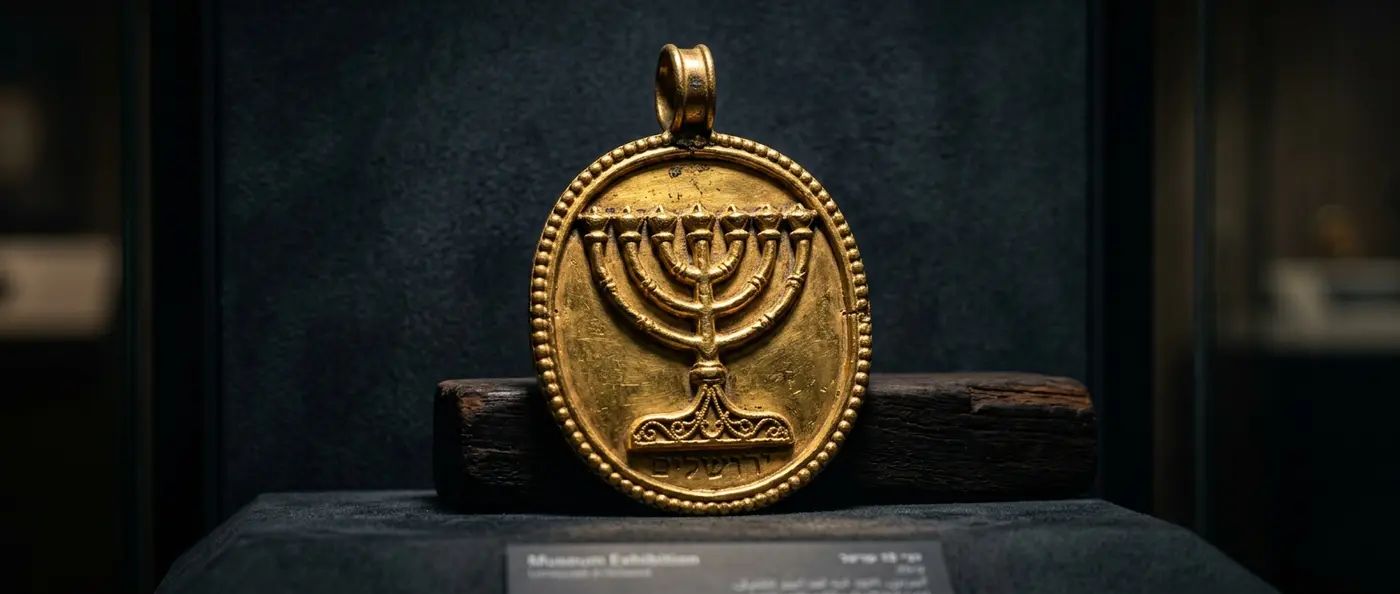
A worker's trowel hit something gray in the dirt. Something that shouldn't exist. Ayayu Belete pulled a lead medallion from the ancient stones of Jerusalem — both sides carved with seven-branched menorahs, the sacred candelabra used exclusively in the Second Temple. The problem? Jews were banned from the city when this 1,300-year-old artifact was made. Yet here it was, buried beneath Byzantine rubble, challenging everything archaeologists thought they knew about Jewish life in medieval Jerusalem.
📖 Read more: 12,000-Year-Old Figurine from Israel: Woman Holding Goose
🔍 The Moment Everything Changed
Belete was digging inside a late Byzantine building at the City of David archaeological site, just southwest of the Temple Mount. "Suddenly I saw something different, gray, among the stones," he recalls. "I picked up the object and saw it was a medallion with a menorah on it."
📖 Read more: Zapotec Owl Tomb Rewrites Death Rituals in Mexico
The medallion lay buried under thick layers of construction debris left by Umayyad rulers who rebuilt parts of the city decades after the Islamic conquest. Dating places the artifact between the late 6th and early 7th centuries CE — when Jerusalem was still under Christian Byzantine rule, just decades before the city would fall first to Sassanid Persians in 614, then to Arab Muslim conquerors around 638.
📖 Read more: Japan's Kofun: Ancient Imperial Tombs That Rewrite History
The timing couldn't be more provocative. Jews had been officially barred from Jerusalem for centuries, ever since Emperor Hadrian's brutal response to the Bar Kokhba revolt (132-136 CE) turned the city into "Aelia Capitolina" and renamed the province Syria-Palaestina.
🏺 What Makes This Medallion Extraordinary
The disc-shaped medallion has a loop at the top for hanging. Both sides display seven-branched menorahs — specifically the type used exclusively in the Second Temple before its destruction by Romans in 70 CE. Each branch ends with a horizontal crossbar topped by flames rising above it.
One side remains well-preserved while the other bears natural patina from centuries of wear. Analysis revealed the medallion was made almost entirely of lead — a detail that transforms our understanding of its purpose.
Lead wasn't chosen for beauty. It was the material of choice for magical amulets, worn for protection rather than decoration. "Lead was common and particularly popular for making amulets at that time," explains Yuval Baruch, archaeologist with the Israel Antiquities Authority's Jerusalem District.
⚖️ The Historical Impossibility
The contradiction is stark: Jews weren't supposed to be in Jerusalem when this medallion was made. The Bar Kokhba revolt's failure had triggered Hadrian's decree transforming Jerusalem into a Roman colony where Jews were forbidden to enter.
Günter Stemberger, professor emeritus of Jewish Studies at the University of Vienna, notes the ban sometimes relaxed, and many Jews lived in nearby towns and territories. But finding such an overtly Jewish religious symbol inside the city itself? No textbook predicted this.
"During periods when imperial decrees prohibited Jews from residing in the city, they didn't stop coming there," Baruch observes. Who dared to carry this symbol?
💡 Why Lead?
The choice of lead over precious metal reveals this wasn't jewelry — it was a protective amulet. Lead was considered ideal for magical protection, making this medallion a deeply personal religious object rather than a status symbol. Someone risked everything to carry this symbol of faith in a city where their presence was forbidden.
🗿 Rarer Than Gold
This is only the second lead medallion depicting a menorah ever discovered. Israeli Antiquities Authority archaeologists Yuval Baruch, Filip Vukosavović, Esther Rakow-Mellet, and Shulamit Terem emphasize its significance: "A medallion made of pure lead, decorated with a menorah, is an extremely rare find. The double appearance of the menorah on each side of the disc indicates the profound importance of this symbol."
Every scratch on its surface matters. The seven-branched menorah connects directly to the Second Temple, destroyed six centuries before this medallion was crafted. Yet someone cared enough about that connection to commission this piece, carry it secretly, and risk discovery in a city where their faith was banned.
Secret Pilgrims?
Did the medallion belong to Jews who came to the city as covert pilgrims, operating under unofficial conditions despite the prohibition?
Merchants?
Perhaps it belonged to Jewish traders who needed to enter the city for business reasons and concealed their identity?
Administrative Missions?
Could the owner have come to the city for administrative purposes, perhaps as part of the Byzantine bureaucracy?
📖 Read more: 160,000 Stone Tools Found in China Break Records
📜 The Temple Connection
The seven-branched menorah carved on this medallion carries profound historical weight. This specific design was used exclusively in the Second Temple, unlike the nine-branched menorahs (hanukkiyot) used during Hanukkah today.
When Romans destroyed the Second Temple in 70 CE, they seized the golden menorah and paraded it through Rome, immortalizing their military triumph on the Arch of Titus. The menorah's appearance on this medallion, centuries after the temple's destruction, shows how deeply this symbol remained rooted in Jewish identity.
The medallion's owner wasn't just carrying jewelry. They were carrying memory — a connection to the sacred space that once stood just hundreds of meters from where the medallion was buried.
🔬 Parallel Discoveries and Significance
Few depictions of menorahs from the Second Temple period survive. One of the most significant is the Magdala Stone, discovered in 2009 in an ancient synagogue near the Sea of Galilee. Dating before 70 CE, it's considered the oldest known depiction of the Second Temple's seven-branched menorah.
The Magdala Stone was found in a small room believed to have stored Torah scrolls. Archaeologist Mordechai Aviam argues the stone may have served as a base for a Torah reading table, with its decorations depicting the Holy of Holies — the space where Jewish tradition says God's presence dwelled.
These rare artifacts create a timeline of Jewish memory. The Magdala Stone captures the menorah while the Temple still stood. The Jerusalem medallion shows how that symbol endured through centuries of exile, carried by someone willing to risk everything to maintain that connection.
⚔️ Menorah Artifacts Timeline
🌍 A City in Transition
The medallion's dating places it during one of Jerusalem's most turbulent periods. Byzantine control was weakening. In 614 CE, Sassanid Persians would capture the city. By 638 CE, Arab Muslim conquerors would control Jerusalem entirely.
During this chaotic transition, religious communities scrambled to adapt. Official policies shifted. Enforcement varied. The Jewish community found itself navigating an increasingly complex landscape where survival often meant invisibility.
Yet someone chose visibility. Someone commissioned this medallion, wore it, carried it into the forbidden city. That choice speaks to faith that transcended politics, identity that survived prohibition.
💭 Questions That Haunt
Every answer breeds three new questions. Who was its owner? How did they enter Jerusalem despite the ban? Why risk wearing such an obvious Jewish symbol when discovery could mean death?
Was this person a merchant whose business required city access? A pilgrim driven by religious devotion? A bureaucrat whose official duties provided cover? Or someone else entirely — perhaps a convert, a sympathizer, or a Jew whose family had somehow remained in the city through generations of prohibition?
The medallion's burial context offers few clues. Found in Byzantine building rubble, it could have been lost, hidden, or discarded during the city's transition to Islamic rule. Each possibility suggests different stories, different lives, different acts of courage or desperation.
Archaeologists continue studying the find and its context. Every new detail might illuminate Jewish life in Byzantine Jerusalem and help us understand how religious communities adapted and survived during periods of restriction and change.
This menorah medallion isn't just an archaeological artifact. It's a window into a complex historical period where faith, identity, and survival coexisted in a constantly shifting political and religious landscape. As archaeologists continue their research in the City of David, who knows what other secrets ancient Jerusalem's soil might reveal?