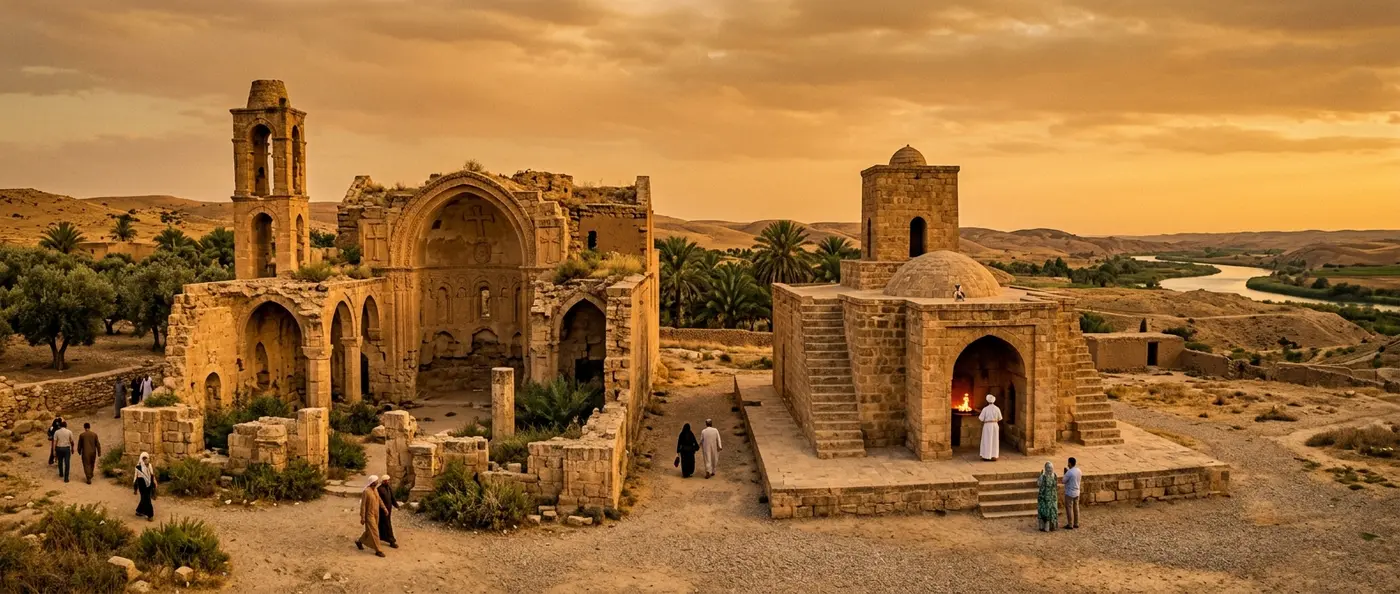
Two faiths. One hillside. Zero conflict. In the mountains of northern Iraq, archaeologists from Erlangen-Nuremberg and Goethe Frankfurt universities have uncovered evidence that challenges long-held ideas about ancient religious conflict. A 1,500-year-old Christian monastery sits mere meters from a Zoroastrian fortress — proof that early Christians and followers of Persia's ancient fire religion lived side by side in peace.
🏛️ The Gird-î Kazhaw Discovery
At the archaeological site of Gird-î Kazhaw, near the modern village of Bestansur in Iraqi Kurdistan, researchers found what they called a "huge surprise." The excavation, which began in 2015, uncovered buried stone columns and architectural elements proving the existence of a Christian church at the heart of a monastery complex.
Dating to around 500 CE, this marks the first Christian structure ever discovered in the region. Among the finds, archaeologists uncovered fragments of a large jar decorated with an early Christian cross — a symbol rarely used before Christianity's legalization by the Roman Empire in the 4th century.
But here's the kicker: the monastery sits just a few meters from a Sassanid Persian fortress where Zoroastrianism was practiced. This proximity suggests peaceful coexistence between two religious communities — overturning assumptions about ancient religious intolerance.
🔥 Zoroastrianism: Persia's Ancient Fire Religion
Zoroastrianism takes its name from the Persian prophet Zarathustra (Zoroaster in Greek), who emerged roughly 3,500 years ago. The religion centers on worshiping the "Wise Lord" Ahura Mazda, with fire as its primary symbol.
For over 1,000 years, Zoroastrianism served as the official religion of royal dynasties ruling Persian empires. From the Achaemenid through the Sassanid dynasties, this faith shaped ancient Persia's culture and politics.
After the Islamic conquest of the Sassanid Empire in the 7th century, Zoroastrianism declined dramatically in Persia (modern-day Iran). Today, only about 120,000 practicing Zoroastrians exist worldwide, mainly in Iran and India (where they're known as Parsis).
⚔️ Rival Empires, Peaceful Neighbors
When this monastery was built, Christianity was spreading beyond Roman Empire borders, where it had become the official religion through Emperor Theodosius's Edict of Thessalonica in 380 CE. Romans — and later Byzantines — were typically Persian adversaries, though sometimes allies.
Despite political tensions, Christianity's new faith spread even among Persians. The church's early dating to the 5th-6th century CE isn't unusual for the region — comparable structures exist in northern Syria and northern Mesopotamia.
The two religious communities lived side by side despite their differences. The sacred spaces sit so close together that the Christians and Zoroastrians likely interacted daily.
💡 Did You Know?
Zoroastrianism significantly influenced the monotheistic religions that followed. Concepts like heaven and hell, angels and demons, and final judgment first appeared in Zoroastrianism and were later adopted by Judaism, Christianity, and Islam.
🗺️ Broader Evidence of Religious Coexistence
The Iraqi discovery isn't isolated. About 600 kilometers north, at Dedoplis Gora in Georgia, archaeologists uncovered a 2,000-year-old sanctuary within a "magnificent" temple complex. The area was under the independent kingdom of Kartli but heavily influenced by the Achaemenid Persian Empire.
According to archaeologist David Gagoshidze from the University of Georgia in Tbilisi, "Kartli kings worshipped Iranian (Zoroastrian) gods merged with local Georgian astral deities." The palace contained three sacred rooms with different religious traditions:
Zoroastrian Sanctuary
Altar where palace residents offered daily sacrifices and prayers to Ahura Mazda.
Greek Worship
Room dedicated to Apollo worship, based on figurines found there.
Local Worship
Syncretic ceremonies for local fertility, agriculture, and harvest worship.
📜 Christianity's Spread into Persian Territory
Christian monasteries in Persian territory during the 5th-6th centuries demonstrate the new religion's rapid expansion. Though Christianity was linked to the Roman/Byzantine Empire — Persia's traditional enemy — Sassanid rulers allowed its establishment.
This tolerance wasn't always consistent. There were periods, especially during the late Sassanid era, when followers of rival religions like Christianity or Manichaeism (a now-extinct Persian religion centered on the prophet Mani) faced persecution. However, the general trend favored tolerance and coexistence.
The Gird-î Kazhaw discovery proves this coexistence wasn't merely political expedience. The physical proximity of the two religious spaces — just meters apart — shows daily interaction between communities.
🏺 Archaeological Finds and Their Significance
Gird-î Kazhaw's findings include not only architectural elements but everyday objects. The decorated jar with the Christian cross is particularly significant, showing the community was established enough to produce or import specialized religious items.
The discovered stone columns indicate substantial construction, not a temporary structure. The monastery appears to have been a permanent installation, with monks living and worshipping there for extended periods. The construction quality compares to similar structures in northern Syria and Mesopotamia, indicating builders had access to specialized techniques and resources.
⚖️ Religious Site Comparison
🌍 The Broader Historical Context
The find challenges the common picture of ancient religious communities as isolated and hostile to outsiders.
Christian monks and Zoroastrian worshippers at Gird-î Kazhaw shared the same hillside. Rather than just tolerating each other, both communities appear to have flourished.
This coexistence pattern was probably more common than our historical sources allow us to see. Written sources tend to focus on conflicts and persecutions, but archaeology reveals the everyday reality of peaceful cohabitation.
🔬 Future Research and Prospects
Archaeologists plan to keep digging at Gird-î Kazhaw to learn more about how this unique religious community functioned. Unanswered questions include:
How was daily life organized in such a mixed religious environment? Were there common spaces where the two communities interacted? What was the monastery's economic foundation and how did it relate to the neighboring fortress?
The discovery also raises questions about other similar sites in the region. If this coexistence model was common, there must be other examples waiting to be discovered. Systematic research of the broader area could reveal an entire network of mixed religious communities.