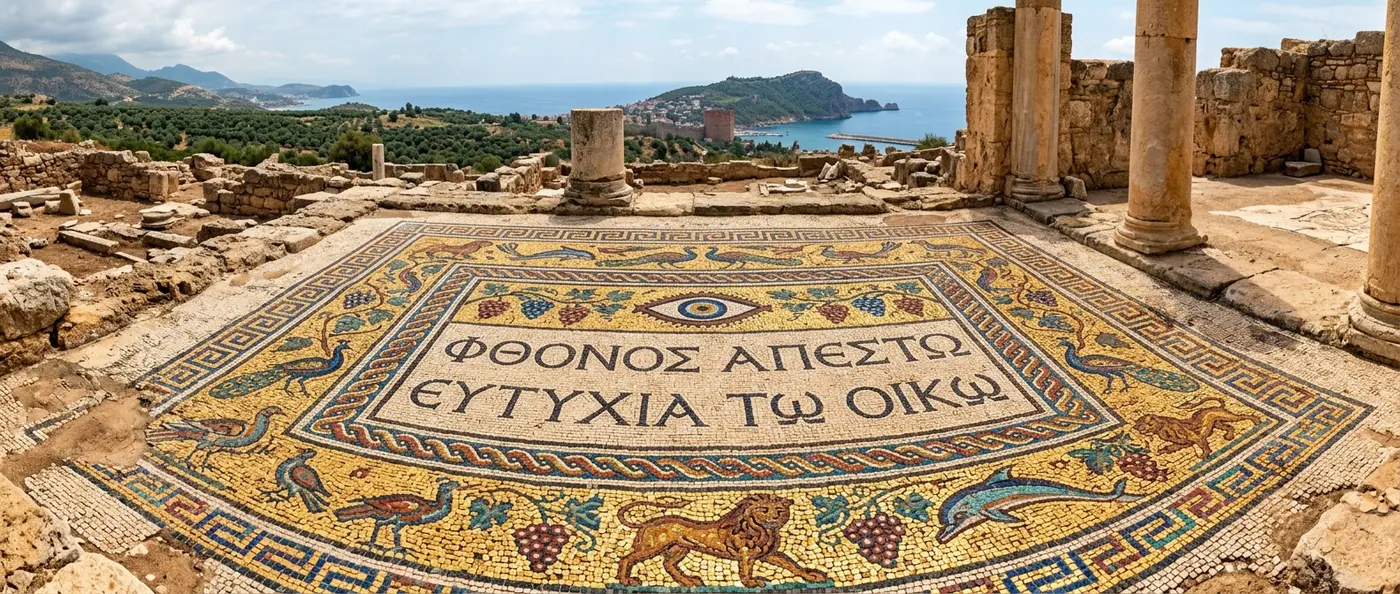
Picture this: you walk into someone's house and the floor immediately tells you to drop dead if you're jealous. That's exactly what happened to visitors entering a wealthy Byzantine home 1,500 years ago in ancient Syedra, Turkey. Archaeologists just uncovered a mosaic floor bearing one of history's bluntest homeowner messages: "Let the envious burst!"
🏛️ Ancient Syedra and the Discovery
Syedra wasn't some backwater village. This was a major Roman and Byzantine port city where modern-day Alanya sits, a place where Mediterranean trade routes converged and fortunes were made. The systematic excavations happening there have been peeling back layers of history for years, but this mosaic caught everyone off guard.
The floor dates to the 5th-6th century CE and survived in remarkable condition. The message hit archaeologists harder than the craftsmanship. Instead of the usual religious scenes or mythological figures you'd expect, this homeowner went straight for the jugular with a direct challenge to anyone harboring jealous thoughts.
The mosaic was discovered in what appears to have been a reception area of a wealthy residence. The location and quality scream "status symbol" — this was where the owner showed off to guests and made it crystal clear what he thought of their potential envy. The placement wasn't accidental. Every visitor would have read that message the moment they stepped inside.
📜 The Anti-Envy Message
The inscription hits like a slap. Written in Greek — the language of education and culture across the eastern Mediterranean — it reads "Let the envious burst!" No beating around the bush. No subtle symbolism. Just pure, unfiltered "deal with it" energy embedded in a floor that cost a fortune to create.
This wasn't just interior decoration with attitude. The homeowner was playing psychological warfare. In the ancient world, envy wasn't considered merely an emotion — it was a genuine threat that could bring real harm through the evil eye. By calling out potential enviers so directly, the owner was essentially throwing down a gauntlet while simultaneously trying to neutralize their power.
The choice to make this statement so public reveals layers of social anxiety. This guy was wealthy enough to commission an elaborate mosaic but insecure enough to feel the need for such an aggressive preemptive strike. The message functioned as both a boast and a shield — showing off his wealth while daring anyone to resent it.
Experts point out that such inscriptions weren't just decorative choices. They served as apotropaic symbols, designed to ward off evil. The ancient belief held that acknowledging envy openly could strip it of its power. By forcing visitors to confront the accusation directly, the homeowner was trying to disarm any malicious intentions before they could take hold.
🎨 The Artistry Behind the Attitude
Strip away the sassy message and you're left with a masterpiece of Byzantine craftsmanship. Thousands of tiny tesserae in multiple colors create intricate geometric patterns that frame the central inscription. The technical skill required to execute this work represents the pinnacle of 5th-6th century mosaic art.
The tesserae themselves tell a story of quality and permanence. Made from carefully selected natural stones and ceramic materials, they were chosen not just for color but for durability. The fact that this mosaic survived 1,500 years in such excellent condition proves the materials and workmanship were top-tier.
The geometric designs surrounding the inscription aren't random decoration. Braids, diamonds, and other motifs carried symbolic weight in Byzantine art, often representing eternity, unity, or protection. These patterns created a visual frame that elevated the central message from graffiti to formal declaration.
💡 Did You Know?
Creating a mosaic floor in antiquity could take months or even years, depending on size and complexity. A skilled craftsman could lay roughly 1 square meter of mosaic per day, making this floor a significant investment of time and money.
🏺 Late Antiquity Society
The mosaic inscription reveals the cutthroat social dynamics of late antiquity. Syedra in the 5th-6th centuries was a thriving city within the Byzantine Empire, bustling with trade and marked by cultural diversity. This was a society where displaying wealth wasn't just acceptable — it was expected among the elite.
Wealthy citizens competed through conspicuous consumption. Grand houses with elaborate mosaic floors, intricate frescoes, and luxury furnishings were the Instagram posts of their era — ways to broadcast success and social status. But this display culture created its own problems, generating resentment among those who couldn't afford such luxuries.
The use of Greek for the inscription is significant. Despite being under Byzantine rule, Greek remained the prestige language of culture and education. The homeowner's choice to write in Greek signals his membership in the educated elite — he wasn't just wealthy, he was cultured enough to craft his insult in the proper literary language.
Economic Boom
Syedra was a major trading hub with a port connecting East and West. Wealth from commerce allowed many residents to fund elaborate art projects, creating a competitive atmosphere of luxury display.
Cultural Life
The city boasted theaters, baths, and other public buildings that supported a rich cultural life. Art and architecture flourished under the patronage of local elites.
Religious Transition
The 5th-6th centuries marked the transition from paganism to Christianity. Many mosaics from this period blend traditional motifs with Christian symbols.
🔍 Ancient Anti-Envy Traditions
Syedra's blunt mosaic wasn't unique in the ancient world, though it remains exceptionally rare. Similar messages have surfaced across the Mediterranean, revealing a shared obsession with envy and the evil eye. Pompeii, for instance, yielded frescoes and inscriptions with protective purposes, though none quite so direct as "let them burst."
Belief in the evil eye's power was universal across ancient cultures. From Egypt to Rome, people deployed various symbols and charms to ward off envious glances. The Eye of Horus in Egypt, the Nazar in the Middle East, and various Roman fascinums all served similar protective functions.
What makes Syedra's inscription special is its confrontational approach. Instead of using traditional symbols or indirect references, this homeowner chose to call out the envious directly, essentially daring them to try their worst. This aggressive strategy suggests either supreme confidence or deep insecurity — possibly both.
⚖️ Anti-Envy Symbols Across Cultures
🗿 Why This Discovery Matters
The Syedra mosaic cuts straight to the social psychology of late antiquity. It proves that people 1,500 years ago grappled with the same anxieties that plague us today: envy, social status, the desire for recognition, and fear of malicious gossip. Human nature, it seems, has remarkable consistency across millennia.
For archaeologists, this find cuts through centuries of formal records to show how one Byzantine really felt. Most surviving texts from this era focus on religious or administrative matters. Such personal, direct expressions of individual anxiety are rare and precious for understanding how ordinary people actually lived and felt.
The discovery proves archaeologists still have surprises waiting underground. Every shovelful of dirt might hide another ancient insult or boast. After decades of digging at Syedra, archaeologists thought they knew what to expect — until this homeowner's blunt message proved them wrong.
🔬 Future Research and Conservation
The mosaic discovery has opened new avenues for research in the area. Archaeologists plan to expand excavations around the building where the mosaic was found, hoping to uncover more details about the owner's life and the broader social context of the period.
Conservation work has already begun on the mosaic. Preserving such finds requires specialized techniques and careful handling. Conservators are working to stabilize the tesserae, clean the surface, and protect the mosaic from future deterioration.
Plans are also underway to create a museum space that will allow the public to view the mosaic in its original context. This will give visitors from around the world the chance to see this unique message from the past firsthand and reflect on the timeless nature of human emotions and social tensions.
💭 Timeless Human Nature
The Syedra mosaic with its anti-envy message reminds us that certain aspects of human nature remain unchanged across centuries. Envy, the need to display success, fear of the evil eye — all these feelings that tormented people 1,500 years ago continue to exist today, just in different forms.
The homeowner's choice to confront envy with such direct provocation stands out most. In an era when belief in supernatural forces was strong, the boldness to openly challenge the envious shows either remarkable confidence or desperate insecurity — maybe both.
Future digs at Syedra might uncover more homes with attitude — or perhaps the neighbors' equally blunt responses. The archaeological record suggests ancient homeowners weren't shy about broadcasting their feelings, one mosaic insult at a time.