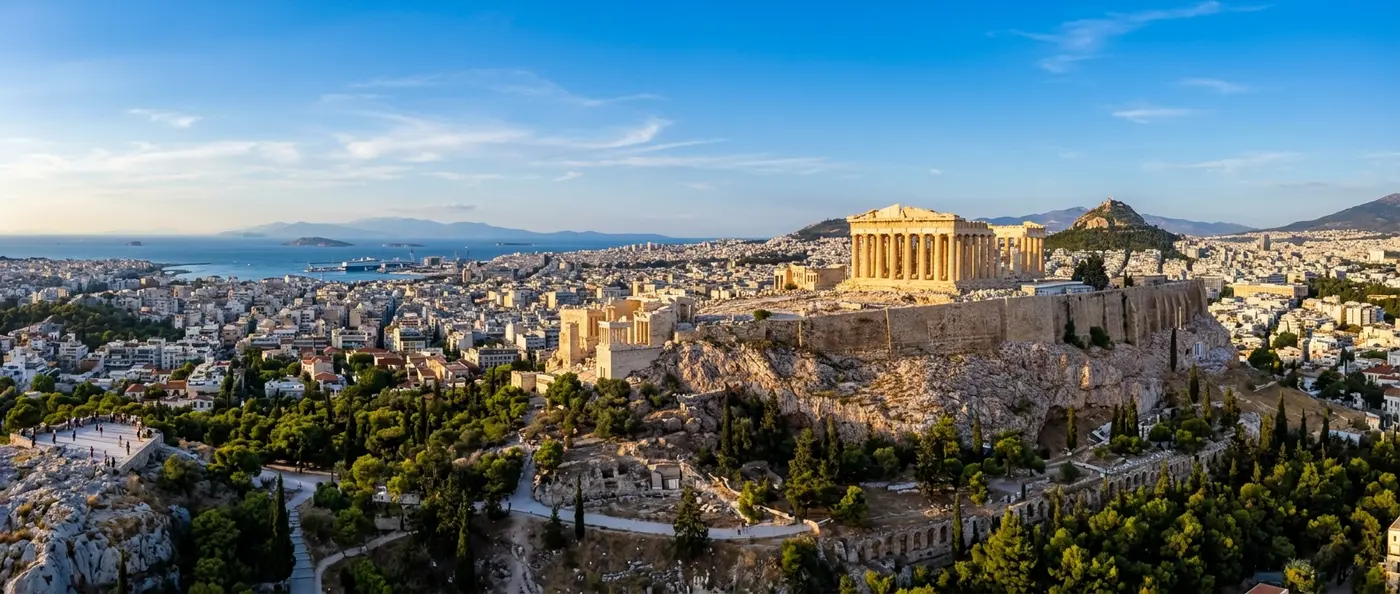
Standing on the Acropolis rock as the sun rises over Athens, you understand why this place has magnetized humans for millennia. But behind the marble masterpieces lie stories that would surprise most visitors.
🏛️ The Parthenon Wasn't Always Athena's Temple
The most iconic monument of the Acropolis has a history extending far beyond ancient Greece. After the fall of ancient religion, the Parthenon was converted into a Christian church dedicated to the Virgin Mary. For nearly a thousand years, Byzantine pilgrims climbed the sacred rock to pray where Athena's chryselephantine statue once stood.
The transformation didn't stop there. When the Ottomans conquered Athens in 1456, the Parthenon became a mosque. A minaret rose beside the ancient columns, and for nearly 400 years, Muslim prayers echoed where the Panathenaic festivals once took place. These successive uses left their marks on the monument - from Byzantine frescoes to Ottoman inscriptions carved into ancient stones.
⚔️ The Acropolis as Fortress and Palace
Many visitors see the Acropolis as a sacred space, but its strategic position made it ideal for defense. During the Middle Ages, the entire rock was transformed into a fortified city. Frankish dukes built towers between the ancient temples, and Catalan mercenaries used the Propylaea as barracks.
Most striking is that where today's museum stands, there was once an entire medieval palace. The Frankish dukes of Athens lived there from 1205 to 1458, organizing knightly tournaments at the foot of the sacred rock. The foundations of this palace were only discovered in the 20th century, revealing a hidden world of medieval life above the ancient city.
Modern laser scanning techniques have revealed details invisible for centuries. Microscopic deviations from straight lines were detected in the Parthenon's columns - the so-called "entasis" - creating the optical illusion of perfect straightness. This technique required mathematical calculations so advanced that only in the 19th century did engineers fully understand them.
Even more captivating is the discovery that the ancient marbles retain traces of their original coloring. Using ultraviolet lighting and spectroscopy, scientists have located remnants of red, blue, and gold paint. The white marble Parthenon we know today was actually painted in brilliant reds, blues, and golds that would seem almost garish by today's standards.
Laser Scanning
Revealed column "entasis" and microscopic details invisible to the naked eye
Color Analysis
Located traces of ancient colors that made the marbles polychromatic
DNA Analysis
From bones found near the Acropolis, we learn about ancient inhabitants
💀 The Dark Side of the Sacred Rock
Beneath the marble's brilliance lie dark stories. In 480 BC, when the Persians approached Athens, the Acropolis defenders refused to surrender. The invaders burned the old Parthenon and slaughtered those who had taken refuge there. The charred remains of this destruction were later used as foundations for the new temple - a permanent memorial to the tragedy.
Centuries later, in 1687, another catastrophe struck the sacred rock. During the Venetian siege of Athens, the Ottomans used the Parthenon as an ammunition depot. A Venetian cannonball hit the building, causing a massive explosion that destroyed much of the temple. More than 300 people were killed, and the Parthenon became the ruin we see today.
🗿 The Mystery of the Heads
Archaeologists have found dozens of decapitated statues around the Acropolis. Many weren't destroyed by enemies but by the Athenians themselves, who buried them ritually when they had worn out over time.
🏺 Hidden Treasures Beneath Our Feet
The Acropolis isn't just what we see above ground. Beneath the rock extends a network of caves and underground passages used for worship long before the Parthenon was built. In Aglauros' cave, young Athenians swore loyalty to their city. In Pan's sanctuary, believers left offerings to the god of shepherds.
In 1885, workers uncovered an underground treasure trove. It contained hundreds of votive offerings from the Archaic period, including the famous "Korai" - the smiling female statues that today adorn the Acropolis Museum. These statues had been carefully buried by the Athenians after the Persian destruction, preserving them for us 2,500 years later.
The Acropolis' financing caused one of history's first political scandals. Pericles used money from the Delian League treasury - a defensive alliance of Greek cities - to build the monuments. Allies protested that their money was being used to beautify Athens instead of protecting Greece from the Persians.
According to ancient sources, Pericles cynically replied that since Athens protected its allies, it had every right to use the money as it wished. When his opponents in Athens accused him of waste, he offered to pay for the works himself - provided he could write his name on them. The people's assembly begged him to continue with public funds.
💰 The Cost of Glory
🔱 The Forgotten Gods
Athena wasn't the only deity worshipped on the Acropolis. Before her, the rock was dedicated to older chthonic deities. In the depths of the Erechtheion still exists the mark from Poseidon's trident, which according to myth struck the rock during his dispute with Athena for dominion over the city.
Even more mysterious is the worship of Cecrops, the mythical first king of Athens who had a serpent's body from the waist down. His tomb was located beneath the Erechtheion, and Athenians offered him honey-milk - a mixture of honey and milk. Traces of these ancient rituals have been found in underground crypts sealed for centuries.
🌍 The Acropolis as Global Symbol
Few know that copies of the Acropolis exist worldwide. The most impressive is in Nashville, Tennessee, where a full replica of the Parthenon was built in 1897. It even includes a massive statue of Athena, similar to the lost chryselephantine original.
In Germany, Ludwig I of Bavaria built the Walhalla near Regensburg, inspired by the Parthenon. In Scotland, the National Monument in Edinburgh began as a Parthenon copy but remained unfinished. These monuments show how the Acropolis became a global symbol of democracy and civilization.
🏗️ The Endless Restoration
Acropolis restoration began in 1975 and continues today. Every piece of marble is laser-recorded, and new sections are cut with millimeter precision from the same Pentelic quarry the ancients used. The work revealed that ancient craftsmen used iron clamps covered with lead to join the marbles - a technique that ensured their survival for millennia.
Piece by piece, scattered fragments return home. Marbles that had been used as building material in Plaka houses or sold to collectors are gradually returning to their place. Each year, the Acropolis puzzle becomes a little more complete, bringing us closer to the monuments' original form.