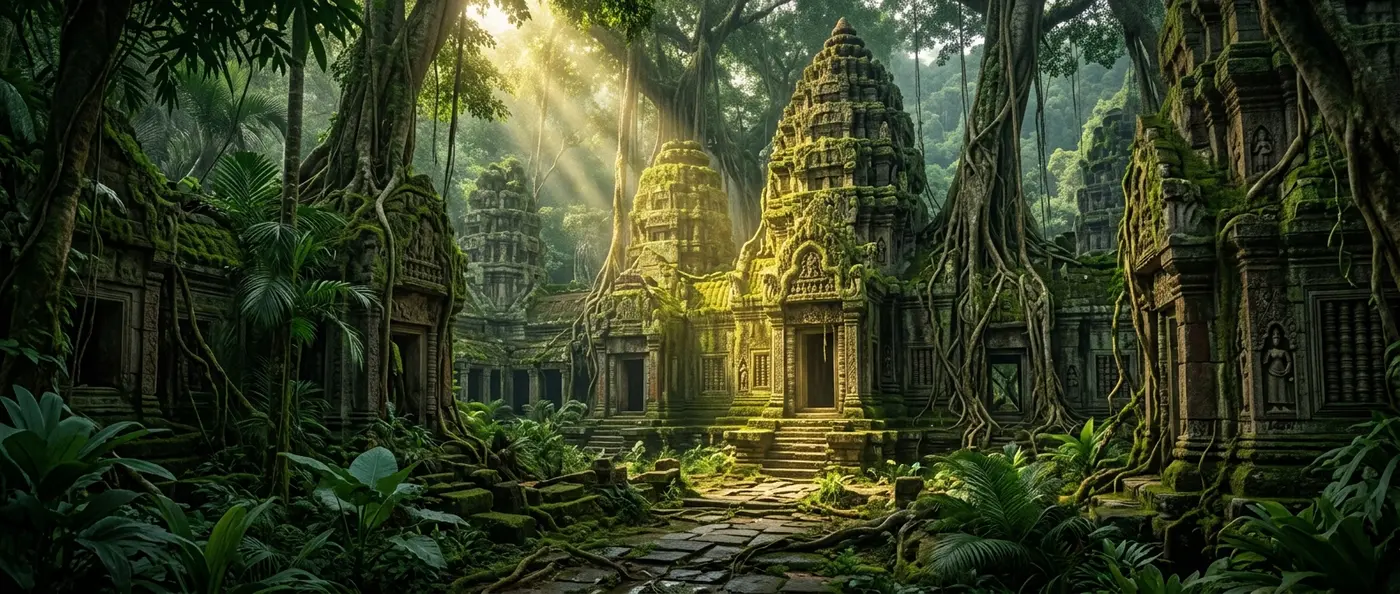
Deep in the Sahara Desert, archaeologists recently uncovered traces of a city buried for centuries beneath shifting sand dunes. The discovery wasn't just another ruin—it was a complete urban center with streets, buildings, and artifacts that rewrote what we knew about ancient trade routes. This find joins dozens of other lost cities that once thrived across the globe before vanishing mysteriously, taking their secrets with them into the earth, sea, and jungle.
🗺️ When Civilizations Disappear
Cities don't just vanish. They get swallowed by earthquakes, buried by volcanic ash, or abandoned when rivers change course. Sometimes war destroys them. Other times, climate shifts make them uninhabitable. The lucky ones leave behind pyramids and temples. The unlucky ones disappear so completely that only legends survive.
What sets these lost cities apart isn't just their disappearance—it's what they reveal about human resilience and failure. The Maya built astronomical observatories that tracked celestial movements with mathematical precision, then abandoned their cities to the jungle. The people of Thonis-Heracleion created a bustling port that connected Egypt to the Mediterranean world, only to watch it sink beneath the waves.
Modern technology has revolutionized the hunt for lost cities. LiDAR can peer through dense forest canopy to reveal hidden structures. Ground-penetrating radar maps buried foundations. Underwater robots explore sunken harbors. Each discovery forces historians to revise their timelines and acknowledge that ancient civilizations were far more sophisticated than previously thought.
🏛️ Thonis-Heracleion: Egypt's Sunken Gateway
For over a thousand years, Thonis-Heracleion existed only in ancient texts and scattered inscriptions. Historians knew it had been Egypt's main port before Alexandria rose to prominence, but nobody knew where to look. Then in 2000, marine archaeologist Franck Goddio found what he was looking for in Abu Qir Bay.
Six and a half kilometers off Egypt's coast in Abu Qir Bay, 10 meters below the Mediterranean's surface, lay an entire city. Temples, harbors, residential districts, and a complex network of canals stretched across the seafloor. The Egyptians called it Thonis. The Greeks knew it as Heracleion. Both names described the same thriving port that controlled trade between Egypt and the Mediterranean world from the 7th century BC onward.
The artifacts reveal a pattern of wealth and international commerce. A massive red granite statue of the god Hapy, symbol of abundance, towers over the underwater ruins. Sphinxes guard temple entrances. Gold coins, jewelry, and ceremonial objects lie scattered across the seabed. Greek pottery found alongside Egyptian artifacts proves this was a cosmopolitan trading hub where cultures mixed and merchants grew rich.
What destroyed Thonis-Heracleion? Earthquakes probably triggered the initial collapse. The soft sediment beneath the city couldn't support its weight during seismic activity. Tsunamis may have delivered the final blow. By the 8th century AD, the Mediterranean had claimed Egypt's greatest port, preserving it in salt water and sand for future archaeologists to discover.
Far south in modern Sudan, along the Nile's fertile valley, the rulers of ancient Kush built their capital at Meroë in the 6th century BC. Surrounded by rich agricultural land and positioned at the crossroads of African trade routes, the city developed a thriving metallurgy industry that produced exquisite gold jewelry and iron tools.
Kushite civilization blended Egyptian and indigenous African influences. Some temples depicted major Egyptian gods like Ammon and Isis. Others featured Apedemak, a lion-headed Kushite war god. The Egyptian legacy appears most dramatically in Meroë's 200-plus steep pyramids and elaborate tombs.
The kingdom was famous for its powerful female rulers. Known as kandakes, these queens and queen mothers didn't hesitate to take up arms. Greek historian Strabo described Queen Amanirenas, who fought the Romans in the 1st century BC, as a "masculine woman, blind in one eye." By the 4th century AD, the kingdom had declined, possibly after invasion by the neighboring Kingdom of Axum.
Kandakes: The Warrior Queens
Queen Amanitore, who ruled in the early 1st century AD, appears on temple walls wielding a long sword. Kushite queens weren't ceremonial figures but active leaders in war and peace, commanding armies and governing vast territories along the Nile.
200+ Nubian Pyramids
Meroë's pyramids, though smaller than their Egyptian counterparts, are equally impressive. Built with steep angles, they housed the tombs of kings, queens, and nobles, often accompanied by sacrificed animals and servants.
🌊 Alexandria: The Drowned Library of the World
Alexandria wasn't completely lost—modern Egypt's second-largest city sits on top of it. But the ancient metropolis that Alexander the Great founded in 332 BC has largely vanished beneath rising seas and shifting sediment. Today, much of the original city lies under 6 meters of water in Alexandria's harbor.
This was the intellectual capital of the ancient world. The Great Library, part of the larger Museum complex, aimed to collect "all the books in the world." Scholars copied every manuscript that entered the city. Ships arriving in Alexandria's harbor had their books confiscated, copied, and returned—the originals stayed in the library.
Some of history's greatest minds lived here: Euclid developed geometry, Archimedes invented mechanical devices, Ptolemy mapped the stars. The geographer Eratosthenes calculated Earth's circumference for the first time. Hundreds of scholars produced the first translation of the Old Testament from Hebrew into Greek.
A massive tsunami in 365 AD, among other disasters, caused tremendous damage. Unlike so many other cities that were simply abandoned, ancient Alexandria was swallowed as a new, modern city was built on top of it. The exact locations of some of its most famous monuments, including the tombs of Alexander the Great and Cleopatra, remain mysteries.
🏺 The Maya: Jungle-Swallowed Genius
At its peak, the Maya empire stretched across the Yucatan Peninsula, modern Guatemala, Belize, and parts of Mexico. The Maya were sophisticated engineers who built massive pyramids without metal tools and used complex mathematics to create the most accurate calendar in the ancient world. Then around 900 AD, something went catastrophically wrong.
The collapse wasn't sudden—it was a slow-motion disaster that unfolded over decades. Recent research suggests a combination of warfare, climate change, and environmental degradation created a perfect storm. Extended droughts made agriculture impossible. Deforestation and soil depletion reduced crop yields. City-states turned on each other in desperate competition for dwindling resources.
DNA analysis of ancient Maya remains reveals signs of malnutrition and disease in the civilization's final years. Overfarming and deforestation may have created an ecological domino effect that made recovery impossible. The magnificent cities were abandoned to the jungle, which slowly reclaimed the pyramids and palaces.
💡 The Mystery of Collapse
Recent DNA studies of ancient Maya burials show widespread malnutrition and disease in the civilization's final years. Overfarming and deforestation created an ecological cascade that made recovery impossible once the climate shifted.
🗿 Easter Island: Silent Sentinels
Famous for the massive stone heads lining its shores, Easter Island (Rapa Nui) was home to a thriving Polynesian civilization that first settled the island around 700 AD. The inhabitants were skilled navigators who demonstrated other advanced capabilities in their isolated Pacific home.
Some theorize that resource depletion led to the civilization's decline. Disease and other factors may also have played a role. The moai, as the statues are called, remain silent witnesses to a culture that once flourished on one of Earth's most remote locations.
The Khmer Empire had spread across modern Cambodia. Angkor was one of the civilization's largest cities, with an extensive system of roads and canals and an estimated population of up to one million people. The Khmer Empire was at its peak between 1000 and 1200 AD.
Experts aren't sure what caused the civilization's disappearance, leaving its cities to the mercy of the relentless jungle. Theories range from warfare to environmental disaster. The impressive Angkor Wat temple complex remains as testimony to the once-powerful empire.
⚔️ Major Lost Cities: Timeline
🏺 Djenné-Djenno: Sub-Saharan Africa's Oldest City
The Sahara Desert stretches across northern Africa, creating a barrier that Western historians believed prevented cities from flourishing until the 9th century AD. The discovery of the ancient city of Djenné-Djenno, near Djenné in modern Mali, proved them wrong.
In the 1970s, aerial photography revealed the remains of a settlement in fertile floodplains near the Niger River. Archaeologists Susan and Roderick McIntosh uncovered a densely populated community dating to around 250 BC, making it one of the oldest cities found in sub-Saharan Africa.
Residents cultivated rice, sorghum, and other grains, crafted ornaments from iron, copper, and bronze, and shaped sophisticated ceramics and expressive terracotta sculptures. Hundreds of small clay animals found there may have been made as toys. About 7,000 to 13,000 people lived in the mud-brick dwellings.
🌾 The Mississippians: America's Lost Empire
From about 700 AD until European contact and colonization, much of the southeastern United States and the midwest was home to an agricultural civilization known as the Mississippians. One of their largest cities, Cahokia, was located near present-day Collinsville, Illinois.
Estimated at six square miles, Cahokia featured a massive central plaza, large earthen pyramids, and wooden structures similar in shape to Stonehenge that were used for tracking the stars. Some estimate Cahokia's population at 40,000, with many more living in villages outside the main city.
As with other lost civilizations, experts don't know with certainty what led to the Mississippians' gradual decline. Popular theories suggest the decline resulted from environmental degradation or famine and disease arising from poor sanitation.
Monks Mound: The Largest Pyramid
Cahokia's Monks Mound covers about 15 acres and rises roughly 100 feet high. It's the largest human-made earthen structure in North America, dwarfing the cars visible on the road beside it.
Astronomical Knowledge
The Mississippians built wooden circles similar to Stonehenge to track celestial bodies. These structures show advanced astronomical knowledge and the ability to predict seasons and agricultural cycles.
Dense Urban Center
With an estimated 40,000 residents at its peak, Cahokia was larger than London of the same era. The extensive network of villages around the central city created an urban area unprecedented in pre-Columbian America.
🔍 The Eternal Mystery of Atlantis
No discussion of lost cities would be complete without Atlantis. Plato described this ancient civilization around 360 BC in his dialogues Timaeus and Critias. The founders, he said, were half-gods and half-humans who created a utopian civilization and became a great naval power.
Their homeland consisted of concentric islands in the Atlantic Ocean, somewhere near what would later be called the Strait of Gibraltar. The islands were separated by wide moats and connected by a canal that penetrated to the center. There was a great capital on the central island, where a palace was built for Poseidon's mortal wife, Cleito.
Few scientists believe Atlantis actually existed. Ocean explorer Robert Ballard notes that "no Nobel Prize winner" has said that what Plato wrote about Atlantis is true. However, Atlantis's story is "logical," as catastrophic floods and volcanic eruptions have occurred throughout history.
About 3,600 years ago, a massive volcanic eruption destroyed the island of Santorini in the Aegean Sea. At that time, a highly advanced Minoan society lived on Santorini. The Minoan civilization disappeared suddenly around the same time as the volcanic eruption. But Ballard doesn't believe Santorini was Atlantis because the timing of the eruption doesn't match when Plato said Atlantis was destroyed.
🌊 Why Does Atlantis Captivate Us?
"It's a story that captures the imagination," says James Romm, a classics professor at Bard College. "It's a great myth. It has many elements that people love to imagine." Romm believes Plato created it to convey some of his philosophical theories.
💭 Lessons from Lost Cities
Lost cities teach us harsh lessons about civilization's fragility. Even the most powerful empires can collapse from a combination of factors: climate change, resource overexploitation, warfare, natural disasters. The story of Atlantis, whether real or mythical, speaks to moral decay and hubris leading to downfall.
Each new discovery proves that human history holds more surprises than textbooks suggest. Cities dismissed as myths prove real. Civilizations once considered primitive reveal sophisticated engineering and astronomy. Beneath sand, jungle, and sea, more lost cities wait for their turn to emerge.
LiDAR penetrates dense vegetation to map hidden structures. Underwater robots explore sunken harbors. Satellites spot geometric patterns in desert sand that reveal buried cities. The technology keeps improving, and the discoveries keep coming.