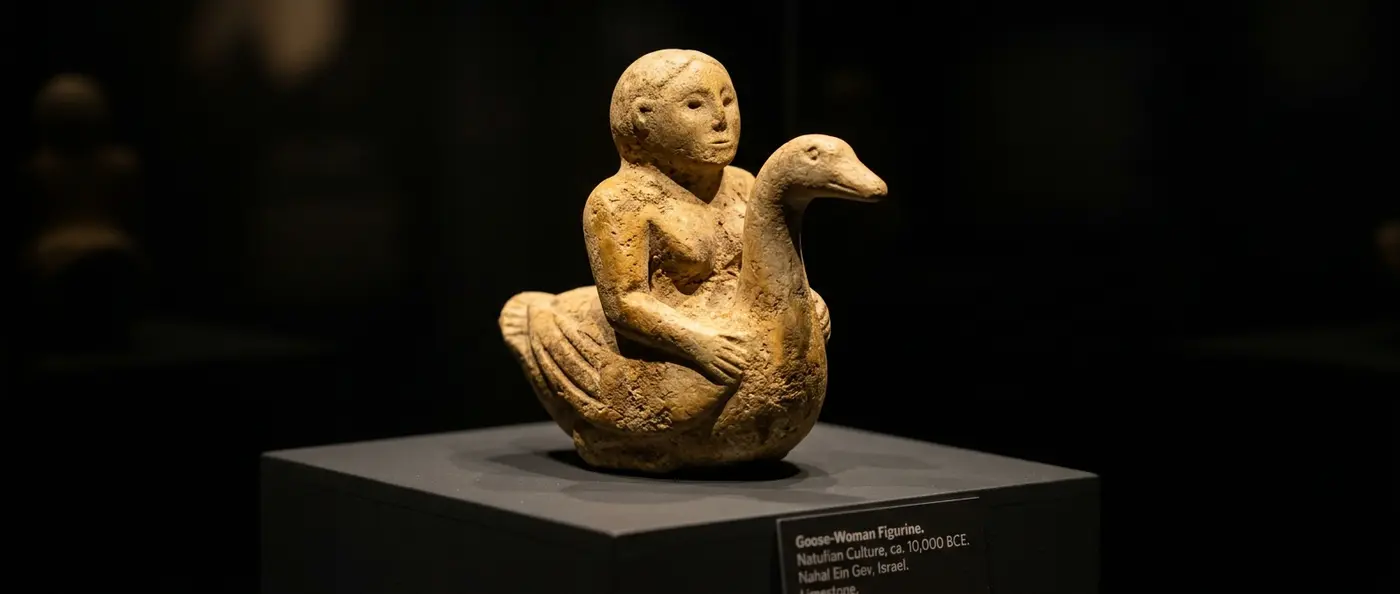
Deep within a cave near the Jordan River, archaeologists unearthed a discovery that pushes back the timeline of humanity's earliest religious practices. A tiny figurine, just a few centimeters tall, depicts a woman cradling a goose and dates back 12,000 years—making it one of the oldest examples of symbolic art in the Middle East.
🗿 The Discovery That Stunned the Archaeological Community
The figurine was uncovered during systematic excavations at a Paleolithic site in the Jordan Valley. The Jordan Valley sits at a crossroads where nomadic groups first began experimenting with permanent settlements. Archaeologists were working through layers dating to the Epipaleolithic period when they spotted the microscopic artifact.
Carved from local limestone, the figurine stands just 4.5 centimeters tall. Despite its diminutive size, the details are remarkably clear. The female figure is depicted holding a waterfowl—most likely a goose—in her arms, with the bird's characteristics distinctly visible despite millennia of wear.
Radiocarbon dating of organic remains from the same layer confirmed the artifact's age at 12,000 years before present. This places it at the end of the Paleolithic era, a period of critical changes for human society.
🏺 Craftsmanship and Artistic Merit
The carving required hours of patient work with primitive stone tools. The artist used stone tools to carve the limestone, creating delicate lines and curves. The surface bears traces of polishing, indicating hours of careful finishing work.
The most striking element is the depiction of the relationship between woman and bird. The figure's posture, with arms protectively embracing the goose, suggests tenderness and care. Few Paleolithic carvings capture such intimacy between human and animal.
Experts note that the rendering of anatomical details—facial features and body proportions—shows deep understanding of human form. Similar attention was given to the goose, with its long neck and characteristic body shape clearly recognizable.
💎 Symbolism and Religious Significance
No one agrees on what the figurine means. The depiction of a woman with a waterfowl is unique for this period and region. Most researchers agree the figurine likely served ritual or religious purposes.
The goose, as a waterfowl, symbolically connects to water—the source of life in the arid Middle East. The pairing of woman and bird may represent fertility, renewal, or the relationship between humans and nature. In later regional cultures, waterfowl often linked to fertility deities.
🔍 Why a Goose?
Geese were common in the region during the Epipaleolithic period, migrating along the Jordan Valley. Their domestication began much later, so the figurine likely depicts a wild goose. The choice of this bird may relate to behavior—geese are known for caring for their young and lifelong pair bonding.
🗺️ Archaeological Context
The site where the figurine was found reveals evidence of a semi-permanent settlement. Excavations uncovered remains of circular structures, flint tools, and animal bones. Analysis of the bones shows inhabitants hunted gazelles and wild sheep while also gathering wild cereals.
Hunter-gatherers were beginning to stay put. People began experimenting with plant cultivation and animal domestication. The figurine may reflect these changing human-nature relationships.
The same layer yielded other symbolic objects, including perforated shells used as jewelry and small stones with engraved geometric patterns. These finds suggest a community with developed symbolic thinking and artistic expression.
Settlement Type
Semi-permanent installation with circular structures, indicating transition from nomadic to settled life
Technology
Advanced flint tools, polished grinding stones, early ceramic elements
Diet
Combination of hunting (gazelles, wild sheep) and gathering wild cereals
🔬 Modern Analysis Methods
Researchers examined the figurine under microscopes and 3D scanners. Microscopic examination revealed traces of red ochre in certain areas, indicating the figurine was once painted. 3D scanning enabled creation of precise digital copies for study without risk of damaging the original.
Analysis of sediments around the figurine showed it was located in a specially prepared space, possibly a kind of shrine. Traces of burned bones and seeds were found, potentially indicating ritual offerings. The figurine's position, facing east, may also have symbolic significance.
Comparative studies with other figurines from the period show this one is unique. While other female figures exist from the Epipaleolithic era, none depict the relationship with an animal in such detail and tenderness.
⚡ Implications for Understanding the Past
This figurine's discovery revises our understanding of spiritual life 12,000 years ago. It shows that symbolic representations and religious thought were more complex than previously believed. The depiction of human-animal relationships suggests a worldview where nature and humanity were closely connected.
For archaeologists, the find opens new research avenues. The Israel-Palestine region emerges as a pivotal point in early human society development. Here, influences from Africa, Europe, and Asia converge, creating a unique cultural mosaic.
🌍 Parallels with Other Cultures
During the same period this figurine was crafted in the Jordan Valley, other cultures worldwide experienced similar changes. In Anatolia, early settlements like Göbekli Tepe showed signs of organized religion. In Europe, the last hunter-gatherers created impressive cave art.
What makes the Israeli figurine distinctive is its emphasis on human-animal relationships. While other cultures depicted animals as prey or threats, here we see a more complex, emotional connection. This may reflect early steps toward domestication.
🏛️ Contemporary Cultures (12,000 BCE)
🔮 Future Research
Excavations in the area continue, hoping to find more similar objects. Each find fills in gaps in the archaeological record. Researchers hope to locate the complete ritual assemblage to which the figurine belonged.
DNA technology opens new possibilities. If human bones from the same period are found, we could learn more about the people who created these artworks. What was their origin? How do they relate to modern populations in the region?
The small figurine of the woman with the goose reminds us that human creativity and spirituality have deep roots. 12,000 years ago, our ancestors weren't just concerned with survival. They created art, held beliefs, and expressed emotions through material objects that survive today to tell us their story.