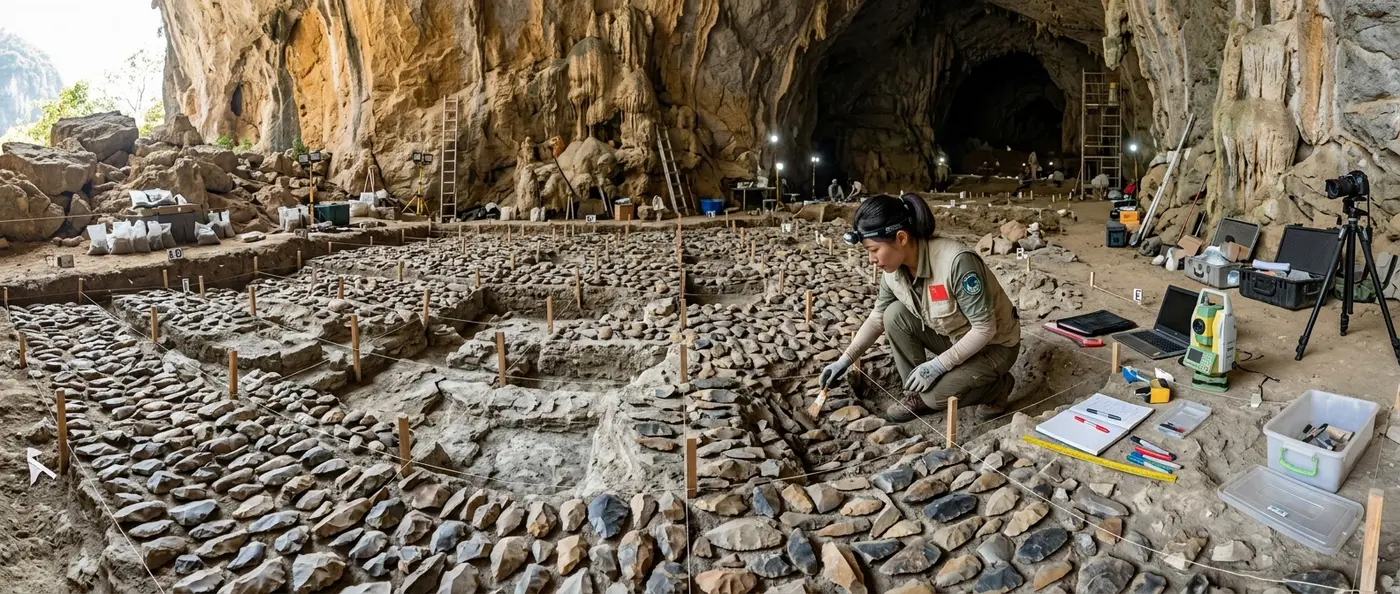
A team of archaeologists in northwestern Kenya has just uncovered something that fundamentally changes our understanding of human evolution. Over 130 stone tools, dating back 3.3 million years, were found near Lake Turkana, proving that our ancestors were making tools 700,000 years earlier than we previously believed.
📖 Read more: 430,000-Year-Old Wooden Tools Discovered in Greece
🔨 The Discovery That Shocked the Archaeological Community
In 2011, archaeologist Sonia Harmand from Stony Brook University spotted something unusual near Lake Turkana. What initially looked like simple stones scattered on the ground turned out to be ancient stone tools. The site, named Lomekwi 3, harbors an archaeological treasure that overturns our theories about human evolution.
The excavations that followed in 2012, funded by National Geographic, revealed tools buried beneath the surface. Pieces found on the surface matched perfectly with fragments buried in the sediments, indicating they belonged to the same set of tools.
Paleomagnetic dating placed the sediments at 3.3 million years old. This makes them several hundred thousand years older than the previous record-holders from Gona, Ethiopia, which date to approximately 2.6 million years ago.
🗿 Characteristics of the Ancient Tools
The Lomekwi 3 tools aren't just random stones. These are carefully crafted objects that show clear intentional manufacture. The finds include three basic types of tools that reveal a complete manufacturing process.
Sharp stone flakes were found that could be used for cutting, cores from which the flakes were removed, and anvils used to hold the cores during the knapping process. Some of these tools are impressively large, weighing over 30 pounds.
Sharp Flakes
Thin pieces of stone with cutting edges, ideal for slicing materials like hide, wood, or plant fibers.
Stone Cores
Larger stones from which flakes were removed through controlled strikes.
Anvils
Flat stones that served as bases for supporting cores during processing.
🧠 Who Made the Tools?
This creates a puzzling gap. Until now, the scientific community believed that toolmaking began only with the emergence of the genus Homo. But the oldest Homo fossils we know are about 2.8 million years old - half a million years younger than the Lomekwi 3 tools.
This means two things: either ancient australopithecines, like the famous "Lucy," had developed the ability to use stone tools before the genus Homo evolved, or there are older members of the genus Homo that we haven't discovered yet.
Nicholas Toth, a paleoanthropologist at the Stone Age Institute, argues that australopithecines would have had the cognitive abilities to do this. Although their hands probably weren't as dexterous as those of later humans, they could have knapped stone without particular difficulty.
An interesting candidate for the toolmaker is Kenyanthropus platyops, a controversial human relative discovered near Lomekwi 3 in 1998. The geographical proximity and chronological compatibility make it a likely candidate.
🐵 Comparison with Modern Apes
To better understand how the brains of our ancient ancestors might have worked, scientists turned to modern apes. Toth has conducted extensive research with bonobos, African apes that are close relatives of humans.
When given the appropriate materials for toolmaking, bonobos created tools that look remarkably similar to those found at Lake Turkana. They use flint to cut ropes or membranes, in a way similar to how one would skin an animal.
💡 Did You Know?
Bonobos understand the concept of "sharp" and can create tools similar to those of our ancient ancestors, despite their smaller brain size.
⚡ Sparks of Innovation or Continuous Tradition?
A critical question that arises is whether this discovery marks the beginning of millennia of toolmaking or if it's simply an isolated case. Toth proposes an interesting theory: perhaps we're seeing small sparks of attempts to use stone for certain activities, which didn't evolve into consistent tradition until the last 2.3 million years.
This view suggests that toolmaking ability may have appeared sporadically in various populations of ancient hominids, but didn't become a stable feature of human behavior until later. It's like seeing the first sparks of a fire that would fully ignite hundreds of thousands of years later.
🌍 Significance for Human Evolution
The Lomekwi 3 discovery forces us to reconsider fundamental assumptions about human evolution. Traditionally, toolmaking was considered the distinguishing characteristic that separated the genus Homo from its predecessors. Now it appears this ability may have preceded it.
This challenges long-held beliefs about cognitive evolution. If beings with smaller brains could make tools, then perhaps intelligence and technological innovation aren't as closely linked to brain size as we believed.
⚔️ Ancient Tool Comparison
🔬 Future Research and Open Questions
The Lomekwi 3 discovery opens more questions than it answers. Archaeologists are now searching for more sites of similar age to confirm whether toolmaking was a widespread practice or an isolated phenomenon.
Also, the search for older Homo fossils is intensifying. If Homo fossils aged 3.3 million years or older are found, they could explain who made these tools without requiring us to revise our views about australopithecine capabilities.
Meanwhile, scientists are studying the tools themselves to better understand how they were used. Analysis of microscopic wear marks on tool edges can reveal whether they were used for cutting meat, processing plants, or other activities.
🏺 The Broader Context of Human Technology
The Lomekwi 3 discovery reminds us that the history of human technology is much longer and more complex than we often imagine. From these first, simple tools to modern technology, human innovation has followed a long and often unpredictable path.
The Lomekwi 3 tools perhaps represent the first steps in this journey. They show that the ability to see a stone not just as a stone but as a potential tool - this cognitive leap that separates humans from most other animals - may be much older than we believed.
As research continues in Kenya and elsewhere, we can expect more surprises that will change our understanding of when and how our ancestors became technological beings. Each new discovery adds a piece to the puzzle of human evolution, revealing a story that is richer and more interesting than any fiction.