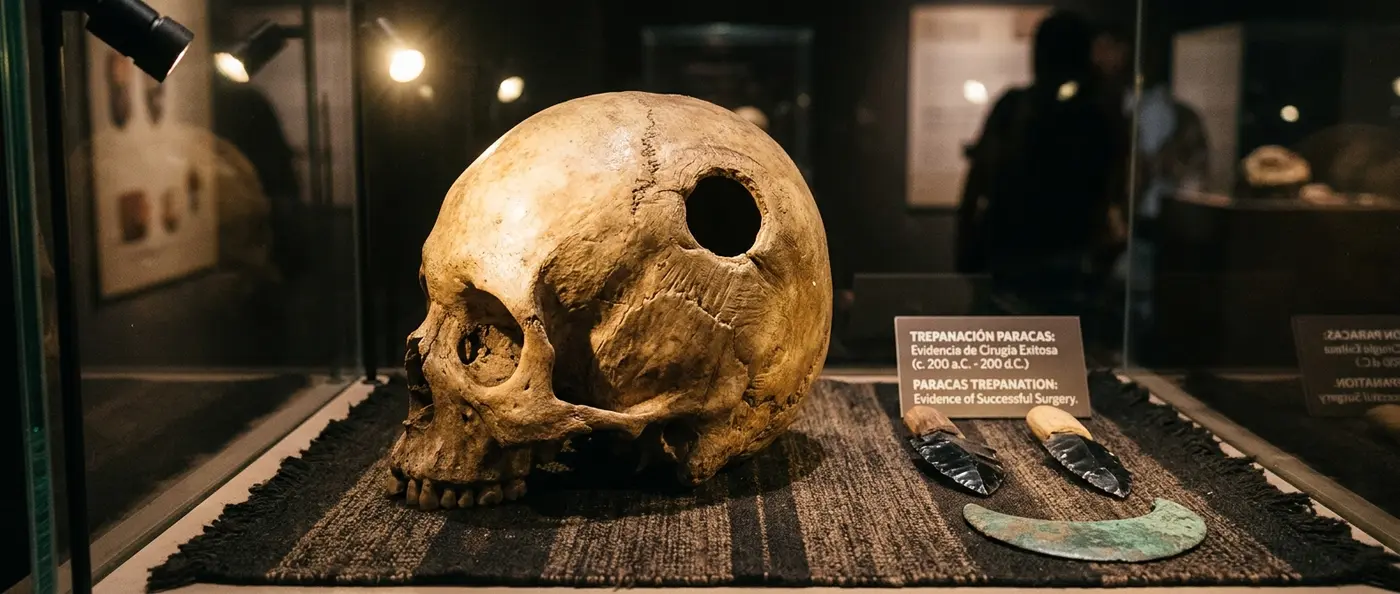
🗿 The Discovery That Shocked Spanish Conquistadors
When Spanish conquistadors climbed into the Andes in the 16th century, they froze. The locals had elongated, pointed heads unlike anything Europeans had seen. The Collagua, an indigenous group conquered by the Incas, practiced cranial modification from birth, before skull bones fused and soft spots disappeared.
Christina Torres, a bioarchaeologist at UC Riverside, says the Spanish jumped to horrific conclusions. "They claimed brains were running out of ears and that it was something terrible," Torres explains. "But that doesn't appear to be the case." Reality was far different — and more impressive — than the conquistadors imagined.
The Paracas skulls date to around 1000 BC, millennia before the Inca Empire rose. The Paracas skulls show cranial modification was widespread in pre-Inca cultures for thousands of years. This wasn't some isolated practice. It was sophisticated surgery performed across generations.
⚕️ The Science Behind Skull Shaping
Cranial modification was slow and gradual, Torres explains. "Bones remodel easily when children are young, so a simple strip of wrapped fabric can control how the head grows, just like a bonsai tree can be shaped and pruned."
Specialists have identified more than two dozen devices used to create different head shapes. The most typical method was simply wrapping the baby's head circumferentially, creating a longer, more conical shape. This technique required minimal equipment and training.
Tyler O'Brien, a forensic anthropologist at the University of Northern Iowa and author of "Boards and Cords" (2024), found head wrapping typically started around 6 months of age in most cultures and finished within one or two years. The shaping was likely done by the mother or midwife.
🔬 Archaeological Evidence and Global Spread
To recognize a modified head, archaeologists use visual inspection and human skull measurements known as craniometry. Researchers often employ three-dimensional, mathematical analysis of cranial measurements to see if the ratio of certain measurements — like skull width, length, and height — falls outside the expected range of natural variation.
Analysis shows head shaping is widespread in the archaeological record. Cranial modification has been found in skulls from Europe, the Middle East, Africa, Asia, and Oceania, with the strongest association in the Americas. But that doesn't necessarily mean it was more common there. Evidence of shaped heads may have preserved better in the Andes, where cool, dry conditions didn't degrade mummified remains as quickly, explains Matthew Velasco, a bioarchaeologist at the University of North Carolina.
Australia - 13,000 years ago
The oldest archaeological evidence of head shaping comes from Australia. Two artificially flattened skulls were discovered in Victoria state at the Kow Swamp site.
Europe - 12,500 years ago
The practice appeared in Europe during the Neolithic period, with the earliest evidence dating back 12,500 years.
China - 11,000 years ago
In China, cranial modification appeared about 11,000 years ago, while in present-day Iran it began 10,000 years ago.
💀 Health Effects and Brain Function
One of the most common questions about cranial modification concerns its health effects. There isn't much information about whether this practice was painful, but it doesn't appear to have had significant consequences for brain development, according to Torres.
"There's only one case where bioarchaeologists believe a child died from cranial modification, where the head was compressed too much," she says. "That's abnormal, from what I can tell. It was a slow and gradual process done with cloth and padding."
The child likely adapted quickly to any discomfort, and the brain would conform to the skull's shape, resulting in no adverse effects on cognition or intelligence. However, if done incorrectly, head shaping involving overly restrictive or rarely changed bindings could cause infection.
🧠 Myths vs Reality
Despite Spanish explorers' claims of seeing "brains coming out" and children with eyes "protruding from their sockets," these subjective reports are likely highly exaggerated. The brain adapted to the skull's new shape without affecting its function.
🏺 Connection to Andean Civilizations
Cranial modification in Peru wasn't unique to the Paracas. Pre-Hispanic indigenous groups weren't the only ones practicing head shaping. For centuries, archaeologists have found skulls on every continent except Antarctica showing evidence of "cranial vault modification" — heads shaped to be either flatter or more conical than they would be if left alone.
Since babies can't bind their own heads, specialists believe head shaping was done by caregivers. Now, archaeologists are beginning to uncover clues about why humans performed this practice for millennia, particularly in places like the Andes, where the practice is best documented.
🎨 New Discoveries and Cultural Connections
Recent research has revealed fascinating connections between cranial modification and other cultural practices. In Peru's Toro Muerto region, archaeologists discovered petroglyphs dating between 1,400 and 2,100 years ago that depict dancers with similarly elongated heads.
According to Andrzej Rozwadowski, an archaeologist at Poland's Adam Mickiewicz University, many of the carved rocks "are characterized by dynamic poses, the knees of some of them are bent, the legs of others are straight but spread wide, suggesting movement." These depictions may represent ritual dances connected to cranial modification practices.
📊 Cranial Modification Methods Compared
🔍 The Meaning Behind the Practice
Through systematic analysis, what specialists are uncovering is a wealth of practices and explanations, some of which are confusing or contradictory. In some places, a shaped head might indicate social status, while in others, head shapes differ even among close family members.
"Something as seemingly shocking as cranial modification might have been almost routine for certain children at certain time periods," says Velasco. It likely originated deep in human history and appeared across multiple eras and locations. "I think we need to start from the assumption that meaning varies by time and place."
Christine Lee, a bioarchaeologist at the University of Mississippi, emphasizes that the practice may have served multiple purposes: social identity, religious significance, or even aesthetic preferences. The fact that the practice continued for thousands of years suggests it held deep cultural meaning for the peoples who practiced it.
🌎 The Paracas Legacy
The Paracas skulls show the sophistication of ancient South American civilizations. The precision and technique required to safely perform this practice reveal a culture with advanced medical knowledge and deep understanding of human anatomy.
Today, these ancient skulls remind us that our perceptions of beauty, identity, and social status are deeply cultural. What may seem extreme or unusual to us was an established and respected practice that lasted millennia and spread across the globe.
Study of the Paracas skulls continues, with new technologies allowing researchers to examine these ancient remains in unprecedented detail. Each new discovery adds another piece to the puzzle of understanding this remarkable civilization and its achievements in ancient surgery.