🗿 The Discovery That Rewrites Celtic History
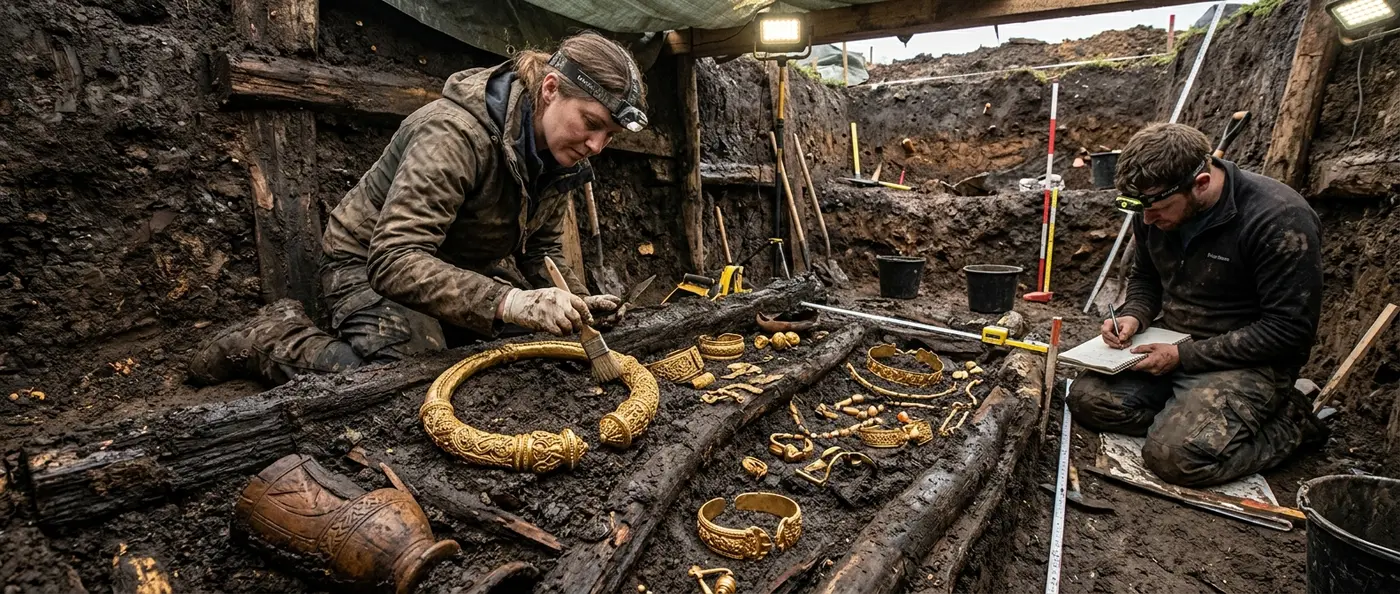
The Celtic burial chamber near Riedlingen represents only the second perfectly preserved wooden tomb found in Germany. Ever. That makes this discovery extraordinarily rare — only one other wooden Celtic tomb has survived intact in all of Germany.
Dirk Krausse, Baden-Württemberg's state archaeologist, called the Riedlingen tomb "a true gift to archaeology" during a packed press conference. The exceptional preservation stems from groundwater that kept the wood waterlogged and oxygen-free for over two millennia. No oxygen means no decay.
The burial chamber itself measures roughly 11 by 13 feet, constructed entirely from massive oak beams. Floor, walls, ceiling — all survived virtually untouched. The Celtic builders who assembled this tomb in 585 BC used construction techniques that archaeologists can now study in unprecedented detail.
⚔️ The Celts of Central Europe
Ancient Celts controlled territory from modern France to Turkey — Gauls in France, Celtiberians in Spain, and the early Celtic tribes of southern Germany where this tomb was built. These weren't the painted warriors of Hollywood but sophisticated societies with complex social hierarchies and advanced metalworking skills.
Between 620 and 450 BC, Celts in southwestern Germany built enormous burial mounds for their elite. These "princely tombs" required massive resources and coordinated labor — clear evidence of organized societies with powerful leaders who could mobilize entire communities.
The Riedlingen mound originally measured 213 feet across and nearly 20 feet high. Building something this massive would have taken hundreds of workers months to complete. The sheer scale tells us the buried individual wielded extraordinary power and influence.
🔬 Precision Dating Through Tree Rings
The preserved wood allows archaeologists to use dendrochronology — tree ring dating — to pinpoint exactly when the chamber was built. So far, they've dated a tool left behind by Celtic builders to 585 BC, giving them a precise construction date.
Analysis of human remains revealed the main occupant was a young man between 15 and 20 years old, standing roughly 5'3" to 5'6" tall. A second, later burial near the mound's surface contained an older man aged 25 to 35.
Beneath the burial mound, archaeologists discovered two cremation urns dating to around 600 BC, suggesting the site held sacred significance before the large tomb was built. They also found ceramic vessels from the early 6th century BC buried in a pit under the mound.
Dendrochronology
Tree ring analysis allows researchers to determine the exact year wood was cut, providing absolute dating for the tomb's construction with precision impossible through other methods.
Osteological Analysis
Study of skeletal remains reveals information about age, sex, height, and health of buried individuals, painting a picture of Celtic society's physical characteristics.
💀 Ancient Tomb Robbers and Lost Treasures
Despite the tomb's robust construction, ancient grave robbers managed to break in. Excavations revealed that looters had dug two tunnels into the burial mound and created an entrance hole through the chamber's roof.
This explains the absence of precious grave goods inside the tomb. However, archaeologists discovered several nails in one of the robbers' tunnels. They believe these nails came from a four-wheeled chariot buried with the deceased — a custom observed in other princely Celtic tombs.
The chariot's presence indicates the deceased's high social status. In Celtic society, chariots were symbols of power and wealth. Burying them with the dead reflected beliefs about the afterlife where the deceased would need their earthly possessions.
🏺 Did You Know?
Celts believed the afterlife was as real as earthly life. They buried their dead with everything needed to continue living in the other world — from weapons and jewelry to entire chariots and food supplies.
🏛️ What This Discovery Means for Celtic Archaeology
This discovery offers invaluable insights into Celtic society during the Early Iron Age. The exceptional preservation of the wooden chamber allows researchers to study Celtic construction techniques in detail never before possible.
The massive oak beams used in construction demonstrate the Celts' advanced woodworking skills. Their ability to cut, transport, and assemble such large timber pieces indicates an organized society with specialized craftsmen and sophisticated tools.
The burial mound's size and construction complexity reveal a hierarchical society with clear social stratification. The ability to mobilize resources for such a project indicates powerful leaders with significant influence over their communities.
🔱 Parallel Discoveries and New Perspectives
While the Riedlingen discovery focuses on the Celts, other recent archaeological research across Europe brings new evidence about prehistoric cultures to light. In Cornwall, England, for example, charred hazelnut shells discovered at Tregunnel Hill provided new dating for the arrival of the Neolithic period in the region.
Radiocarbon dating of the shells showed dates between 3985 and 3793 BC, placing the beginning of agriculture in Cornwall at least a century earlier than previously believed. This suggests the transition from nomadic hunter-gatherer lifestyles to permanent farming communities happened faster and earlier in Britain.
These discoveries, along with the Riedlingen Celtic tomb, show how new dating technologies and careful excavations can radically change our understanding of the past. Each new find adds another piece to the puzzle of European prehistory.
📊 Archaeological Finds Comparison
🗺️ The Future of Research
Excavations at Riedlingen continue, and archaeologists expect more revelations. Ongoing analysis of human remains may reveal information about ancient Celtic diet, diseases, and lifestyle.
Study of the wood itself can provide data about the period's climate, as tree rings record environmental conditions each year. This could help scientists better understand climate changes that affected ancient civilizations.
Finally, comparison with other Celtic tombs across Europe may reveal trade networks, cultural exchanges, and common practices among different Celtic groups. Each new discovery brings us closer to understanding this important European civilization that left its mark from Ireland to Turkey.