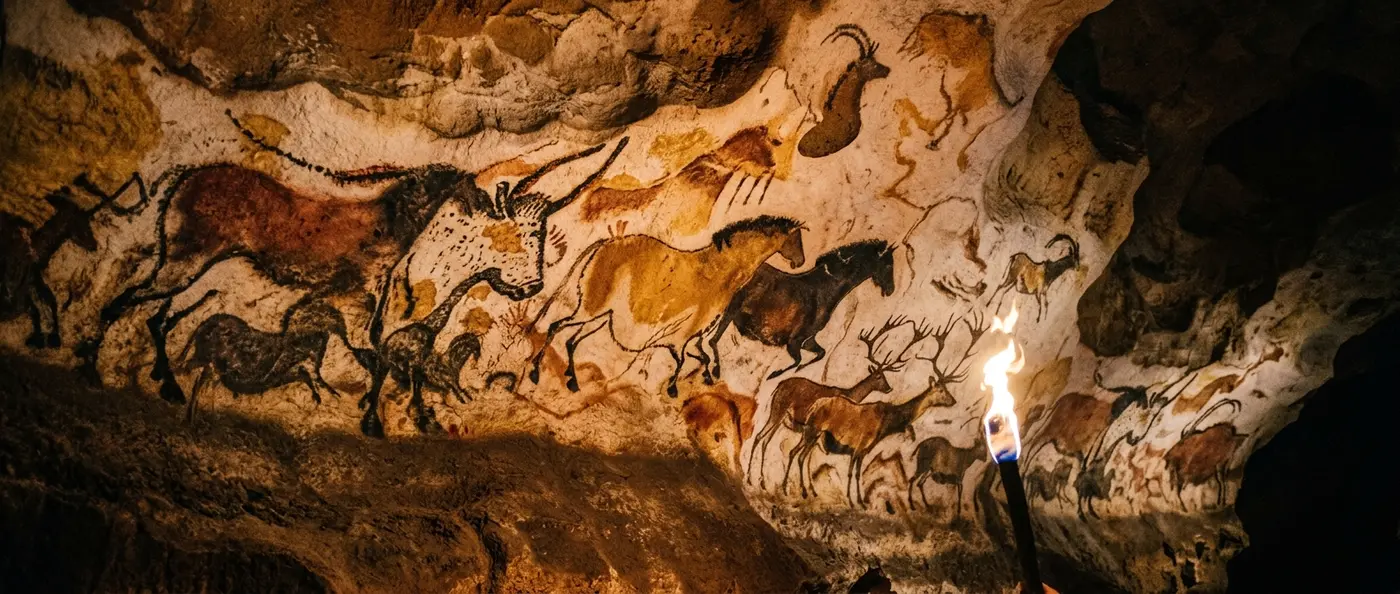
A bison charges across a cave wall in perfect perspective. Its muscles ripple. Its eye glares with primal fury. The painting is so vivid you can almost hear its hooves thunder against stone. This masterpiece wasn't created by a Renaissance master or modern artist. It was painted 17,000 years ago by someone who never saw a city, never held a metal tool, never knew that art history would even exist.
🎨 The Discovery That Shattered Everything We Knew
Franco-Cantabrian art gets its name from where it was found: southwestern France and northern Spain, in the Cantabria region. Over 200 caves have been identified so far, with Lascaux and Altamira leading the pack as underground galleries that house artwork spanning tens of thousands of years during the Upper Paleolithic period.
Here's what blew archaeologists' minds: most of these caves weren't homes. Our ancient artists made pilgrimages to these underground cathedrals specifically to create art. They'd venture deep into pitch-black caverns, sometimes crawling through passages barely wide enough for a human body, carrying torches and pigments to paint in chambers that wouldn't see daylight for millennia.
Only a handful of caves show signs that people actually lived there. The rest were art studios. Sacred spaces. Places where creativity mattered more than shelter.
🏛️ Stone Age Artists Had Serious Skills
These weren't crude stick figures scrawled by firelight. Paleolithic artists mastered four distinct techniques with a sophistication that rivals modern training. They carved engravings directly into cave walls. They painted with natural pigments mixed to perfection. They sculpted relief carvings that seemed to emerge from living rock. In the French Pyrenees, they even worked with clay sculptures.
Iron oxides delivered reds and browns. Manganese created deep blacks. Limestone provided whites. They mixed these pigments with animal fat or water, creating paints that have survived 25,000 years without fading. They painted with their fingers, brushes made from animal hair, or blew pigment through hollow bones to create spray-paint effects that would make modern street artists jealous.
The genius move? They used the cave walls themselves as part of the composition. A natural bulge became a bison's shoulder. A crack transformed into a horse's mane. These artists understood three-dimensional space in ways that wouldn't be "invented" again until the Renaissance.
💡 Mind-Blowing Fact
Paleolithic artists used the natural curves and hollows of rock surfaces to give their paintings a 3D effect. An animal painted on a curved wall section appeared to "emerge" from the stone itself — a technique that predates modern special effects by 25 millennia!
🦌 What They Painted Reveals Everything
Walk into Lascaux and you're surrounded by a Pleistocene zoo. Horses gallop across walls. Bison thunder in herds. Deer leap with impossible grace. Mammoths lumber through painted landscapes that existed when ice sheets covered half of Europe. These weren't random doodles — they were anatomically perfect portraits of animals these people knew intimately.
Human figures? Rare as hen's teeth. When people do appear, they're usually stick-figure simple compared to the photorealistic animals. The artists could paint every muscle fiber on a cave bear but drew themselves like children's sketches. Either they were incredibly modest, or animals held a significance we're still trying to understand.
Then there are the symbols. Dots, lines, geometric patterns scattered throughout the caves like some prehistoric code. Archaeologists have catalogued hundreds of these abstract marks, but their meaning remains locked in the Stone Age. Were they maps? Calendars? Religious symbols? The world's first writing system? We're still guessing.
🗿 The Greatest Hits: Caves That Changed History
Lascaux in southwestern France earned the nickname "Sistine Chapel of Prehistory" for good reason. Discovered in 1940 by four teenagers and their dog, it contains over 600 animal paintings dating to around 17,000 years ago. The Hall of Bulls is pure spectacle — massive aurochs stretching 17 feet across the ceiling, painted with a mastery that rivals anything hanging in the Louvre.
Altamira in northern Spain shocked the world when it was discovered in 1879. The polychrome bison paintings on its ceiling were so sophisticated that experts initially refused to believe they were prehistoric. "No caveman could paint like this," they scoffed. They were wrong. Dead wrong. The paintings date to 14,000 years ago and represent some of the finest naturalistic art ever created.
Chauvet Cave in France holds the record for age — 32,000 years old. Its paintings of lions, rhinoceros, and cave bears capture animals that had already vanished from the region, suggesting these artists were painting from cultural memory passed down through generations.
Lascaux Cave
The "Versailles of Prehistory" with over 2,000 figures. The complexity of compositions and use of perspective still astounds visitors today.
Altamira Cave
Famous for its polychrome ceiling paintings. Artists used natural rock curves to give volume and dimension to painted animals.
Chauvet Cave
At 32,000 years old, it's among the earliest. Contains stunning depictions of lions and rhinoceros that had vanished from the region.
⚡ Why Did They Do It?
Nobody knows for sure, and that's what makes it fascinating. The theories range from practical to mystical. Maybe the paintings were hunting magic — paint the animal, catch the animal. Maybe they were educational tools, Stone Age textbooks teaching young hunters about animal behavior and anatomy.
Recent research suggests acoustics played a role. Many of the most spectacular paintings sit in cave chambers with unique echo properties. These spaces might have been prehistoric concert halls where shamans told stories, sang songs, and painted visions during firelit ceremonies that lasted for days.
The evidence points to something profound: these people weren't just surviving. They were thinking symbolically, creating beauty for its own sake, and passing down artistic traditions across thousands of generations. They had fully modern minds trapped in Stone Age bodies.
The cave paintings suggest that artistic expression emerged as a fundamental human trait, not learned behavior. Give people pigment and a surface, and they'll make something beautiful. They did it 25,000 years ago. They're doing it today. They'll do it 25,000 years from now.
📊 Major Cave Comparison
🔬 Modern Tech Reveals Ancient Secrets
Twenty-first-century science is revolutionizing how we study Stone Age art. Laser ablation uranium-series dating can now pinpoint the age of microscopic calcite samples formed over paintings. We're dating art with atomic precision.
Digital imaging and 3D scanning create virtual copies of entire caves. This tech is crucial because many original caves have closed to protect them from damage. Lascaux shut down in 1963 after scientists realized that human breath was literally destroying the paintings. Carbon dioxide + ancient pigments = disaster.
The solution? Perfect replicas. Lascaux IV, which opened in 2016, reproduces every crack, every brushstroke, every shadow of the original. Visitors experience the wonder without threatening the art. It's preservation through replication — and it works.
🌍 A Global Phenomenon
Franco-Cantabrian art isn't unique to Europe. It's part of a worldwide explosion of artistic creation during the Upper Paleolithic. Similar cave art spans from Portugal to Russia, suggesting that the urge to create was spreading along with modern humans themselves.
Recent discoveries in Indonesia shattered assumptions about European artistic superiority. A hand stencil in Sulawesi dates to at least 67,800 years ago. Cave paintings in Borneo are 40,000 years old. The artistic revolution wasn't European — it was human.
These discoveries rewrite our understanding of cognitive evolution. Symbolic thinking and artistic expression didn't suddenly appear in one place. They developed in parallel as modern humans spread across the planet, suggesting that creativity is as fundamental to our species as language or tool use.
We're not just the species that makes tools. We're the species that makes art. Always have been. Always will be.
🎯 The Future of Research
New technologies like DNA analysis of ancient pigments might soon reveal the genetic profiles of individual artists who created these masterpieces thousands of years ago. We could literally meet the painters.
🏛️ Racing Against Time
Preserving this irreplaceable heritage is an ongoing battle against physics itself. The paintings are incredibly fragile. Temperature changes destroy them. Humidity warps them. Light fades them. Even carbon dioxide from human breath can cause irreversible damage.
That's why many caves have created precise replicas for public viewing. Lascaux IV uses cutting-edge technology to reproduce not just the visual experience but the temperature, humidity, and even the smell of the original cave. Visitors get the full Paleolithic experience without endangering the originals.
International organizations like UNESCO have designated many caves as World Heritage Sites, ensuring their protection for future generations. Research continues with new discoveries happening regularly, adding pieces to the puzzle of prehistoric human creativity.
Every new cave painting discovered is a message from our ancestors. They're telling us: "We were here. We thought. We felt. We created beauty." Twenty-five thousand years later, we're finally learning to listen.