🏺 The Discovery That's Shaking the Archaeological World
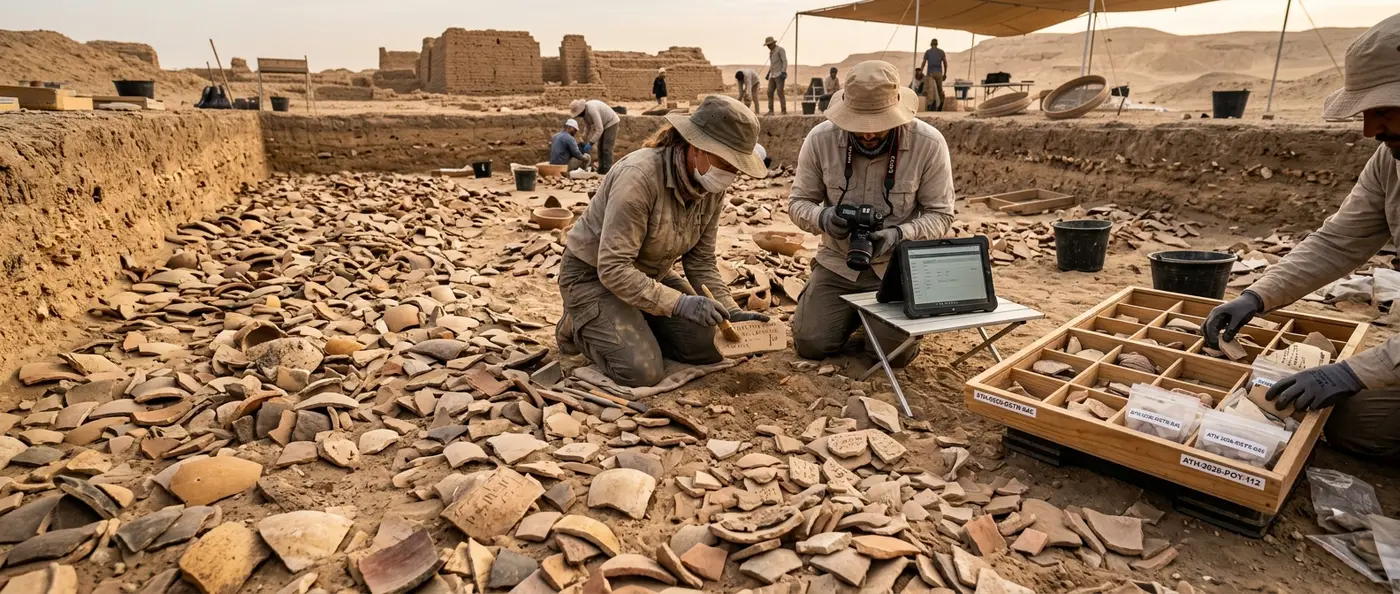
The excavation at Athribis, located in the Nile Delta near the modern town of Benha, has revealed something extraordinary. The Polish team from the University of Warsaw, led by Professor Krzysztof Janus, discovered a massive collection of ostraca concentrated in what appears to have functioned as an archive or administrative center.
Ostraca — fragments from broken pottery vessels — were widely used in ancient Egypt as cheap writing material. Unlike papyrus, which was expensive, pottery shards were abundant and free, making them ideal for everyday notes, receipts, and letters.
The timing places these texts at a pivotal moment in Egyptian history. The ostraca are from the Ptolemaic period (305-30 BCE), an era when Egypt was under Greek rule following Alexander the Great's conquests. This period is characterized by intense cultural mixing and administrative reforms.
📜 What the Texts Reveal
Initial analysis of the ostraca reveals a fascinating world of daily transactions and administrative procedures. Most texts are written in demotic script — a simplified form of hieroglyphs used for everyday purposes. However, there are also texts in Greek, reflecting the bilingual nature of Ptolemaic administration.
Among the finds are tax receipts, worker lists, correspondence between officials, and even personal letters. One particularly interesting ostracon contains a detailed list of daily grain rations distributed to workers employed on some major public project.
The variety of subjects is impressive. Land sale contracts, wills, medical prescriptions, and even student writing exercises have been found. These texts span all social classes, from farmers scratching out subsistence notes to officials managing complex trade networks.
🏛️ Athribis' Significance in Ancient Egypt
Athribis wasn't just a random provincial town. During the Ptolemaic period, it served as an important administrative and commercial center in the Nile Delta. Its strategic position at the crossroads of major trade routes made it an ideal point for tax collection and trade control.
The city had a long history dating back to the Pharaonic era. However, during the Ptolemaic period it experienced particular prosperity. The Ptolemies, in their effort to modernize Egypt's administration, created an extensive bureaucratic system that required detailed record-keeping.
The discovery of 3,000 ostraca in one location suggests the existence of an organized archive. Such archives were essential for operating the Ptolemies' complex tax system, which combined traditional Egyptian practices with Greek administrative methods.
💡 Why Ostraca Instead of Papyrus?
Papyrus was the premium writing material in ancient Egypt, but its cost made it prohibitive for daily use. A sheet of papyrus cost as much as a worker's daily wage. In contrast, pottery shards were free — you simply picked up a piece from a broken vessel and wrote on it with ink made from soot and water.
⚗️ The Analysis and Conservation Process
Analyzing 3,000 ostraca represents a titanic challenge. Each fragment must be carefully cleaned, photographed, catalogued, and studied. The team uses advanced imaging techniques, including multispectral photography, to reveal texts that have faded over time.
The demotic script used on most ostraca requires specialized knowledge to read. Only a few experts worldwide can fluently read this script. The team collaborates with specialists from various universities to ensure accurate translations.
One of the biggest problems is the fragmentary nature of many texts. Ostraca often break, and part of the text is lost. Researchers attempt to match fragments belonging to the same vessel, like reconstructing conversations from scattered sentence fragments.
Technological Analysis
Use of infrared and ultraviolet photography to reveal faded texts. Digital image processing to improve readability.
Digital Documentation
Creating a database with all ostraca, including transcriptions, translations, and metadata for future research.
Fragment Reconstruction
Attempting to match fragments belonging to the same vessel to reconstruct complete texts.
🔍 First Findings and Surprises
Among the most interesting finds is a series of ostraca describing the organization of a major religious festival. The texts detail the quantities of food ordered, musicians hired, and even the number of flowers for temple decoration.
Another fascinating discovery is a collection of medical texts. They include prescriptions for various ailments, from headaches to scorpion bites. The prescriptions combine practical ingredients with magical formulas, reflecting the Egyptian belief that medicine and magic were interconnected.
Personal letters are particularly interesting. One touching example is a letter from a mother to her son serving in the army, where she sends wishes and asks him to write about his health. A mother's worry about her soldier son could have been written yesterday.
📊 Economic Life in Ptolemaic Egypt
The ostraca offer valuable information about the economy of Ptolemaic Egypt. Hundreds of tax receipts have been found that reveal the complex tax system of the era. There were taxes on almost everything: land, animals, sales, even for using public roads.
The Ptolemies had created one of the most efficient tax systems in the ancient world. Every transaction was recorded, every tax proven with a written receipt. This bureaucratic obsession created the massive volume of ostraca discovered.
Work contracts are also interesting. Agreements for hiring workers for various jobs have been found, from grain harvesting to building construction. The contracts detailed wages, working hours, and obligations of both parties.
💰 Prices and Wages in Ptolemaic Egypt
🌍 Multicultural Society in Transition
Ptolemaic Athribis was a microcosm of the multicultural society created by Alexander the Great's successors. The ostraca reveal a society where Greeks, Egyptians, Jews, and other ethnicities coexisted and interacted daily.
Texts showing mixed marriages, business partnerships between people of different origins, and religious ceremonies combining Greek and Egyptian elements have been found. The texts reveal both cooperation and tension — business partnerships alongside ethnic disputes.
Educational ostraca are particularly revealing. Student exercises learning to write in both Greek and Egyptian have been found. This shows that bilingual education was common, at least for children of the middle and upper classes.
🔮 Future Prospects and Expected Revelations
The complete study of the 3,000 ostraca is expected to take several years. Researchers estimate that only 10% of the material has been studied so far. As analysis continues, more revelations about life in Ptolemaic Egypt are expected.
One of the main goals is reconstructing Athribis' administrative system. The ostraca contain names of officials, descriptions of their duties, and references to administrative procedures. By combining this information, researchers hope to create a detailed organizational chart of local administration.
Another important research area is economic history. The ostraca contain prices of goods, wages, loan interest rates, and other economic data. Analysis of these elements will allow reconstruction of economic life with unprecedented detail.
Finally, personal texts — letters, diaries, notes — offer a unique opportunity to study daily life and the mentality of ordinary people. In an era where most written sources come from the elite, the voice of common citizens is particularly valuable.
🔬 New Technologies Serving Archaeology
The team uses artificial intelligence for automatic recognition and categorization of texts. Machine learning algorithms are trained to recognize different writing styles and group ostraca likely written by the same person. This significantly speeds up the analysis process.
🎭 The Human Dimension of the Discovery
Beyond their statistical and economic significance, the Athribis ostraca bring us close to people who lived 2,000 years ago. We read a mother's concerns for her child, a young man's dreams of becoming a scribe, a farmer's struggles to pay his taxes.
One particularly moving ostracon contains a letter from an elderly father to his children. He asks them to visit because he feels his end is approaching. He describes how he divided his property and gives them his final advice. It's a text that could be written today.
An elderly father dividing his property, a mother missing her son — the emotions transcend millennia. The people of Ptolemaic Athribis faced challenges similar to ours and sought solutions in ways familiar to us.
The discovery of 3,000 ostraca at Athribis represents a milestone in understanding Ptolemaic Egypt. As their study continues, we expect more revelations that will illuminate this fascinating period of human history. Each deciphered ostracon is a window to the past, a voice that comes alive again after two millennia of silence.