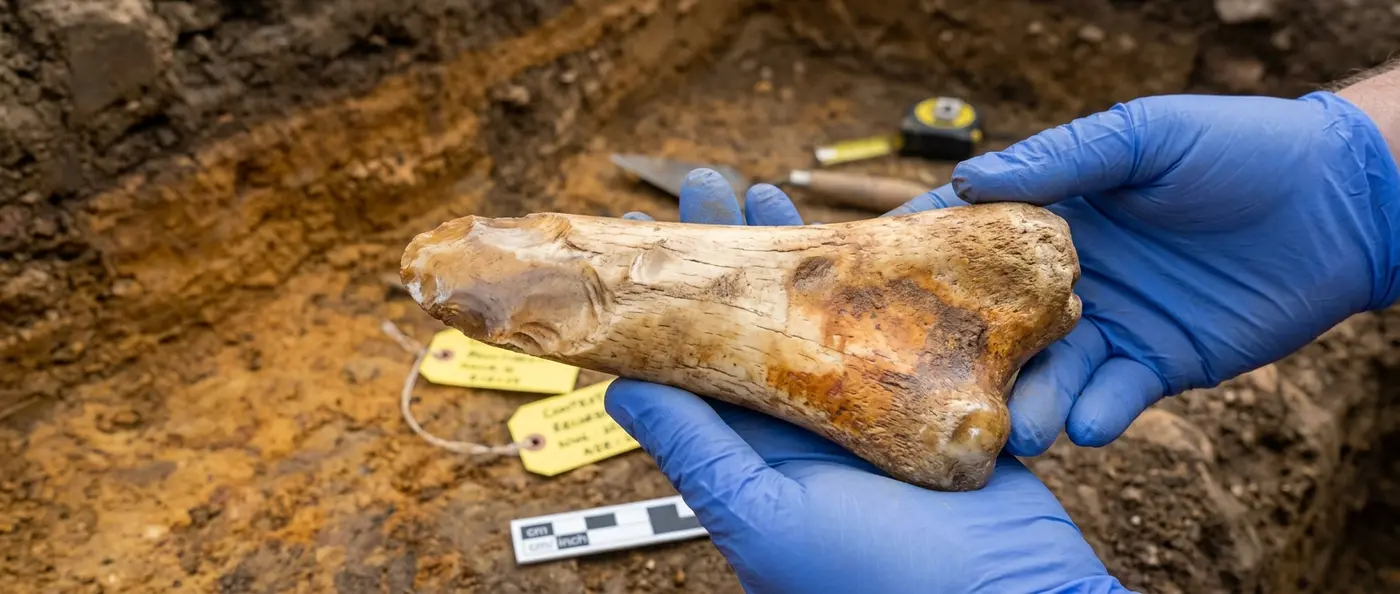
Deep within a Central European cave, archaeologists have unearthed a bone tool that pushes back the timeline of sophisticated human craftsmanship by tens of thousands of years. A bone tool crafted from an elephant's femur nearly half a million years ago reveals cognitive abilities we didn't expect from our ancestors of that era.
🦴 The Discovery That's Shaking Paleolithic Archaeology
The tool, dating to approximately 480,000 years ago, stands as the earliest known evidence of complex bone processing in Europe. Its discovery in Lower Paleolithic strata suggests that humans of this period had already developed advanced techniques for working hard materials.
This particular tool appears to have been crafted from the femur of an ancient elephant, most likely Palaeoloxodon antiquus, which dominated European landscapes during the Middle Pleistocene. The choice of this material wasn't random. Elephant bones, due to their size and density, provided ideal raw material for creating durable tools.
🔬 Analysis Techniques and Methodology
Studying the tool required cutting-edge analytical technologies. Researchers applied microscopic analysis to examine use-wear traces and manufacturing marks, while radiocarbon dating confirmed the artifact's stunning antiquity.
Cut marks and polishing traces found on the tool's surface reveal a systematic manufacturing process. The makers appear to have had clear understanding of bone properties and applied techniques requiring significant skill and experience.
Analysis of sediments surrounding the find provided additional information about the environment these early humans inhabited. Evidence points to a temperate climate with extensive forests and grasslands, ideal for large mammals like elephants.
🗿 The Tool's Creators
Who were the humans who created this specialized tool? 480,000 years ago, Europe was inhabited by Homo heidelbergensis, an ancestor of both Neanderthals and modern humans. This species had already developed significant cognitive abilities and technological skills.
Homo heidelbergensis were hunter-gatherers living in small groups with the ability to hunt large prey. Creating tools from elephant bones indicates not only successful hunting or scavenging, but also the capacity for planning and organizing complex activities.
Cognitive Abilities
Manufacturing such tools required planning, understanding material properties, and technical skill indicating advanced intelligence.
Social Organization
Elephant hunting and bone processing required cooperation and knowledge transmission among group members.
⚔️ How the Tool Was Used
The tool's morphology and preserved use-wear traces provide clues about its function. It appears to have been used for processing softer materials, likely hide or wood. The sharp edge would have allowed precise movements, while its size and shape made it ergonomic for extended use.
Such tools were valuable for daily activities of Paleolithic groups. They could be used for making leather clothing, processing wooden objects, or even food preparation. The bone's durability meant the tool could be used for extended periods without replacement.
💡 Why Elephant Bones?
Elephant bones were ideal for tool-making due to their size, density, and straight structure. A single femur could produce multiple tools, making it a valuable resource for Paleolithic communities.
🏺 The Broader Archaeological Context
This tool's discovery isn't isolated. It fits into a broader set of Lower Paleolithic European finds revealing the complexity of early human life. Other similar tools have been found at various sites, but few are this old or well-preserved.
The period around 500,000 to 400,000 years ago represents a critical phase in human evolution. We see significant innovations in stone tool technology, the first evidence of controlled fire use in many regions, and the emergence of more complex forms of social organization.
At the same archaeological site where the bone tool was found, researchers also discovered stone tools, faunal remains, and traces of human activities. This assemblage provides a comprehensive picture of life at a Paleolithic campsite.
🔱 Significance for Understanding Human Evolution
This find forces archaeologists to reconsider what Homo heidelbergensis could accomplish. Nearly half a million years ago, our ancestors had already mastered techniques once thought to belong to much later periods.
The ability to manufacture specialized bone tools indicates a level of abstract thinking and planning fundamental to human intelligence. It requires the ability to envision the final product before beginning construction, understand different materials' properties, and apply a series of technical steps in specific sequence.
⚔️ Tool Technology Evolution
🌍 Comparisons with Other Early Cultures
While European Homo heidelbergensis crafted sophisticated bone tools, other early human populations in different world regions developed their own technological innovations. In Africa during the same period, we see the emergence of more advanced stone tools and the first evidence of symbolic behavior.
In Asia, Homo erectus populations continued using traditional technologies but had already spread across a vast geographical range, from Indonesia to China. This diversity in technological traditions reflects early humans' adaptability to different environments and the various ways they addressed similar challenges.
Comparing these different technological traditions helps us understand that human evolution wasn't a linear process, but a complex mosaic of innovations, adaptations, and cultural exchanges unfolding at different rates in different regions.
🔬 Future Research Directions
The discovery of this 480,000-year-old bone tool opens new research avenues. Scientists plan further analyses using cutting-edge technologies like micro-tomography and isotope analysis to reveal more details about the tool's use and origin.
Additionally, continued excavation at the site where the tool was found promises to reveal more evidence about these early Europeans' lives. Each new find adds a piece to the puzzle of human prehistory and helps us better understand the long journey that led to modern humanity.
Studying such ancient tools isn't merely an academic exercise. It teaches us about human creativity, adaptability, and the capacity for innovation that has characterized our species since its beginnings. In an era of rapid technological change, understanding the roots of human technology takes on particular significance.