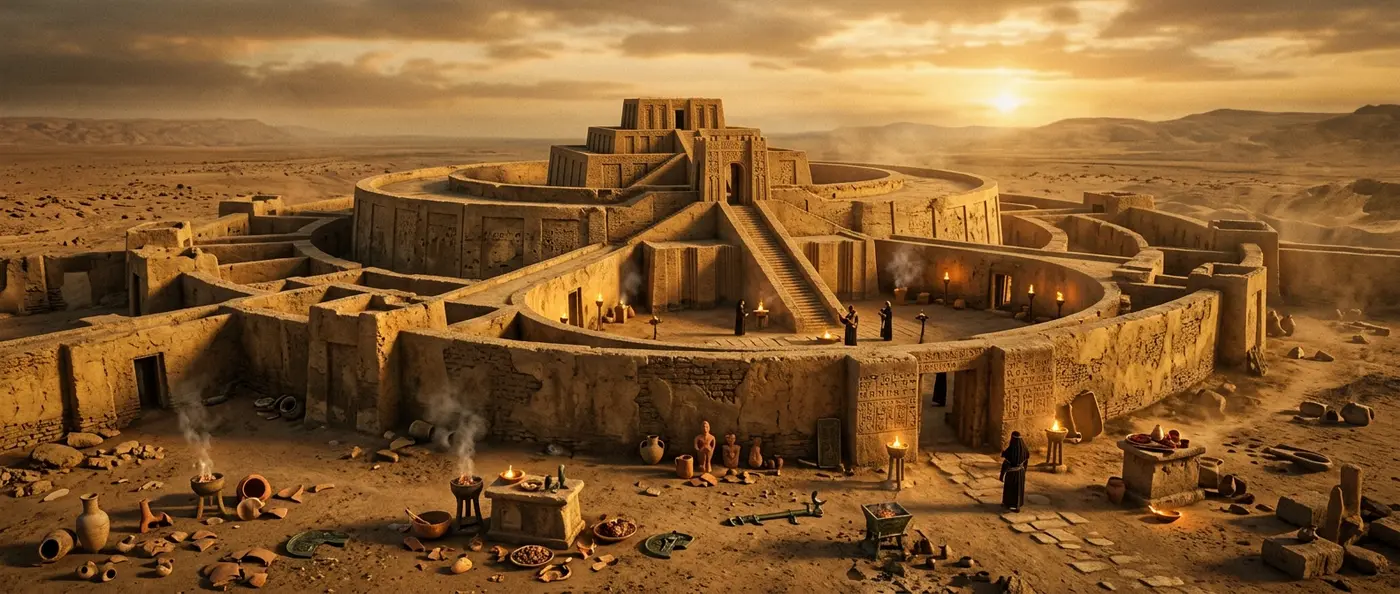
Archaeologists in northern Iraq just pulled a 5,000-year-old temple from the ground. The massive structure, buried in the foothills of the Zagros Mountains, dates to humanity's first urban experiment — when Uruk became the world's first true city. What they found 300 miles away from that ancient metropolis changes how we see civilization's first reach.
🏛️ The Discovery at Kani Shaie
September 2024. University of Coimbra archaeologists scraped away millennia of dirt at Kani Shaie, in Iraq's Sulaymaniyah province, and hit something extraordinary. A monumental building emerged, its walls still standing after 5,000 years. Carbon dating pinned it between 3300 and 3100 BCE — smack in the middle of the Uruk period, when humans first figured out how to build cities.
The location matters. Kani Shaie sits 480 kilometers north of ancient Uruk, roughly 15 days on foot by ancient standards. For decades, archaeologists assumed this made it a backwater settlement — too far from the action to matter much. The building proves otherwise.
Its architectural style screams official business. Probably a temple or sacred complex, the researchers say. The kind of structure that required serious resources, skilled craftsmen, and political backing. Finding it this far from Uruk suggests the world's first city had a much longer reach than anyone imagined.
🗿 Artifacts That Scream Power
The building held objects that reveal authority and connection. Cylinder seals from the Uruk period topped the list — these weren't decorative trinkets. They were administrative tools, stamps of bureaucratic power used to authenticate documents and transactions. Finding them 300 miles from Uruk means someone here wielded serious influence.
The gold medallion fragments are equally telling. Gold doesn't just appear in remote settlements. It signals wealth, status, and the kind of elite class that could afford to flash precious metals as social markers. Someone important lived here, or at least visited regularly.
The wall cones reveal something similar. These fired clay or stone decorative elements got pressed into wet plaster, creating geometric patterns on temple walls. Their flat ends were painted, forming intricate mosaics of triangles and zigzags. You don't build decorative walls for storage sheds. This was public architecture, meant to impress.
⚡ The Uruk Period and the Birth of Cities
To understand what archaeologists found at Kani Shaie, you need to picture 4th millennium BCE Mesopotamia. Uruk, sprawling across southern Iraq, was probably humanity's first real city. 80,000 people. 400 hectares. Organized street grids. Distinct zones for administration, crafts, and housing. Nothing like it had existed before.
Uruk's residents get credit for two inventions that changed everything. First, cuneiform writing — humanity's first written language, initially used to track grain stores and livestock. Second, written numbers, which let them record agricultural output with unprecedented precision. Suddenly, complex societies could keep track of themselves.
The city pioneered monumental architecture with ziggurats — those stepped pyramid temples that became the signature of Mesopotamian civilization. Here too appeared the first specialized priests with distinctive clothing and religious symbols, establishing an organized clergy that would dominate the region for millennia.
The First Megacity
Uruk was the first settlement to break 50,000 residents, with organized neighborhoods, administrative centers, and workshops. Its urban planning became the template for every Mesopotamian city that followed.
The Invention of Writing
Around 3200 BCE, Uruk produced the first clay tablets with cuneiform script. Initially used for accounting, it quickly evolved into a complete writing system that recorded laws, literature, and history.
Religious Organization
Uruk's temples weren't just worship spaces. They functioned as economic and administrative centers, with priests managing land, labor, and trade across vast territories.
🔱 The Uruk Network Extends
The Kani Shaie discovery proves Uruk's influence stretched far beyond the city walls. Despite the 480-kilometer gap, this wasn't an isolated outpost. It was part of an extensive cultural and political network that covered much of Mesopotamia.
The cylinder seals found at Kani Shaie are identical to Uruk's, suggesting shared administrative practices. The wall cones follow the same decorative style found in the metropolis's temples. Even the building's architecture bears Uruk's signature. This level of consistency across such distance raises fascinating questions.
How did they stay connected across two weeks of walking? What held this network together? Maybe Kani Shaie operated as Uruk's northern outpost, a forward base for projecting power into the Zagros foothills.
💡 Kani Shaie Through Time
Archaeologists have worked at Kani Shaie since 2013, finding evidence of occupation from the Chalcolithic period (6500 BCE) through 2500 BCE. It's considered the most important archaeological site east of the Tigris for understanding human settlement during the Early Bronze Age.
🏺 Religion as Organizing Force
That this was probably a temple makes sense. In Mesopotamia, religion wasn't just about belief — it was the framework that organized every aspect of life. Temples operated as economic centers, managing vast estates, organizing trade, and maintaining records.
During the Uruk period, Mesopotamian gods began taking the forms they'd keep for millennia. Each city had its patron deity, and that god's temple was the center of urban life. Priests weren't just ritual performers — they were managers, accountants, astronomers, and advisors to rulers.
Finding such a temple so far from Uruk suggests the city's religious system had already spread across vast distances. Maybe this was the secret of Uruk's success — exporting not just goods and technology, but an entire organizational system based on religion.
📜 From Sumerians to Akkadians
The Kani Shaie discovery also lets us examine Mesopotamia's broader picture. The region was first settled by Sumerians, who created the first city-states. By the late 4th millennium BCE, Semites from the west — the Akkadians — migrated into the area.
Instead of replacing Sumerian civilization, the Akkadians adopted and enriched it. Their gods merged with the Sumerian pantheon, their writing adapted to their Semitic language, and their political structures built on Sumerian models. This blend defined Mesopotamia for thousands of years.
Kani Shaie, positioned at the northern edge of this world, may have played a role in spreading Mesopotamian civilization to neighboring peoples — the Elamites to the east, the Hurrians and Hittites to the north.
🏛️ Mesopotamian Periods
🔬 What This Discovery Means for Archaeology
The researchers emphasized that if the building's monumental character is confirmed — something they're investigating in detail — the discovery could transform our understanding of Uruk's relationship with peripheral regions. Until now, they believed the city's influence was limited to a relatively small radius.
The new evidence shows a much more complex and extensive network. Uruk wasn't just a city that traded with its neighbors. It appears to have exported an entire organizational system — administrative, religious, cultural. Remote settlements like Kani Shaie weren't passive recipients, but active members of a broader civilizational system.
This has major implications for understanding how civilizations spread. It's not about simple conquest or imposition. It's a process of cultural integration, where local communities adopt and adapt elements from the center, creating something new.
Continued excavations at Kani Shaie promise more revelations. Each new find shows more about how humans first built cities and states from farming villages.