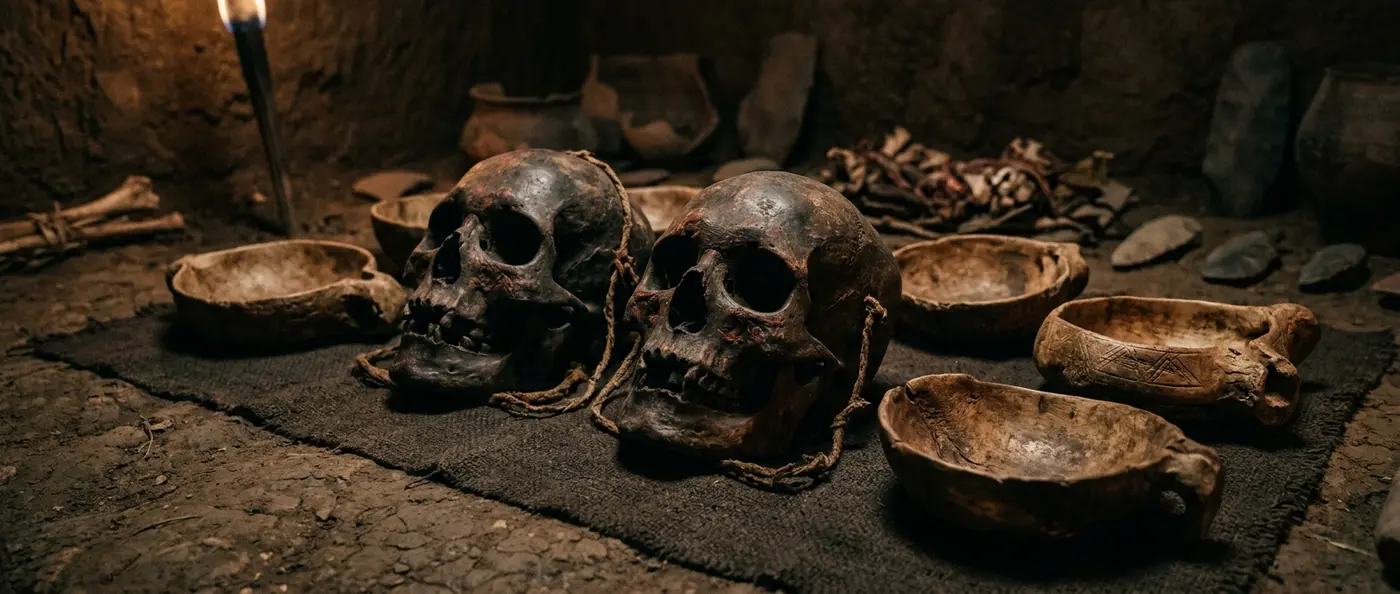
Four human skulls split vertically down the middle. Four more sliced horizontally to create drinking cups. In China's Zhejiang Province, archaeologists have uncovered artifacts that would make even seasoned researchers shudder: masks carved from human skulls and cups fashioned from severed heads. The 5,000-year-old finds belong to the Liangzhu civilization and expose a chilling chapter in East Asia's earliest urban society.
🗿 The Liangzhu Civilization: East Asia's First City
The Liangzhu culture flourished between 3300 and 2300 BCE in the Yangtze River delta region. Archaeologists consider it one of China's most advanced Neolithic civilizations, with sophisticated developments in architecture, agriculture, and social organization. The city of Liangzhu, discovered in 2007, sprawls across roughly 290 hectares and sits surrounded by an intricate system of walls and canals.
Liangzhu residents mastered jade working, creating elaborate objects that point to a hierarchical society with clear social stratification. The discovery of massive public works — dams and irrigation systems — shows they developed centralized authority capable of organizing large-scale projects.
What makes Liangzhu unique is its representation of the transition from small farming communities to the region's first urban society. And it's precisely during this transition that the macabre artifacts archaeologists discovered emerge.
💀 The Grisly Finds: Masks and Cups from Skulls
Dr. Junmei Sawada's team from Niigata University of Health and Welfare in Japan published the discovery in Scientific Reports in August 2024. The finds come from canals and ditches at five different Liangzhu culture sites.
The most striking discovery was four adult skulls that had been cut horizontally to create "skull cups." Four other skulls had been cut vertically, top to bottom, creating objects resembling masks. These skull-masks have no parallel in other ancient Chinese civilizations.
Beyond the skulls, archaeologists found other processed human bones: a skull with holes drilled in the back and a lower jaw that had been deliberately flattened. Many bones were unfinished, suggesting they were discarded during the manufacturing process.
🔬 The Bone Processing Technique
Analysis of the bones revealed they had undergone various forms of processing. Some had been cut, others drilled, while still others had been smoothed or polished with tools. There were no signs of violent death on the bones, nor evidence that the skeletons had been dismembered immediately after death.
This means the bones were processed after the corpses had already decomposed. The process appears systematic and organized, with specific techniques for each type of object they created.
The fact that many processed bones were found unfinished and discarded in canals alongside ceramics and animal remains suggests something disturbing: human bones were treated as simple raw material, without particular respect for the dead.
🏺 Skull Cups in High-Status Burials
While most processed bones were found discarded like garbage, skull cups have been discovered in tombs of Liangzhu elite members. This suggests some of these objects had religious or ritual significance, while others were simply failed manufacturing attempts.
🏙️ Urbanization and Dehumanization
Dr. Sawada and her team propose a theory for the emergence of this practice. The rise of urban society in the Liangzhu culture and subsequent encounters with social "others" beyond traditional communities may hold the key to understanding this phenomenon.
In a small farming community, everyone knows everyone. The dead are ancestors, relatives, friends. But in a city of thousands, anonymity increases. When people no longer know all their neighbors or consider them kin, it may become easier to separate bones from the humans they once belonged to.
Elizabeth Berger, a bioarchaeologist from the University of California, Riverside, agrees with this interpretation. What stands out about these finds is that processed human bones were essentially garbage. The casual treatment of bones may indeed relate to the increasing anonymity of an urban society.
Skull Masks
Four skulls cut vertically to create mask-like objects. No similar artifacts have been found in other ancient Chinese civilizations.
Skull Cups
Four skulls cut horizontally to create cups. Similar objects have been found in tombs of high-ranking Liangzhu society members.
Unfinished Works
Many bones were found in various stages of processing, indicating organized production of such objects.
⏳ A Practice That Appeared and Vanished
The timeline of this discovery raises questions. The practice of processing human bones appeared suddenly in the Liangzhu culture, lasted at least 200 years based on radiocarbon dating, and then disappeared completely.
Why did it start? What triggered it? And why did it stop? These are questions archaeologists hope to answer with future research. Dr. Sawada notes that further analysis may help reveal when and how people obtained the bones.
One possibility is that the practice connects to specific religious or social changes that occurred during this period. Its disappearance may be due to changes in religious beliefs or the social structure of the Liangzhu culture.
🌏 Comparisons with Other Ancient Civilizations
Using human bones to make objects isn't unique in human history. However, the scale and nature of the practice in the Liangzhu culture is unusual.
In other ancient civilizations, skull cups often connect to ritual practices or consuming enemies in warfare. For example, the Scythians of Central Asia were known for using enemy skulls as cups. But in the Liangzhu case, there's no evidence of violence or warfare.
The uniqueness of Liangzhu's skull-masks makes them even more enigmatic. No similar objects have been found in other Neolithic cultures of China or elsewhere, raising questions about their use and significance.
🏺 Comparison of Skull Practices
🔍 New Research Directions
The discovery creates new opportunities for understanding the Liangzhu culture and early urbanization in China. Scientists plan to conduct DNA analysis on the bones to determine whether they came from community members or outsiders.
Isotopic analyses can also reveal information about the diet and origin of individuals whose bones were used. This will help researchers understand whether there were specific criteria for bone selection.
Studying the unfinished objects may also provide information about manufacturing techniques and reasons why certain objects were discarded. Were they technical mistakes or were there other reasons?
💭 Implications for Understanding Human Nature
The Liangzhu discovery shows that human behavior toward the dead isn't constant or universal. It changes according to social, cultural, and economic conditions.
The transition from small communities to large cities brings profound changes in how we view other humans. When social bonds loosen and anonymity increases, it can radically alter how we treat even the dead.
The Liangzhu people came to see some human bodies as inert raw material. But what caused this change and why did it last only a few centuries? These questions await answers.
🔬 Future Research
Scientists plan DNA and isotope analyses to learn more about the bones' origins. They'll also study the unfinished objects to better understand manufacturing techniques and reasons for disposal.
📚 Conclusions and Discovery Significance
The discovery of skull masks and cups in the Liangzhu culture represents an important chapter in understanding early human history in China. It shows how urbanization can fundamentally change human relationships and values.
The finds also demonstrate how archaeological research reveals disturbing aspects of our past.
As research continues, we can hope to learn more about the people who lived in the Liangzhu culture and their practices. Until then, the skull masks and cups remain a dark but fascinating mystery from China's past.