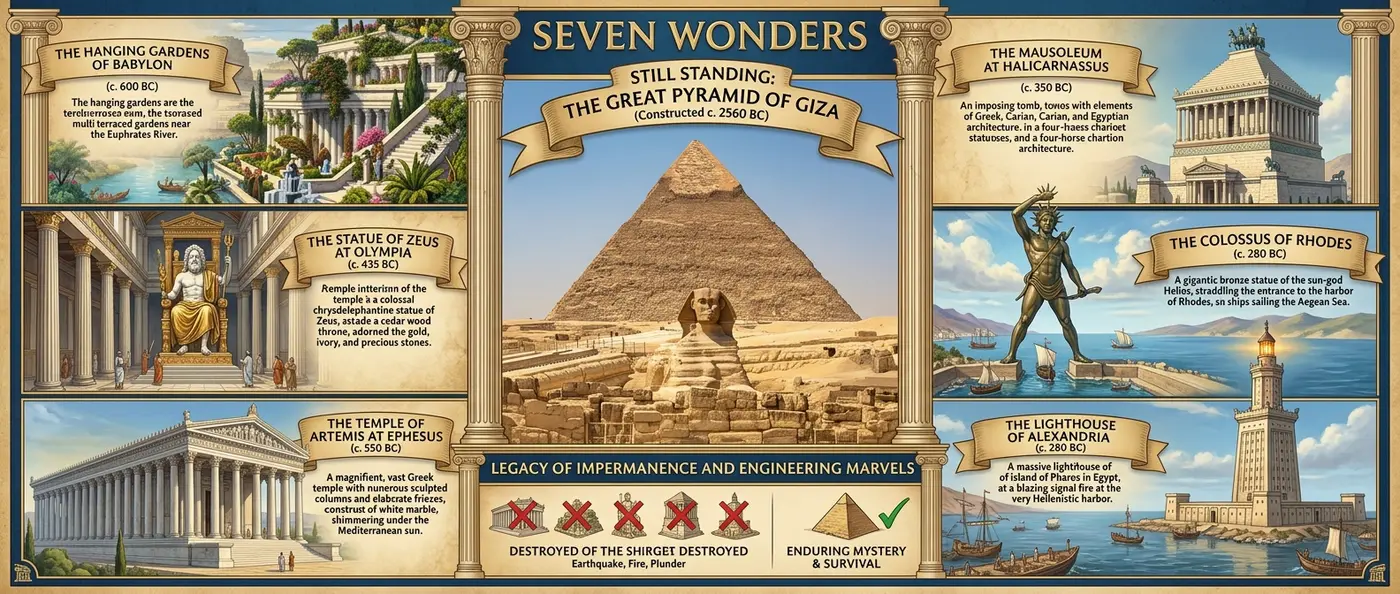
Stand before the pyramids of Giza today, and you're looking at the only one of the seven ancient wonders that survived intact. The other six? Earthquakes, fires, and time reduced them to ruins or erased them entirely. But archaeologists still dig up pieces of these lost monuments.
🏛️ The Seven Wonders: A List Born in Antiquity
The idea of cataloging humanity's most impressive achievements isn't modern. Ancient Greek travelers and scholars, like Antipater of Sidon in the 2nd century BC, compiled lists of the most wondrous works they had seen or heard about. The final list of seven wonders reflected the known world of the Hellenistic period — from Egypt to Mesopotamia.
These monuments weren't chosen solely for their size. Each represented something unique: technological innovation, artistic perfection, or the absolute expression of human ambition. Of these, only the pyramids still stand upright, while for the rest we have only ancient descriptions and sporadic archaeological finds.
🔍 The Pyramids of Giza: The Eternal Wonder
The three great pyramids of Giza — of Khufu, Khafre, and Menkaure — were built around 2580-2510 BC. The Great Pyramid of Khufu, with an original height of 146.5 meters, remained the tallest human structure for over 3,800 years. Today, despite weathering and the loss of its outer white limestone casing, it still impresses at 138.8 meters tall.
The most astounding aspect? The construction precision. Archaeologists have found that the base of Khufu's pyramid is nearly perfectly square, with a deviation of just 5.8 centimeters. The stone blocks, weighing from 2.5 to 15 tons each, were placed with such accuracy that not even a knife blade fits between them.
Modern technologies like muon tomography continue revealing new secrets. In 2017, researchers discovered a massive void 30 meters long above the Grand Gallery, whose function remains unknown.
In 280 BC, the Rhodians erected a massive bronze statue of the sun god Helios to celebrate their victory over Demetrius the Besieger. Standing about 33 meters tall, the Colossus stood near Rhodes' harbor — not straddling the entrance with spread legs as myth suggests.
Just 56 years after completion, a catastrophic earthquake in 226 BC toppled the giant. Its remains lay on the ground for 800 years, still attracting visitors who marveled at even the broken pieces. Pliny the Elder reported that few people could embrace the thumb of the fallen statue.
Today, underwater archaeological surveys in Rhodes harbor search for traces of the Colossus's base. So far, large stone blocks possibly belonging to the pedestal have been found, but the exact location remains uncertain.
💡 Did You Know?
The Colossus of Rhodes inspired the Statue of Liberty. French sculptor Frédéric Auguste Bartholdi studied ancient depictions of the Colossus before designing New York's famous statue.
🏺 The Temple of Artemis at Ephesus: Fragments of Grandeur
The Temple of Artemis at Ephesus was rebuilt at least three times. The final and most magnificent version, completed around 550 BC, had 127 columns 18 meters high. Antipater of Sidon wrote that when he saw the temple, all other wonders paled in comparison.
Destruction came gradually. First from Herostratus in 356 BC, who set fire to the temple to become famous. Then from Goths in 262 AD. Finally, its stones were used to construct other buildings, including Hagia Sophia in Constantinople.
Today, only a single lonely column stands at the temple site, reconstructed from fragments. However, finds from excavations — sculptures, jewelry, coins — testify to the wealth and importance of this sacred space that was a pilgrimage center for centuries.
Architectural Elements
127 marble columns in Ionic order, with relief-carved bases by the era's finest sculptors.
Economic Center
The temple also functioned as a bank, safeguarding vast sums of money and precious objects.
Modern Finds
The British Museum houses sculptures from the columns, showing mythological scenes.
🗿 The Mausoleum at Halicarnassus: Birth of a Term
When Mausolus, satrap of Caria, died in 353 BC, his wife Artemisia erected a tomb so impressive that his name became synonymous with magnificent burial monuments. The Mausoleum, about 45 meters tall, combined Greek, Egyptian, and Eastern architecture.
Earthquakes from the 12th-15th centuries destroyed the monument. The Knights of St. John used its stones to build the Castle of St. Peter in Bodrum (modern Halicarnassus). Ironically, this preserved many sculptures that were built into the castle walls.
19th-century excavations revealed the foundation and decorative fragments. The British Museum now houses some of the best-preserved sculptures, including statues possibly depicting Mausolus and Artemisia.
🔥 The Lighthouse of Alexandria: The Light That Went Out
Built under Ptolemy II (280-247 BC) on the island of Pharos, the Lighthouse of Alexandria raised its flame to a height of 100-140 meters. For over 1,500 years it guided ships into Alexandria's busy harbor.
Three earthquakes between 956 and 1323 AD gradually collapsed the lighthouse. In 1480, Sultan Qaitbay used its ruins to build a fortress on the same site.
Underwater archaeology has yielded major discoveries. Since 1994, French archaeologists have located massive granite blocks, colossal statues, and architectural elements on the seabed around the fortress. Among them, a statue possibly depicting one of the Ptolemies as pharaoh.
Of all the wonders, the Hanging Gardens are the most enigmatic. According to ancient sources, Nebuchadnezzar II (605-562 BC) built them for his wife Amytis, who missed the mountains of her homeland, Media.
The problem? No Babylonian inscription mentions the gardens. Extensive excavations in Babylon have revealed no traces of the complex irrigation system that would have been required.
A new theory suggests the gardens were in Nineveh, not Babylon. British researcher Stephanie Dalley argues that the Assyrian king Sennacherib (704-681 BC) built the gardens, and that later writers confused them with Babylon. Reliefs from Nineveh do indeed show gardens with irrigation systems.
⚖️ Babylon vs Nineveh: Where Were the Gardens?
🏛️ The Chryselephantine Statue of Zeus: Lost Art
Phidias, antiquity's greatest sculptor, created the statue of Zeus for the temple at Olympia around 435 BC. Standing 12 meters tall, the seated Zeus was made of ivory and gold over a wooden frame.
The statue remained in Olympia for 800 years. In the 5th century AD it was moved to Constantinople, where it was destroyed in a fire in 475 AD. Nothing survived of the statue itself.
However, excavations at Olympia revealed Phidias's workshop. There, tools, molds for casting glass ornaments for the statue, and a cup inscribed "ΦΕΙΔΙΟ ΕΙΜΙ" (I belong to Phidias) were found. These discoveries give us a taste of the process behind creating this lost masterpiece.
🔬 Modern Technology Reveals the Past
Modern archaeology uses tools unknown to the ancients. Satellite imagery spots buried structures. LiDAR reveals hidden foundations beneath vegetation. Photogrammetry creates 3D models from fragments.
In Alexandria, robots explore the seabed where the lighthouse once stood. At Ephesus, ground-penetrating radar maps the temple's underground structures. Even at the pyramids, new technologies reveal hidden chambers after millennia.
These discoveries don't bring back the lost wonders. But they help us better understand how they were built, how they functioned, and why they left such a deep imprint on humanity's collective memory. Each new find is a piece of the puzzle that composes the image of a world where human imagination and skill knew no bounds.