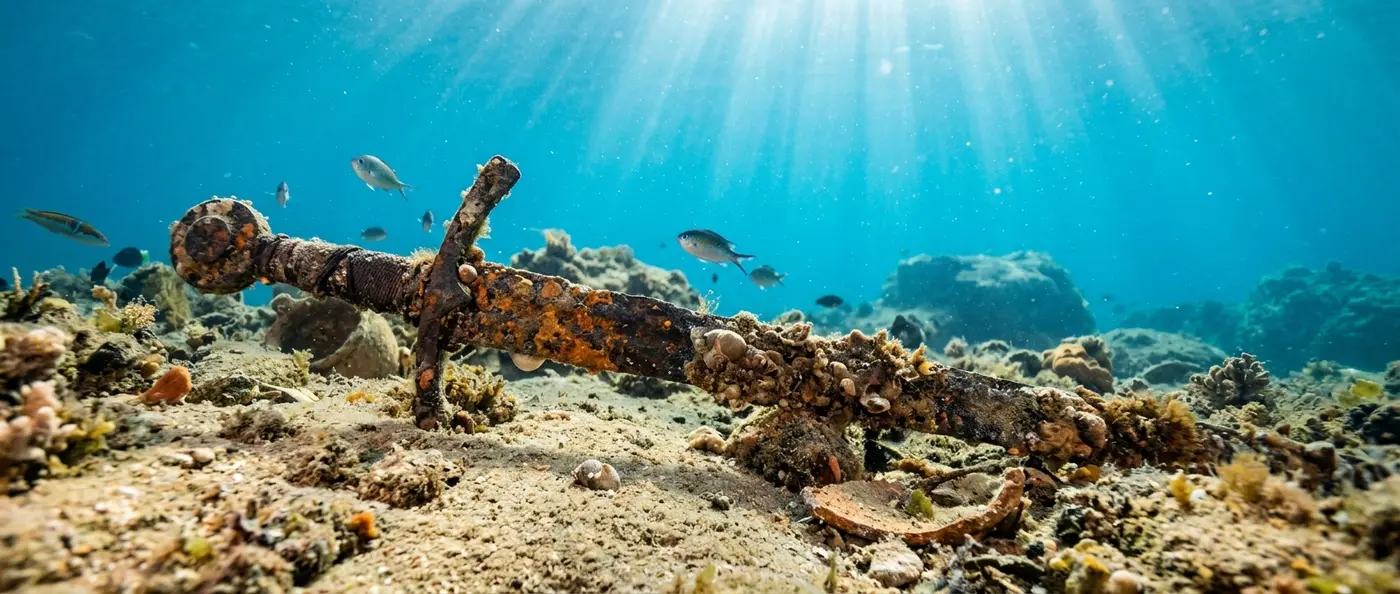
A graduate student was swimming off Israel's coast when he spotted something jutting from the sandy seabed. This wasn't the first time Shlomi Katzin had found a medieval sword — but the weapon he pulled from the Mediterranean would reveal Crusader secrets buried for nearly 900 years.
🗡️ The Discovery That Stunned Archaeologists
In March 2026, Shlomi Katzin, a graduate student in the Maritime Civilizations Department at the University of Haifa, made a discovery that would reshape our understanding of Crusader presence along Israel's coast. Swimming offshore, he noticed a group of divers with metal detectors and worried they might be antiquities smugglers.
After driving the group away, Katzin spotted something unusual protruding from the sand. His experience from 2021, when he'd discovered a similar sword, helped him immediately recognize the object. He contacted Deborah Cvikel, a maritime archaeologist at the University of Haifa, who alerted the Israel Antiquities Authority.
The meter-long sword dates to the 12th century CE, the height of the Crusades (1095-1291 CE). According to Cvikel, it's an "extremely rare find — only a handful of similar Crusader-era swords have been found in Israel." Only a handful of similar Crusader-era swords have been found in Israel.
The sword's age wasn't the only surprise. The research team used cutting-edge medical technology to peer inside the corroded weapon without destroying the marine sediments that had protected it for centuries.
⚔️ Secrets Revealed by CT Scanning
The researchers used an innovative approach to study the sword without destroying the marine sediments that had covered it for centuries. They transported the find to a hospital and performed a CT scan that revealed details invisible to the naked eye.
The scan showed the sea had left its mark on the ancient weapon. The blade appeared fragmented and only a small portion of the original iron core had survived. However, the examination revealed the sword was designed for one-handed combat, a characteristic indicating it belonged to a Crusader knight, most likely a Frank.
Sára Lantos, a researcher in the Maritime Civilizations Department, emphasized the discovery's significance: "In the Middle Ages, the sword became a symbol of knights and chivalry, as well as a symbol of Christian faith. The discovery and study of such a symbolic and personal object is rare and enriches our knowledge of the material culture of the Crusader period."
The CT scan revealed something else remarkable. Despite nine centuries underwater, the sword retained enough structural integrity to show its original design. The weapon featured a crossguard — the horizontal bar between blade and handle — that marked it as distinctly European rather than Middle Eastern in origin.
🏰 The Crusades and the Mediterranean
During the Crusades, Christians from Western Europe waged a series of religious wars against Muslims, primarily aimed at controlling the Holy Land. These religious conflicts were fought by European knights with the blessing of the Catholic Pope.
The newly discovered sword provides evidence of medieval warrior movements along the Mediterranean coast. Such finds are exceptionally rare — swords weren't discarded lightly during this period, as their metal was valuable and could be recycled.
The fact that this sword ended up in the sea suggests its owner lost it during a naval operation or shipwreck. For a knight, losing his sword would have been not just an economic disaster but a symbolic defeat, as the weapon represented his identity and prestige.
The Mediterranean during the Crusader period was a highway of conflict. Christian fleets transported knights, supplies, and siege equipment to the Holy Land, while Muslim naval forces tried to intercept them. Every sword that sank to the bottom represents a story — a battle lost, a ship destroyed, a warrior's final moments.
💡 Katzin's Second Crusader Sword
This wasn't the first time Shlomi Katzin discovered a Crusader sword. In 2021 he found a similar weapon in the same area, suggesting these waters may hide more secrets from Crusader naval operations. Lightning doesn't strike twice — unless you're swimming in a medieval battlefield.
🔬 The Technology of Medieval Swords
While the Israeli sword reveals Crusader secrets, other research illuminates the stunning technology behind medieval weapons. Particularly revealing is the case of the famous Damascus swords.
These legendary weapons, used by Muslims against the Crusaders, were incredibly strong yet flexible enough to bend from hilt to tip. Their reputation claimed they could slice a silk handkerchief falling through air with the same ease they cut through a knight's body.
In 2006, Marianne Reibold and her team from Dresden University revealed Damascus steel's hidden structure: carbon nanotubes. Medieval smiths used nanotechnology unwittingly, at least 400 years before it became a 21st-century scientific concept.
The finding overturned assumptions about medieval metallurgy. These weren't primitive craftsmen hammering crude iron — they were manipulating matter at the molecular level, creating composite materials that modern science struggles to replicate.
Carbon Nanotubes
Cylinders of hexagonally arranged carbon atoms, just half a nanometer in diameter. Ten million fit side-by-side on a pinhead.
Composite Material
Nanotubes protected cementite nanowires (Fe3C), creating a nanometer-scale composite material with unique properties.
Wootz Steel
Small steel discs from India with 1.5% carbon content, which normally would make metal too brittle for sword use.
🗺️ Other Mediterranean Medieval Swords
The Israeli sword isn't the only medieval weapon revealing past secrets. In Spain, a sword dubbed "Excalibur" was found dating from the Islamic period, around 1000 CE.
The 46-centimeter sword was discovered standing upright in a grave in 1994 in Valencia, leading its discoverer to name it "Excalibur" after King Arthur's legendary blade. The sword's handle is decorated with copper plates and contains grooves that facilitated handling.
José Miguel Osuna, an archaeologist from the University of Granada, studied the weapon and determined it dates to the 10th century, when Valencia was under Muslim rule and called Balansiya. The weapon's size and absence of a protective hand guard indicate it was used by a horseman.
Each sword tells a different story. The Spanish blade speaks of Islamic Al-Andalus, where Christian, Muslim, and Jewish cultures created a unique medieval synthesis. The Israeli sword whispers of religious war, of European knights far from home, fighting for control of sacred ground.
🏺 The Significance of Underwater Discoveries
Underwater archaeological discoveries like Katzin's sword offer unique insights into the past. The sea, despite the corrosion it causes, can also preserve objects that would have been destroyed on land.
These finds help us better understand warrior life during the medieval period, the naval routes they followed, and the conflicts that shaped Mediterranean history. Each recovered sword documents an era when religion, war, and trade converged in Mediterranean waters.
The preservation isn't perfect — salt water corrodes iron relentlessly. But it also creates an anaerobic environment that can protect organic materials like leather scabbards or wooden handles that would have rotted away centuries ago on land.
⚔️ Medieval Sword Comparison
🔍 The Future of Underwater Archaeology
Katzin's discovery underscores the importance of cooperation between amateurs and professional archaeologists. His quick response to notify authorities and his experience from previous finds contributed to saving a precious piece of history.
Advanced seafloor scanners and non-invasive analysis methods like CT scanning now allow archaeologists to study finds without destroying them.
The Mediterranean waters, which for centuries served as a crossroads of civilizations, continue revealing their secrets. Each new discovery — from Crusader swords to ancient shipwrecks — documents another chapter of Mediterranean history.
But there's urgency here too. Climate change is altering ocean chemistry, potentially accelerating the corrosion of underwater artifacts. Rising sea levels threaten coastal archaeological sites. The race is on to document and preserve these underwater time capsules before they're lost forever.
Katzin's sword reminds us that the past isn't truly lost — it's just waiting to be discovered again. Sometimes by professional archaeologists with million-dollar equipment. Sometimes by a graduate student taking a swim, who notices something glinting in the sand and has the wisdom to call the experts.