🗿 Birth of an African Superpower
Aksum wasn't built by accident. Around 100 CE, the empire emerged at the crossroads of Africa, Arabia, and the Red Sea — the perfect chokepoint for ancient global trade. While Rome controlled the Mediterranean and China dominated the Silk Road, Aksum owned the sea lanes that connected them.
The empire stretched across what is now northern Ethiopia and Eritrea, but its influence reached far beyond. Aksumite merchants sailed to India for spices, crossed to Yemen for frankincense, and traded with Roman Egypt for luxury goods. They weren't just middlemen — they were power brokers who could make or break trade routes with a single policy decision.
What set Aksum apart from other African kingdoms was its sophistication. The empire minted its own gold, silver, and bronze coins — the only sub-Saharan African state to do so in antiquity. These weren't crude tokens but precisely crafted currency that competed with Roman denarii in international markets. The royal palace complexes rivaled anything in the Mediterranean, with multi-story stone buildings and elaborate throne rooms where the "negus" (king of kings) held court.
The port city of Adulis became one of the ancient world's busiest harbors. Roman merchants described it as a cosmopolitan hub where African ivory met Indian silk, where Arabian incense mixed with Chinese ceramics. Aksumite traders spoke multiple languages and operated in currencies from three continents. They were the venture capitalists of the ancient world.
⚓ The Trade Network That Connected Three Continents
Aksumite ships didn't wait for customers to come to them. Their fleets sailed east to India and Sri Lanka, north to Egypt and Rome, south deep into the African interior. This wasn't casual trading — it was systematic economic imperialism that made Aksum rich enough to build monuments that still baffle engineers today.
The empire's merchants brought back ebony wood from Sri Lanka and southern India, an exotic material prized for luxury furniture and religious idols. Recent excavations in Israel uncovered rare ebony figurines in 6th-7th century Christian tombs — likely transported through Aksum's trade networks. The wood had traveled thousands of miles, passed through dozens of hands, and still reached its destination in perfect condition.
But Aksum wasn't just importing. The empire exported African gold from interior mines, ivory from savanna elephants, and the famous frankincense that was essential for religious ceremonies across the ancient world. Roman historians ranked Aksum as one of the four great powers of their time, alongside Rome, Persia, and China. That's not hyperbole — that's recognition of genuine geopolitical influence.
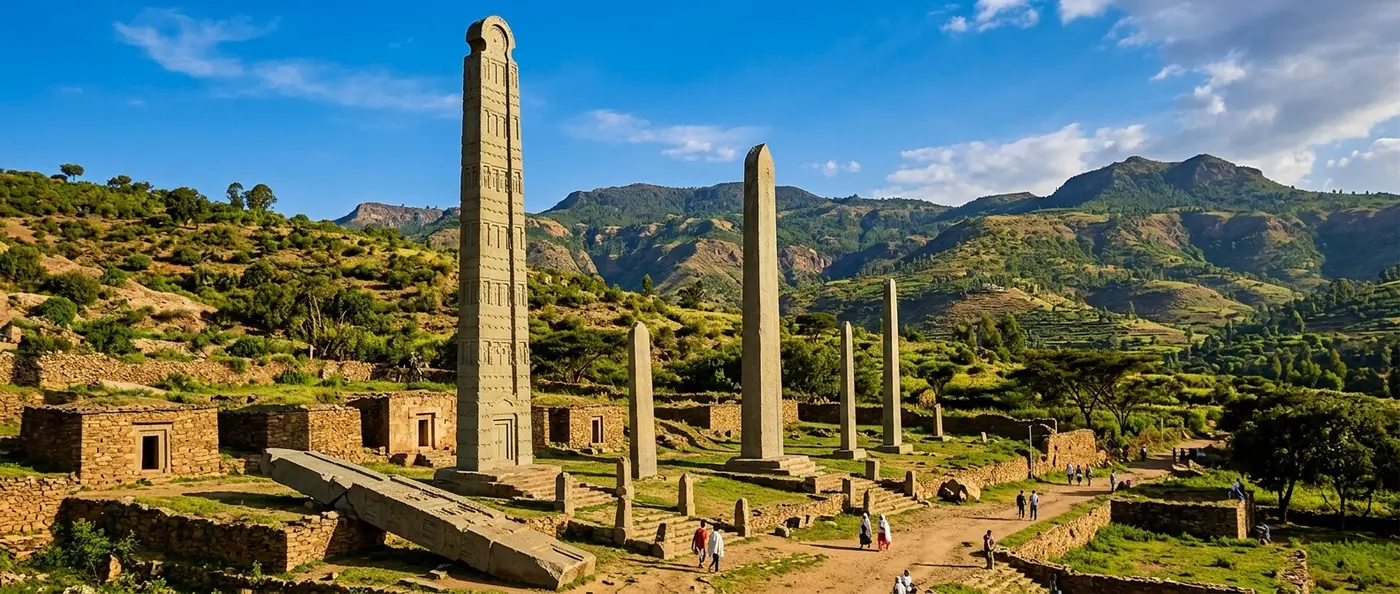
The towering obelisks of Aksum represent one of humanity's most ambitious engineering projects. These monolithic monuments, carved from single blocks of granite, are among ancient Africa's most impressive architectural achievements. They weren't just big rocks — they were statements of power that could be seen for miles.
The largest standing obelisk reaches 23 meters high and weighs around 160 tons. But the fallen giant would have stretched 33 meters skyward and weighed over 520 tons if it had remained upright. How did ancient Aksumites quarry, transport, and erect these colossi using only bronze and iron tools? Modern engineers still can't figure it out.
The obelisks weren't random monuments. They were carefully designed symbols of royal power and religious authority, probably marking the burial sites of kings or sacred spaces. Their surfaces are carved with intricate patterns resembling multi-story buildings, complete with doors and windows etched into stone. Some researchers believe they represent the palaces of dead kings in the afterlife — architectural blueprints for eternity.
Engineering Marvel
The obelisks were carved from single granite blocks using only copper and iron tools. The precision of the carving is extraordinary by any standard.
Moving Giants
Transporting rocks weighing hundreds of tons without modern machinery required advanced techniques we still don't fully understand.
Royal Tombs
Underground chambers and tombs have been found beneath the obelisks, indicating they marked burial sites of the royal family.
🔱 From Ancient Gods to Christianity
Around 330 CE, King Ezana made a decision that changed African history forever. He converted Aksum to Christianity, making it one of the world's first Christian kingdoms alongside Rome and Armenia. This wasn't just a personal choice — it was a strategic masterstroke that opened new diplomatic and trade relationships across the Mediterranean.
The transition wasn't instant. For centuries, Aksumites had worshipped a pantheon of gods influenced by Arabian and African traditions. Mahrem, the war god, dominated their pantheon, alongside Astar, the sky god, and Beher, a goddess of the earth. Ancient coins show these deities gradually being replaced by Christian symbols — the crescent and disc giving way to the cross.
Aksum's Christian legacy survives today. The Ethiopian Orthodox Church, one of the world's oldest Christian churches, claims to guard the Ark of the Covenant in an Aksum church. While this claim can't be verified, it demonstrates the deep religious significance the city still holds. The church's guardian monk is the only person allowed to see the artifact — if it exists — maintaining a mystery that has persisted for over 1,500 years.
💡 The Ark Mystery
According to Ethiopian tradition, the Ark of the Covenant was brought to Aksum by Menelik I, son of Solomon and the Queen of Sheba. It's kept in a chapel where only one guardian monk has access. No one else is allowed to see it, perpetually fueling the mystery.
📜 The Language and Script of the Aksumites
Aksum developed its own writing system called Ge'ez, evolved from the South Arabian alphabet. This script is still used today in the liturgical language of the Ethiopian Church. Ge'ez inscriptions found throughout the empire give us invaluable insights into Aksumite history, religion, and daily life.
Royal inscriptions are particularly revealing, describing military campaigns and conquests in detail. King Ezana left inscriptions in three languages — Ge'ez, Sabaean, and Greek — describing his victories and territorial expansion. This multilingual approach reflects Aksum's cosmopolitan character and international connections. These weren't provincial rulers — they were sophisticated leaders operating on a global stage.
Aksumite coins also provide crucial information. They're the only sub-Saharan African coins bearing inscriptions in antiquity. Early kings used pagan symbols like crescents and discs, while post-Ezana rulers featured the cross, marking the transition to Christianity. The quality of these coins rivals Roman currency — precise weight, detailed imagery, and consistent purity that international merchants trusted.
Beyond grand monuments and international trade, Aksum was a living city with thousands of residents. Excavations have revealed house foundations, workshops, and public buildings that paint a picture of daily life in this ancient metropolis.
Aksumites were skilled craftspeople. They produced high-quality ceramics, gold and silver jewelry, and intricate metalwork. Their pottery, with distinctive geometric patterns, was exported throughout the Red Sea region. Archaeologists have also found imported objects from the Roman Empire, Persia, and India, showing the wealth and international connections of ordinary citizens.
The Aksumite diet was based on teff (a grain endemic to Ethiopia), barley, and various legumes. They raised cattle, sheep, and goats, while hunting provided additional meat. Trade brought exotic products like spices from India and wine from the Mediterranean, enjoyed by the elite. This wasn't subsistence living — it was a complex urban economy with distinct social classes and specialized occupations.
⚖️ Aksum Compared to Other Empires
🌅 Decline and Legacy
Aksum's decline began around the 7th century CE. Multiple factors contributed: the rise of Islam and Arab control of Red Sea trade routes, climate changes affecting agriculture, and possibly overexploitation of natural resources. The center of Ethiopian power gradually shifted southward, leaving the great obelisks as silent witnesses to a vanished world.
But Aksum's legacy endures. The city remains a holy site for Ethiopian Christians. Its obelisks, designated a UNESCO World Heritage Site in 1980, attract thousands of visitors annually. In 2005, Italy returned an obelisk that Mussolini had looted in 1937 — a symbolic acknowledgment of Aksum's cultural significance that transcends national borders.
Archaeologists continue discovering new findings in the region. Each excavation reveals new aspects of this forgotten African superpower. Aksum proves that Africa was an active participant in global civilization and trade from antiquity — not a passive recipient of outside influence, but a driving force that shaped the ancient world.
Aksum demonstrated that vision, organization, and openness to the world can create great civilizations anywhere. The obelisks of Aksum still stand tall, witnessing a lost world that changed the course of history. They remind us that power and sophistication have always existed in Africa — we just forgot to look.