👑 Birth of a Legend
In 356 BCE, in Pella, Macedonia, Alexander was born. Son of King Philip II and Olympias, princess of Epirus, the young prince grew up in an environment where military excellence and political cunning were essential for survival. From age 13 to 16, his tutor was Aristotle, who instilled in him a love of philosophy, medicine, and scientific inquiry.
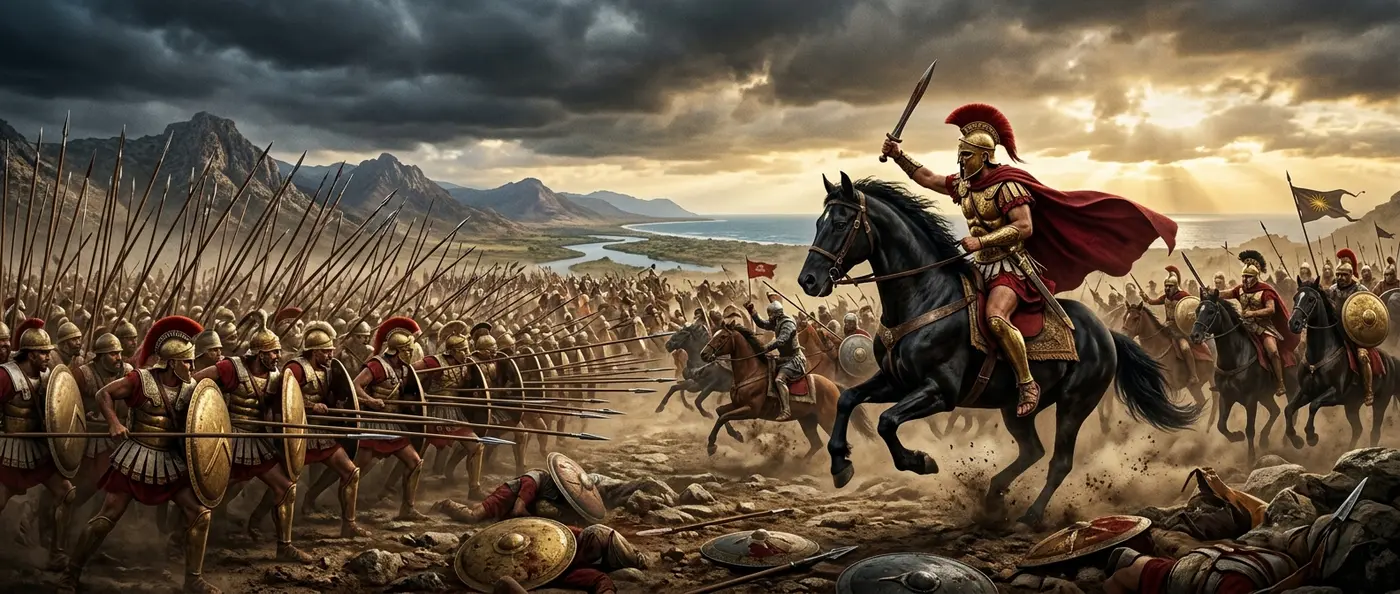
Alexander's education wasn't limited to books. At just 18 years old, at the Battle of Chaeronea in 338 BCE, he led the cavalry charge that crushed the Sacred Band of Thebes, an elite military unit of 300 men. His personal courage and tactical brilliance became legendary from that very moment.
When Philip was assassinated in 336 BCE, the 20-year-old Alexander ascended to the throne. He immediately executed all potential rivals and consolidated his power. He inherited a superbly trained army and his father's dream: the conquest of the Persian Empire.
⚔️ The Campaign That Changed the World
In spring 334 BCE, Alexander crossed the Hellespont with 35,000 men. The invasion of the Persian Empire had begun. At the Granicus River, he defeated Persian forces in his first major battle. This was followed by the crucial Battle of Issus in 333 BCE, where Persian King Darius III was forced to flee, abandoning even his family.
Instead of pursuing Darius, Alexander turned south. He captured Syria, Phoenicia, and Tyre after a seven-month siege. In 332 BCE he entered Egypt, where he was welcomed as a liberator from Persian rule. There he founded Alexandria, the first of many cities that would bear his name.
The final confrontation with Darius came at Gaugamela in 331 BCE. Despite the numerical superiority of the Persians, Alexander's tactical genius and his army's discipline prevailed. After Darius's assassination in 330 BCE, Alexander was proclaimed King of Asia.
🗺️ The Limits of the Known World
Alexander's ambition knew no bounds. After conquering Persia, he turned eastward. He crossed Afghanistan and reached India in 327 BCE. There he impressed local rulers by capturing the impregnable fortress of Aornos, a few miles west of the Indus River.
On the banks of the Hydaspes River, on June 1, 326 BCE, Alexander fought his last great battle. He faced King Porus and his much larger army, which included war elephants. Alexander's victory was complete, but he was so impressed by Porus's courage that he made him an ally.
But here, on the banks of the Hyphasis River, his soldiers refused to go further. After eight years of continuous campaigns, exhausted and homesick, they demanded to return. For the first time, Alexander was forced to retreat.
Empire's Extent
From the Balkans to modern-day Pakistan - the largest empire of its time, covering approximately 5.2 million square kilometers.
City Founding
Founded over 20 cities bearing his name, most famously Alexandria in Egypt, which became a center of learning and culture.
Cultural Fusion
Promoted the merger of Greek and Eastern cultures, marrying Roxana of Bactria himself and encouraging his soldiers to marry local women.
🏛️ The Hellenistic World
Alexander's legacy extends far beyond his military conquests. He spread Greek culture from Gibraltar to the Indus River. The Greek language became the lingua franca of trade and diplomacy across a vast region. Greek coinage facilitated commerce over distances of thousands of kilometers.
As an administrator, Alexander incorporated local rulers into his government and established democratic systems in many cities. His entourage included engineers, architects, scientists, and historians who recorded and studied the new worlds they encountered.
His campaigns advanced geography and the natural sciences. They helped shift centers of civilization eastward. In a real sense, Alexander's achievements paved the way for the rise of the Roman Empire and the spread of Christianity centuries later.
💡 Did You Know?
Alexander named a city in India in honor of his beloved horse, Bucephalus, who died after the Battle of the Hydaspes. The city of Bucephala was located near present-day Pakistan.
🔱 Divine Ambition
As his conquests expanded, Alexander began to believe in his divine origin. In Egypt, priests proclaimed him son of the god Ammon. He began demanding that his subjects worship him as a god, something that caused displeasure among his Macedonian soldiers who rejected such Eastern practices.
Nevertheless, he continued to insist on his divinity, even issuing coins depicting him with divine attributes. He drew inspiration from the gods Achilles, Heracles, and Dionysus, considering himself a successor to the mythical heroes.
This belief led him to increasingly absolute behavior. He executed old friends and generals who challenged him. He adopted Persian customs and dress. But his soldiers remained loyal, believing in him despite all difficulties.
💀 The Mystery of Death
In June 323 BCE, Alexander was in Babylon, planning new campaigns in Arabia. After a prolonged symposium, he suddenly fell ill. On June 13, at just 32 years old, the conqueror of the world died.
The cause of death remains a mystery. The most popular theories suggest he was afflicted with either malaria or typhoid fever. Others claim he was poisoned. Whatever happened, his death marked the end of an era.
His empire fragmented almost immediately. His generals, known as the Diadochi, fought among themselves for control of different regions. Separate kingdoms were created: the Ptolemaic in Egypt, the Seleucid in Asia, the Antigonid in Macedonia.
⚔️ The Legacy in Numbers
📜 The Eternal Myth
For more than 2,000 years, Alexander's life has captivated historians and the general public. Already in his time, he became the subject of legendary stories. Later he was transformed into the hero of an entire myth that had little relation to historical reality.
Modern archaeological discoveries continue to shed light on his world. Recent excavations in Northern Macedonia may have revealed the ancient city of Lynkos, birthplace of Alexander's grandmother, Eurydice I. A coin dating between 325-323 BCE was found at the site, proving the city was active during Alexander's lifetime.
Alexander was one of history's most enigmatic figures. He was simultaneously visionary and tyrant, philosopher and warrior, uniter of cultures and ruthless conqueror. His influence far exceeds the 13 years of his reign. He opened new routes of trade and culture. He brought East and West into contact in ways that forever changed the course of human history.