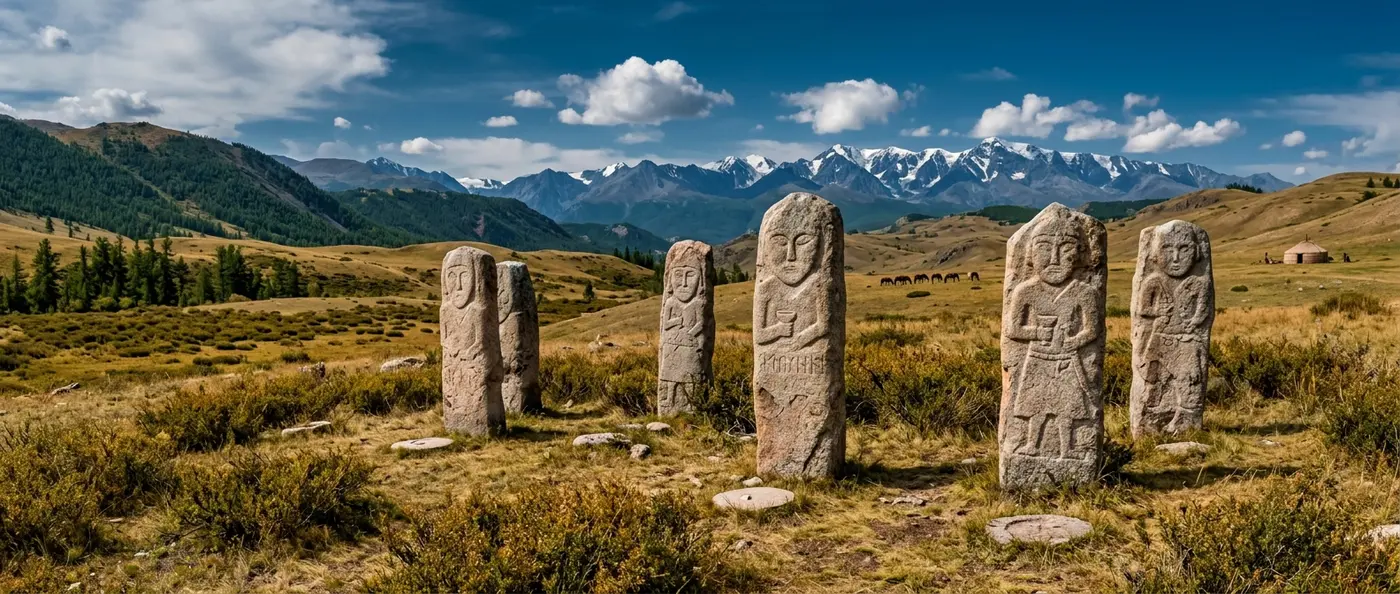
Stone doesn't lie. When archaeologists pulled back centuries of earth and vegetation in the Altai Mountains this March, they uncovered monuments that had been waiting 1,400 years to tell their story. The discovery expands our catalog of early medieval Turkic sites and forces historians to reconsider the scale of nomadic settlement in Central Asia.
🏔️ The Altai: Where Empires Crossed Paths
The Altai Mountains stretch across four countries — Russia, Kazakhstan, China, and Mongolia — forming one of history's great crossroads. For millennia, this rugged landscape has watched empires rise and fall. Scythians rode these valleys. Sarmatians buried their gold here. Then came the Turks, who turned these peaks into the birthplace of their civilization.
Around the 6th century CE, the First Turkic Khaganate planted its flag in Altai soil. From this mountain stronghold, they built an empire that stretched from Manchuria to the Black Sea. But empires fade. What endures are the stones they left behind — monuments that speak across centuries about power, belief, and the human need to be remembered.
The strategic position of the Altai made it a natural hub for trade, migration, and cultural exchange. Nomadic peoples might have lived in tents, but they built in stone when they wanted something to last. The newly discovered monuments prove that nomads built for eternity even as they moved with the seasons.
💡 Did You Know?
The name "Altai" comes from the Mongolian word "altan," meaning "golden" — likely referring to the region's rich gold deposits that attracted traders and conquerors for thousands of years.
🗿 March 2026: The Discovery That Rewrote the Map
The announcement came from Arkeonews on March 13, 2026. Researchers studying Turkic cultural heritage had expanded the known catalog of early medieval monuments in the Altai Mountains. The discovery includes a complex of structures dating to the early medieval period — roughly the 6th to 8th centuries CE, when Turkic power was at its peak.
Details remain scarce, but the significance is clear. Each new monument discovered in the Altai proves this wasn't just a nomadic frontier — it was a cultural center. The early Turks weren't just passing through. They were building to last.
These monuments join an impressive roster of Turkic archaeological evidence scattered across the Altai landscape. Burial mounds called kurgans dot the valleys. Petroglyphs cover cliff faces. Stone stelae inscribed with ancient Turkic script — the runic Orkhon alphabet — stand like ancient billboards announcing the presence of a sophisticated civilization.
The First Turkic Khaganate emerged around 552 CE, when the Turkic leader Bumin Khan overthrew the Rouran Khaganate and established Turkic dominance across the steppes. From their Altai heartland, they expanded rapidly, creating one of the largest empires in ancient history. The monuments they left behind weren't just markers of territory — they were statements of identity, belief, and permanence in a world of constant motion.
Monument Types
Early Turks created diverse monuments: memorial stelae (balbal), monumental inscriptions, burial mounds, and ritual complexes that served both religious and political functions.
Runic Script
The ancient Turkic script, known as Orkhon runic, was carved into stone stelae, providing invaluable records of language, history, and cultural practices.
Nomadic Legacy
The Turks may have lived in portable yurts, but they carved their most important messages in stone that couldn't be moved.
🏺 Gold, Graves, and the Nomadic Tradition
The Turkic discovery comes amid a wave of archaeological breakthroughs across Central Asia. Earlier this year, archaeologists in Kazakhstan unearthed spectacular Sarmatian treasures — over 1,000 artifacts including 100 gold ornaments depicting leopards, wild boars, and tigers in the distinctive "animal style" that defined steppe art for centuries.
These parallel discoveries show nomadic tradition in Central Asia flowing like an underground river across centuries. From Scythians to Sarmatians to Turks to Mongols, the steppes produced civilization after civilization that, despite their mobile nature, left monumental evidence of their sophistication and power.
The Sarmatian finds, dating to around the 5th century BCE, show the deep roots of this tradition. The animal-style gold work — with its flowing lines and fierce predators — would influence artistic traditions across Eurasia for centuries. When the Turks rose to power a millennium later, they inherited and transformed this artistic legacy, creating their own distinctive monumental style.
🔬 Technology Reveals Hidden Histories
Finding monuments in the vast Altai wilderness requires more than luck. Modern archaeology increasingly relies on technology to peer beneath the surface and reveal hidden structures. Lidar (light detection and ranging) has revolutionized the field, allowing researchers to map extensive areas from the air and spot structures invisible from ground level.
Recent discoveries in Ireland demonstrate the power of these techniques. Archaeologists used lidar to reveal hundreds of previously unknown prehistoric monuments, including five rare cursus monuments. In the challenging terrain of the Altai, where distances are vast and access difficult, such technologies are invaluable for locating and studying monuments that might otherwise remain hidden.
The discovery of new Turkic monuments in the Altai has broader implications for understanding Eurasian history. The early Turks played a crucial role in shaping the political and cultural landscape of the continent, influencing the development of many later civilizations. Each new monument reveals another detail about a civilization that shaped the political map of Eurasia.
The study of these monuments contributes to understanding broader patterns of migration, cultural exchange, and political organization in Central Asia. The Altai, as a crossroads of civilizations, offers unique opportunities to study these processes and their long-term effects on Eurasian development.
⚔️ Nomadic Civilizations of Central Asia
🗺️ What Comes Next
The 2026 discovery opens new research avenues in the Altai Mountains. With an expanded catalog of known monuments, researchers now have more data to study settlement patterns, religious practices, and social organization of early Turkic societies.
Future research will focus on detailed documentation and analysis of the new monuments. This includes photogrammetric mapping, analysis of any inscriptions, and comparison with other known monuments in the region. Dating the monuments using modern methods will help place them more precisely in their historical context.
The interdisciplinary approach — combining archaeology, history, linguistics, and physical sciences — will be crucial for fully understanding the significance of these discoveries. Lidar surveys could reveal hundreds more monuments still hidden beneath Altai vegetation.
The stones of the Altai have kept their secrets for 1,400 years. Now archaeologists are learning to read what the Turks carved there: that empires may crumble, but stone endures.