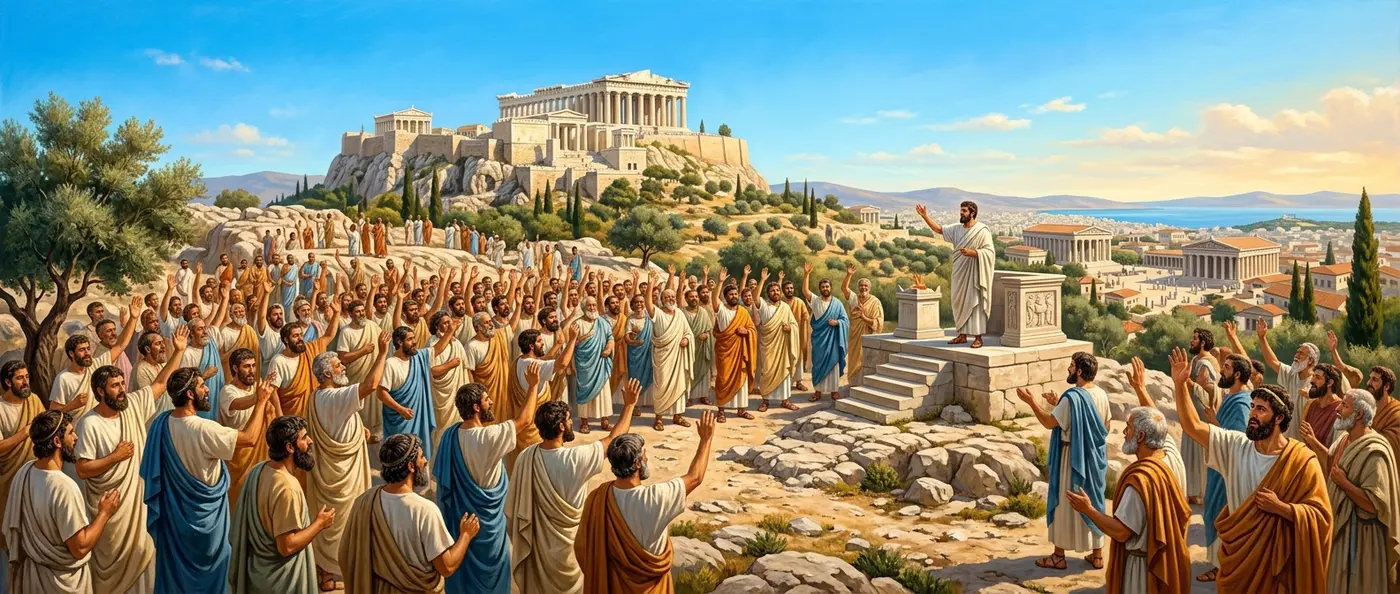
In 508 BC, an Athenian nobleman did something no one had dared before: he gave power to the people. Cleisthenes, exiled and cursed by his own family, returned to Athens with a radical plan that would reshape political power. Democracy emerged from political necessity—a nobleman's gamble to outmaneuver his rivals by unleashing forces no one had tried before.
🏛️ Athens Before Democracy
Before the 6th century BC, Athens was a divided city. The eupatrids, nobles who claimed descent from ancient kings, held all political power. The governance system was based on archons—nine supreme magistrates who shared the religious, military, and judicial functions that once belonged solely to the king.
According to Britannica, the official list of annual archons begins from 682 BC. The eponymous archon gave his name to the year of his term, the polemarch was the military commander and judge for cases involving foreigners, while the basileus retained the religious role and presided over the Areopagus in homicide cases. Six thesmothetae dealt with various judicial matters.
The nobles had rigged the game completely. Only eupatrids could become archons, and after their term they became lifelong members of the Areopagus, the city's most powerful council. Ordinary citizens, farmers, and craftsmen had no meaningful participation in decision-making.
⚔️ Solon's Reforms
By 594 BC, Athens teetered on the edge of civil war. Many small farmers had lost their land due to debt and had become slaves. Armed conflict seemed inevitable. Then Solon was called to mediate and bring peace.
Solon made radical changes. He canceled debts that had led many to slavery and banned debt slavery in the future. Most importantly, he opened political offices to more citizens. As Britannica notes, the monopoly of the eupatrids was broken when Solon made the two upper property classes eligible for the office of archon.
Solon's compromise pleased no one. The nobles thought he went too far, while the people believed he didn't go far enough. Into this chaos stepped Peisistratus.
🗿 The Age of Tyrants
In 560 BC, Peisistratus, a nobleman with a good military reputation, seized power with the support of the poorer classes. The Alcmaeonid family, to which Cleisthenes belonged, initially tried to share power with him, but soon found themselves in opposition.
Cleisthenes' family already had a complex history. His great-great-grandfather, Megacles, had been cursed because he had killed suppliants who had taken refuge at an altar during Cylon's attempt to become tyrant around 632 BC. This curse followed the family for generations.
When Peisistratus returned from exile in 546 BC and defeated his enemies, the Alcmaeonids were forced to leave Attica. Cleisthenes was then about 25 years old and remained in exile for nearly 20 years.
💡 Did You Know?
Cleisthenes was named after his maternal grandfather, who was tyrant of Sicyon. His mother, Agariste, married his father Megacles after a competition organized by her father to find the best son-in-law!
📜 Cleisthenes' Return
After Peisistratus's death in 527 BC, his son Hippias initially tried to reconcile with the exiled nobles. The archon archive found in the Agora shows that Cleisthenes served as eponymous archon in 525-524 BC. However, the reconciliation didn't last.
In 514 BC, the assassination of Hippias's brother made him paranoid and oppressive. In 512 BC, the Alcmaeonids tried to return by force but failed. Then they turned to Delphi for help. The oracle repeatedly pressured the Spartans to liberate Athens, and eventually a Spartan army forced Hippias and his family to leave Attica.
But the fall of tyranny didn't immediately bring democracy. Instead, a fierce struggle for power broke out between Cleisthenes and Isagoras, leader of the most reactionary nobles.
The Role of Delphi
The Alcmaeonids had strong ties to the Delphic oracle. They had helped rebuild Apollo's temple that burned around 548 BC, securing the sanctuary's favor.
Spartan Intervention
The Spartans, under pressure from Delphi, sent an army to expel Hippias. Later, however, they tried to impose Isagoras, fearing a democratic Athens.
🔱 The Birth of Democracy
In 508 BC, Isagoras was elected eponymous archon. It seemed the conservative nobles had won. Then Cleisthenes made the move that changed history. According to tradition, he "took the people as his partner" and transformed the situation.
Before the year 508-507 BC ended, the basic principles of a complete reform of the governance system had been approved by the popular Assembly. Isagoras left Athens to seek Spartan intervention. The Spartan king demanded the expulsion of "those under the curse," and Cleisthenes with his relatives became exiles again.
But when the Spartans tried to install Isagoras, the people fought back. The Spartans were forced to withdraw. The Athenians recalled the exiles and implemented the decisions the Assembly had made.
🏺 The Revolutionary Reforms
Cleisthenes understood that to definitively break the power of noble families, the very basis of political organization had to change. Instead of political rights depending on family, clan, and phratry, they would now depend on place of residence.
Every citizen would belong to a deme, a local community that kept its own citizen registry and elected its own officials. The citizen would no longer be known only by his father's name, but also by the name of his deme.
The most radical change was creating ten new tribes instead of the four old ones based on blood ties. To prevent the formation of local alliances, Cleisthenes divided Attica into three regions—the city with suburbs, the coastal area, and the inland. Each tribe included demes from all three regions.
⚔️ Before and After the Reforms
🌾 The New Political Reality
Cleisthenes didn't just shuffle offices around. He rewrote the rules of who could claim political power and why. For the first time in history, political responsibility was based on being a citizen of a place rather than descent from some family.
Under the new system, archons were elected directly by the Assembly of the people. Later, to ensure even greater fairness, they were chosen by lot from 500 pre-selected candidates. Until 457 BC, the office was still limited to the two upper classes, but gradually extended first to the third and finally, in practice if not in theory, to the fourth class.
The changes weren't without resistance. Many of the old nobles opposed vigorously. But the people had tasted freedom and weren't willing to abandon it. Democracy had taken root.
💀 Cleisthenes' Legacy
Cleisthenes died around 508 BC, immediately after implementing his reforms. He didn't live to see the full development of the system he created. But the foundation stones he laid withstood time.
During the 5th century BC, the power of archons diminished. The polemarch lost military command to the ten tribal generals, who also replaced the archons in the administrative sphere. The archons became mainly judicial officials, conducting preliminary investigations and presiding over trials without directing the jurors.
The system Cleisthenes created became the model for other Greek cities. During the 5th century, the institution spread widely in the Aegean islands, mainly under Athenian influence, and later, during the Hellenistic period, in Asia Minor.
Today, when we speak of democracy, we refer to a system born in the streets of ancient Athens. Not by idealistic philosophers, but by a politician who understood that real power lies with the people. Cleisthenes wasn't just a reformer—he was the man who forever changed how societies organize and govern themselves.