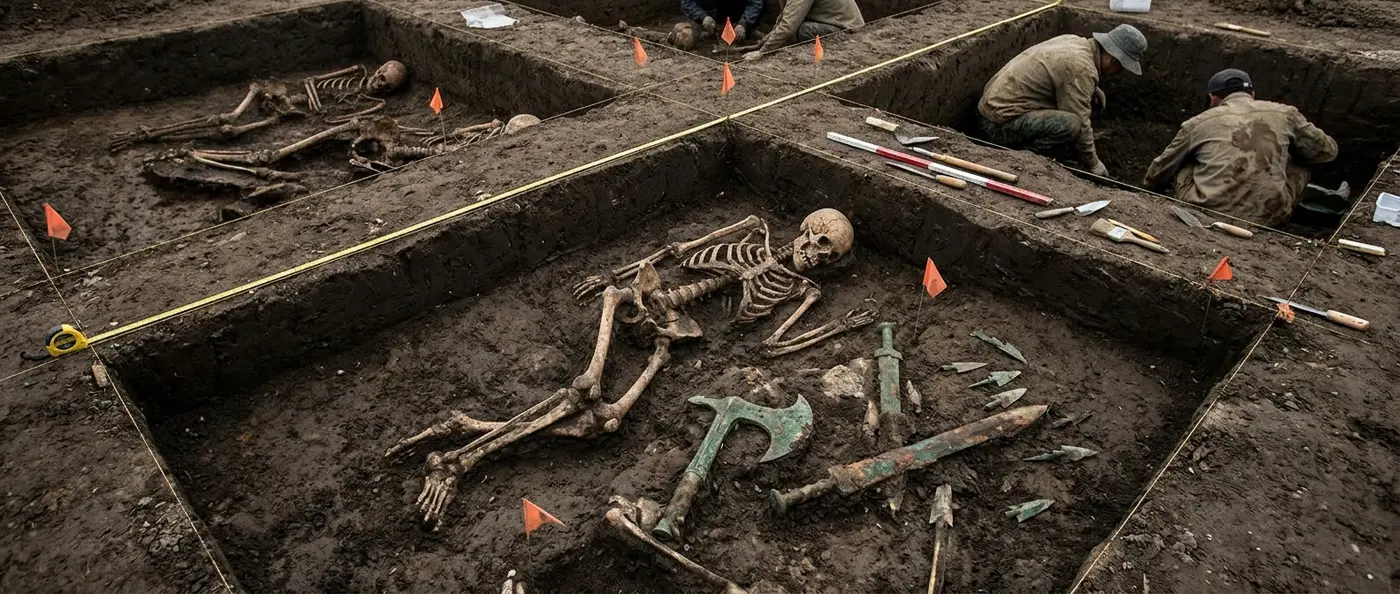
In the dusty hills of China's Loess Plateau, farmers for decades believed the crumbling stone walls near their homes were part of the Great Wall. Until they started finding pieces of jade in the rubble. What followed upended Chinese archaeology: the 4,300-year-old fortress-city of Shimao, with evidence of mass human sacrifice that pushes back the timeline of Chinese urban civilization by centuries.
🏰 The Discovery That Changed History
Shimao appears in no ancient Chinese text. No one expected to find such a large and sophisticated city so far north of the supposed "cradle of Chinese civilization." Covering 1,000 acres — 25% larger than New York's Central Park — Shimao is now the largest known Neolithic settlement in China.
According to Sun Zhouyong, director of the Shaanxi Provincial Institute of Archaeology and head of the excavations, "Shimao is one of the most important archaeological discoveries of this century. It gives us a new way to look at the development of early Chinese civilization."
The city flourished from 2300 BC to 1800 BC, almost 2,000 years before the oldest section of the Great Wall and 500 years before Chinese civilization took root in the Central Plains. After nearly half a millennium of life, it was suddenly and mysteriously abandoned.
💀 The Macabre Secret of the Foundations
Beneath the city's eastern wall, archaeologists made a chilling discovery: 80 human skulls concentrated in six pits — without their skeletons. The two pits closest to the Eastern Gate, the city's main entrance, contained exactly 24 skulls each.
The number and placement of the skulls suggest ritual decapitation during the wall's foundation — the earliest known example of human sacrifice in Chinese history. Forensic experts determined that almost all the victims were young girls, likely captives from rival groups.
As Li Min, an archaeologist at UCLA who has extensively studied Shimao, notes, "the scale of ritual violence observed at Shimao was unprecedented in early China." The skulls foreshadowed the mass human sacrifices that became a defining feature of Shang civilization centuries later.
🏛️ A City Designed for War
The first impression of Shimao is of a city designed to face constant danger. Built in a conflict zone, on borders dominated for thousands of years by wars between northern steppe herders and central plains farmers, the city featured impressive fortifications.
At the city's center rose a 20-level pyramid, 70 meters high — about half the height of the Great Pyramid of Giza built around the same time. Its base, however, was four times larger, and Shimao's elite lived at the top, in a 20-acre palace complex with its own water reservoir, workshops, and likely temples.
Advanced Fortifications
Walls 2.5 meters thick and 10 kilometers long with barbicans, baffle gates, and bastions that allowed defensive fire from multiple directions.
Innovative Construction
Cypress wood beams as reinforcement inside the stone walls — a method scholars believed only began during the Han dynasty, 2,000 years later.
"Mamian" Structure
Angular "horse face" design that trapped attackers in an area where they received fire from three sides — a design that became a basic element of Chinese defensive architecture.
🗿 The Mysterious Reliefs
Before excavations were suspended due to the pandemic, archaeologists revealed 70 stunning stone relief carvings — snakes, monsters, and half-human, half-animal beings reminiscent of later Bronze Age iconography in China.
The stone sculptures likely served as spiritual guardians, archaeologists believe. The art and technology found at Shimao originated from the northern steppe and would influence future Chinese dynasties.
⚔️ Human Sacrifice in Ancient China
The practice of human sacrifice in ancient China was not limited to Shimao. During the Western Zhou dynasty (1100-771 BC), animal sacrifices — and sometimes human ones — to ancestors or deities were a common part of Chinese culture.
According to David Sena, a historian of China at the University of Texas, "there was a tendency to describe the Western Zhou as a more humanistic period, when the practice of human sacrifice declined. But the archaeological evidence clearly shows that human sacrifices continued throughout the Zhou period."
🔮 Oracle Bones
In ancient China, diviners carved questions into cattle bones or turtle shells, heated them until they cracked, then "interpreted" the cracks to predict the future. About 13,000 such "oracle bones" have been found, with over 100,000 inscriptions representing the earliest form of Chinese writing.
🏺 The Broader Picture of Sacrifice
Human sacrifices in prehistoric times were often associated with cannibalism and animal sacrifices. With striking frequency, victims found in ritual remains are women and children, sometimes together with young pigs.
This practice resembles fertility ceremonies and agricultural rituals known to have been practiced in early Mediterranean civilizations. It also resembles beliefs and practices observed among contemporary "primitive" agricultural peoples, where pigs often replace humans.
🌾 Satellite Cities and Social Organization
Shimao was not isolated. More than 70 stone cities from the same Neolithic era, known as the Longshan period, have now been discovered in northern Shaanxi province. Ten of these are located in the Tuwei River basin, where Shimao is situated.
"These satellite villages or cities are like moons orbiting around Shimao," says Sun. "Together they established a solid social foundation for early state formation at Shimao." The sheer scale of the project — the walls alone required 125,000 cubic meters of stone — leads archaeologists to believe that Shimao commanded the faith and labor of smaller satellite cities.
📊 Shimao by the Numbers
💎 The Mysterious Jade
One of the most intriguing elements of Shimao is the abundance of jade found in the ruins — discs, blades, and scepters. Jade is not native to this northernmost part of Shaanxi province. The nearest source is nearly a thousand miles away.
The presence of such large quantities of jade suggests extensive trade networks and cultural exchanges with distant regions. It also underscores Shimao's importance and wealth as a center of power in the region.
🔬 Redefining Chinese History
Along with recent discoveries at other prehistoric sites nearby and along the coast, Shimao forces historians to reconsider the origins of Chinese civilization — broadening their understanding of the geographical locations and external influences of the earliest civilizations.
None of the ancient sources that have guided Chinese archaeology mention an ancient city so far north of the supposed "cradle of Chinese civilization," let alone one of such size, complexity, and intense interaction with external cultures.
The mystery of Shimao's sudden abandonment around 1800 BC remains unsolved. What caused such a powerful and well-fortified civilization to disappear? Was it climate change, invasion, internal conflict, or something else? Ongoing excavations may someday provide answers.