🏛️ The Strategic Position That Changed History
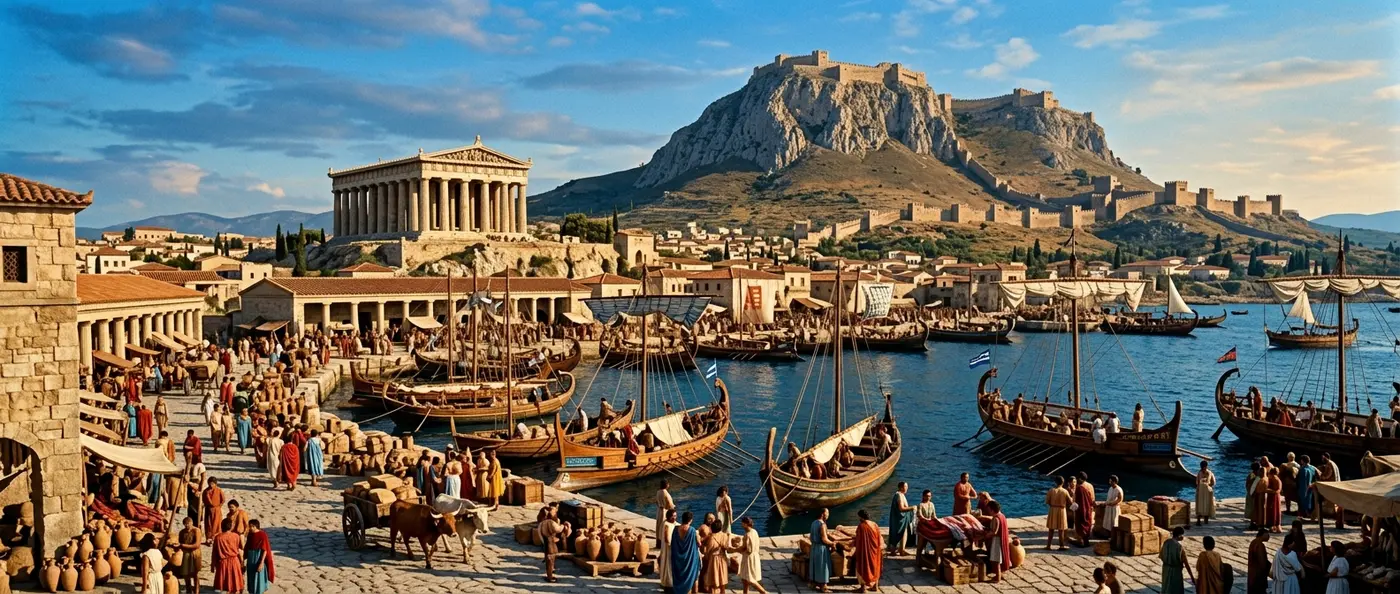
Ancient Corinth sat at the crossroads of the Mediterranean world. Built at the base of Acrocorinth, a 575-meter-high rock that rose like a natural fortress, the city controlled the narrow Isthmus connecting the Peloponnese to central Greece. This choke point gave Corinth control over Greece itself — every overland route from north to south had to pass through the city.
But Corinth's real ace was its position between two seas. With Lechaion on the Corinthian Gulf and Cenchreae on the Saronic Gulf, the city had access to both the Ionian and Aegean seas. Merchants wanting to avoid the dangerous voyage around the Peloponnese could transport their ships and cargo across the Isthmus using the famous diolkos built by the tyrant Periander around 600 BC.
Control of this bottleneck made Corinth rich beyond measure. Archaeological evidence shows the city was inhabited before 3000 BC, but its real rise began in the 8th century BC when it developed as a commercial center. By the late 8th century, the Corinthians had secured complete control of the Isthmus and founded colonies in Corcyra and Syracuse, ensuring dominance in trade with the western Mediterranean.
💰 The Commercial Miracle of Antiquity
Corinth wasn't just wealthy — it was synonymous with wealth in the ancient world. The phrase "to be as rich as a Corinthian" was common parlance. The secret to its success lay in absolute control of trade routes and the innovative entrepreneurship of its inhabitants.
The Corinthians turned ship transport into a science. Instead of waiting for ships to make the dangerous voyage around the Peloponnese, they offered a revolutionary solution. The diolkos, a stone-paved road crossing the Isthmus, allowed entire ships to be transported from one sea to another. Smaller vessels were placed on special wheeled platforms and pulled by animals, while cargo from larger ships was transferred separately.
The Corinthians charged whatever the market would bear, and merchants paid without complaint. A journey that normally took weeks could be completed in days. Revenue from transit fees, combined with taxes on goods passing through the city, generated enormous wealth.
🏺 Corinthian Pottery That Conquered the World
Beyond its strategic position, Corinth developed a thriving manufacturing industry. Corinthian pottery became the most sought-after luxury item in the Mediterranean from the 8th to 6th centuries BC. With characteristic orientalizing motifs, animal friezes, and floral decorative elements, Corinthian vessels were recognizable everywhere.
Corinthian potters were pioneers in technique. They developed new decoration methods and perfected black-figure pottery before the Athenians. Their workshops produced thousands of vessels annually — from small perfume containers to large wine kraters. Every ship leaving Corinth carried hundreds of such vessels throughout the Mediterranean.
Corinthian pottery dominated by design, not chance. The city's merchants had created an extensive distribution network. From Italy to the Black Sea, from Egypt to Spain, agents everywhere promoted Corinthian products. When Athenian pottery began dominating in the 6th century BC, the Corinthians had already accumulated massive profits.
Aryballoi
Small spherical containers for perfumes and oils, with intricate decoration of animals and mythical creatures. Exported throughout the Mediterranean.
Oinochoai
Elegant vessels for serving wine, decorated with scenes from mythology and daily life.
Decoration Technique
Pioneering use of purple and white paint over black background, with detailed designs requiring exceptional skill.
⚔️ The Tyrants Who Brought the Golden Age
Corinth's political history is inextricably linked to its economic development. Until the mid-7th century BC, the city was ruled by the aristocratic Bacchiad family. But in 657 BC, Cypselus overthrew the regime and established a tyranny that would last three generations.
Paradoxically, the period of tyranny brought unprecedented prosperity. Cypselus and his son Periander (625-585 BC) transformed Corinth into a superpower. Periander, one of the Seven Sages, combined wisdom with ruthless ambition. He built the diolkos, founded new colonies along the Adriatic, and extended Corinth's influence to Macedonia.
Corinth's tyrants understood that wealth without security is vulnerable. They fortified Acrocorinth, turning it into an impregnable fortress, and created a powerful fleet to protect trade routes. Simultaneously, they funded magnificent public works — temples, porticoes, aqueducts — that made the city shine.
After the fall of tyranny around 550 BC, Corinth became an oligarchy. The new government launched an ambitious building program. The Temple of Apollo, whose seven Doric columns still stand today, was built during this period. The agora was expanded and acquired the monumental South Stoa, 160 meters long, in the 4th century BC.
💡 The Diolkos: Ancient Technological Marvel
Periander's diolkos was an impressive technical achievement. A stone-paved road with grooves for wheels, it allowed transport of ships weighing up to 100 tons. It operated for approximately 1,500 years, from the 6th century BC to the 9th century AD. Sections of it survive today near modern Corinth.
🛡️ Athens' Rival: The Road to War
When Athens built its navy in the 6th century BC, war with Corinth became only a matter of time. The two cities competed for control of sea routes and markets. Commercial rivalry gradually transformed into political hostility.
In 433 BC, crisis erupted when Athens allied with Corcyra, a Corinthian colony that had rebelled. For the Corinthians, this was an unacceptable provocation. Corcyra controlled sea routes to the West, and its loss would be catastrophic for their trade. When naval battles followed and Athens took measures violating the Thirty Years' Peace, Corinth pressured Sparta to declare war.
During the Peloponnesian War (431-404 BC), Corinth played a crucial role. Its fleet was the second largest in the Spartan alliance, and its money funded much of the war effort. Corinthian generals and engineers participated in critical battles, including the Athenians' fateful expedition to Sicily.
Ironically, victory over Athens didn't bring the renaissance Corinth expected. Sparta emerged as the new hegemonic power, and the Corinthians found themselves in a secondary role. A few years later, in the Corinthian War (395-387 BC), the city allied with its former enemies against Sparta, but without regaining its former power.
🏛️ Legacy of a Great City
Corinth continued to play an important role in Greek history but never again reached the height of its power. In 338 BC, Philip II of Macedon captured Acrocorinth and made the city seat of the League of Corinth. Later, the city became a member of the Achaean League.
Final destruction came in 146 BC when Roman general Lucius Mummius completely destroyed the city. Inhabitants were massacred or sold as slaves, and Corinth's art treasures were looted. According to historical sources, when the Romans auctioned the stolen artworks, King Attalus II of Pergamon bought a painting by Aristides of Thebes for the incredible sum of 100 talents — about 2,500 kilograms of silver.
A century later, Julius Caesar refounded Corinth as a Roman colony in 44 BC. The new city prospered and became capital of the Roman province of Achaea. But it was now a Roman city, not Greek. Ancient Corinth, the city that for centuries controlled trade and influenced Greek politics, was lost forever.
⚖️ Corinth vs Athens: The Great Rivalry
🔬 What Modern Archaeology Reveals
Excavations at ancient Corinth, which began systematically in 1896, have brought impressive finds to light. The agora with its monumental South Stoa, baths, pottery workshops, theater, and villas testify to the city's wealth and organization. Particularly significant is the discovery of sections of the diolkos, confirming ancient descriptions of this technical marvel.
The finds show a city with advanced urban organization. The water system with the Peirene fountain, stone-paved roads connecting the agora to the ports, public buildings with impressive architecture — all testify to a society that had accumulated and wisely invested its wealth.
A recent find that sparked interest is a well-preserved Corinthian helmet dating between 500-450 BC. This type of helmet, which covered almost the entire face leaving only slits for eyes and mouth, became a symbol of the Greek hoplite. Although called "Corinthian," it was used by warriors throughout Greece, including Sparta. The specific helmet, to be auctioned in London, is expected to sell for between $72,000 and $108,000.
Ancient Corinth teaches us that wealth and power are not eternal. A city that for centuries dominated trade and influenced political developments ultimately fell victim to its own ambitions. But its legacy — from ceramic art to technical innovations — survives, reminding us of the creativity and entrepreneurial spirit of the ancient Greeks.