🏛️ The Mythical Island of Light
Delos was no ordinary island in the ancient world. According to mythology, it was the only place on earth that welcomed Leto when she, pregnant by Zeus, sought refuge to give birth. The jealous Hera had forbidden every land from accepting Leto, but Delos, then a floating island, offered her sanctuary. There the twin gods Apollo and Artemis were born.
After Apollo's birth, the island became fixed and sacred. From the 8th century BC, Delos evolved into a Panhellenic sanctuary, attracting pilgrims from across Greece. The Ionians established it as the center of the Delian Amphictyony, a religious and political union of island city-states.
The name "Delos" means "visible" or "manifest," reflecting its mythological emergence from the sea's depths. The ancients believed the island was so sacred that no one could be born or die there. This prohibition led to the establishment of neighboring Rhenia as a place for burial and childbirth.
⚓ From Sacred Site to Commercial Empire
Delos's transformation from religious center to commercial hub began in the 5th century BC. The Athenians, recognizing the island's strategic position at the center of the Cyclades, moved the treasury of the Delian League there in 478 BC. This move marked the beginning of a new era for the island.
In 166 BC, the Romans handed Delos to the Athenians and declared it a free port, triggering an unprecedented commercial boom. Without customs duties, the island became the largest commercial center in the eastern Mediterranean. Merchants from Italy, Syria, Egypt, and Asia Minor settled there, creating a multicultural community.
Delos's harbor became the main transit station for trade between East and West. Beyond traditional products like grain, wine, and oil, Delos became notorious as the Mediterranean's largest slave market. Ancient sources report that up to 10,000 slaves could be sold in a single day.
🏺 Architectural Marvels and Sacred Spaces
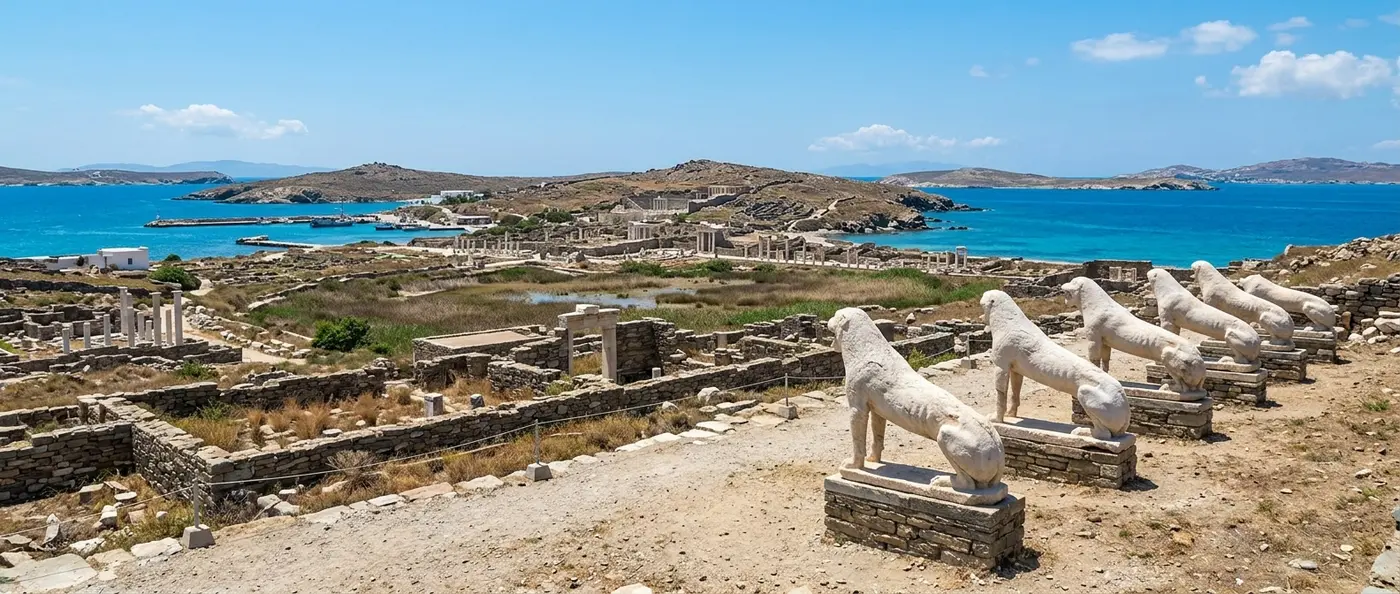
The archaeological site of Delos is one of antiquity's most extensive and well-preserved complexes. The Sanctuary of Apollo, occupying the ancient city's center, includes three temples dedicated to the god. The largest, known as the Great Temple, was built in the 5th century BC and was an imposing Doric structure.
The Terrace of the Naxians displays its famous marble lions in silent vigil. Originally nine or more, five of these guardians still stand watch over the sacred space today. The lions, dating to the 7th century BC, are among Greece's oldest monumental sculptures.
The Sacred Lake, now dry, marks the mythical spot where Apollo was born. Beside it stood the Palm Tree of Leto, a bronze tree symbolizing the palm against which Leto leaned during childbirth. This monument was so famous it was reproduced on coins of the era.
Temple of Apollo
Three successive temples were built on the same spot from the 6th to 3rd centuries BC. The last was a magnificent Doric structure with 13 columns on each side.
Ancient Theater
With a capacity of 5,500 spectators, Delos's theater was built in the 3rd century BC. Its orchestra featured a unique marble floor with geometric designs.
House of Dolphins
A luxurious residence with stunning mosaic floors depicting dolphins. It represents the wealth of Delos's merchants.
🗿 The Mysteries of the Naxian Colossus
One of Delos's most impressive and mysterious monuments is the base of the Naxian Colossus. This was a massive marble statue of Apollo that stood near the House of the Naxians. The statue, approximately 9 meters tall, was monolithic—carved from a single piece of marble.
Today only fragments of the colossus survive: the base with feet and part of the torso. Archaeologists estimate the statue's total weight exceeded 30 tons. How the ancient Naxians transported and erected such a massive statue puzzles archaeologists today.
Inscriptions on the base reveal that the statue was a dedication by the Naxians to Apollo in the 7th century BC. Naxos, rich in high-quality marble, was one of the sanctuary's main sponsors. The colossus demonstrated both the island's piety and technical superiority.
💡 The Transportation Mystery
Modern engineers estimate it would have taken more than 500 men to move the colossus. The sea between Naxos and Delos is often stormy, making transport even more perilous. Specially constructed rafts and favorable weather conditions were likely used.
📜 Delos's Cosmopolitan Society
During the Hellenistic period, Delos became a truly international city. Besides Greek residents, the island hosted large communities of Italians, Syrians, Egyptians, and Jews. Each ethnic group had its own temples, markets, and associations.
Italian merchants, known as "Italici," built the impressive Agora of the Italians, one of ancient Delos's largest building complexes. The structure, covering 5,000 square meters, included shops, warehouses, and meeting spaces. Its mosaic floors, depicting mythological scenes, are among the finest surviving from antiquity.
Delos's Jewish community was one of the diaspora's earliest. A 2nd-century BC inscription mentions a synagogue's existence, making Delos one of the first places outside Palestine with documented Jewish worship. The island's tolerance and cosmopolitanism allowed peaceful coexistence of different religions and cultures.
🌍 Ethnic Communities of Delos
⚔️ Destruction and Abandonment
Delos's golden age ended abruptly. In 88 BC, during the Mithridatic Wars, the fleet of Mithridates VI of Pontus attacked the island. Ancient sources report that 20,000 inhabitants were massacred. The city was plundered and many sanctuaries desecrated.
A second devastating raid by pirates in 69 BC delivered the final blow. Although Roman general Gaius Triarius attempted to rebuild the city, Delos never recovered its former glory. Trade had already shifted to other ports like Alexandria and Rhodes.
By the 2nd century AD, Delos had shrunk to a small community. The last inhabitants abandoned the island in the 7th century AD, when Arab raids made life on small Aegean islands dangerous. For over a thousand years, Delos remained uninhabited, its ruins serving as a quarry for building materials.
🔬 Discovery and Modern Research
Systematic excavations at Delos began in 1873 by the French School of Archaeology at Athens. For over 150 years, French archaeologists have uncovered an entire ancient city, making Delos one of the most completely excavated ancient sites.
The excavations have yielded remarkable finds. Thousands of statues, reliefs, and inscriptions have been discovered. Mosaic floors from wealthy houses reveal the era's artistic excellence. Particularly important are inscriptions recording economic transactions, providing valuable information about the ancient economy.
Recent research using modern technologies has revealed new aspects of Delos's past. Underwater archaeology has located ancient harbor works and shipwrecks around the island. DNA analysis from human remains helps understand the population's multiethnic composition. Digital restoration allows virtual reconstruction of monuments.
💎 Treasures and Art of Delos
Delos was a center of artistic production and art trade. The island's sculpture workshops produced statues exported throughout the Mediterranean. The "Delian style" in sculpture, characterized by detailed fabric rendering and intense expression, influenced Hellenistic art.
One of the most famous works is the Aphrodite of Delos, a marble statue depicting the goddess removing her sandal. This 1st century BC masterpiece captures the goddess in fluid motion, her body rendered with startling realism. It's now housed in the National Archaeological Museum of Athens.
Delos's mosaics constitute a special chapter. In the House of Dionysus, a stunning mosaic depicts the god riding a panther. Thousands of tiny tesserae create this testament to ancient artistic skill. Other mosaics depict dolphins, mythological scenes, and geometric motifs.
Mosaic Floors
Over 300 mosaics have been discovered, from simple geometric designs to complex mythological scenes. The opus tessellatum and opus vermiculatum techniques were used for stunning results.
Jewelry
Gold and silver jewelry of high craftsmanship, with precious stones from the East. Delos's workshops were famous for fine granulation and filigree techniques.
🌅 Delos Today: A Living Museum
Today Delos is one of Greece's most important archaeological sites and a UNESCO World Heritage Site since 1990. The island remains uninhabited except for guards and archaeological site staff. Daily, hundreds of visitors arrive by boat from Mykonos to walk the ancient streets.
Visiting Delos is a unique experience. Visitors can wander among temple ruins, admire mosaics in ancient houses, and climb Mount Cynthus for panoramic views of the Aegean. The Delos Museum houses many portable finds, including statues, inscriptions, and everyday objects.
Conservation challenges are significant. Sea erosion, strong winds, and increasing tourism threaten the monuments. Conservation and restoration programs are ongoing. Modern technology like 3D scanning and digital documentation helps preserve the site's memory for future generations.
🗺️ Practical Visitor Information
Delos is accessible only by boat from Mykonos (30 minutes). The archaeological site is open from April to October. Morning visits are recommended to avoid heat and crowds. Essential items: hat, sunscreen, water, and comfortable shoes for walking on uneven terrain.