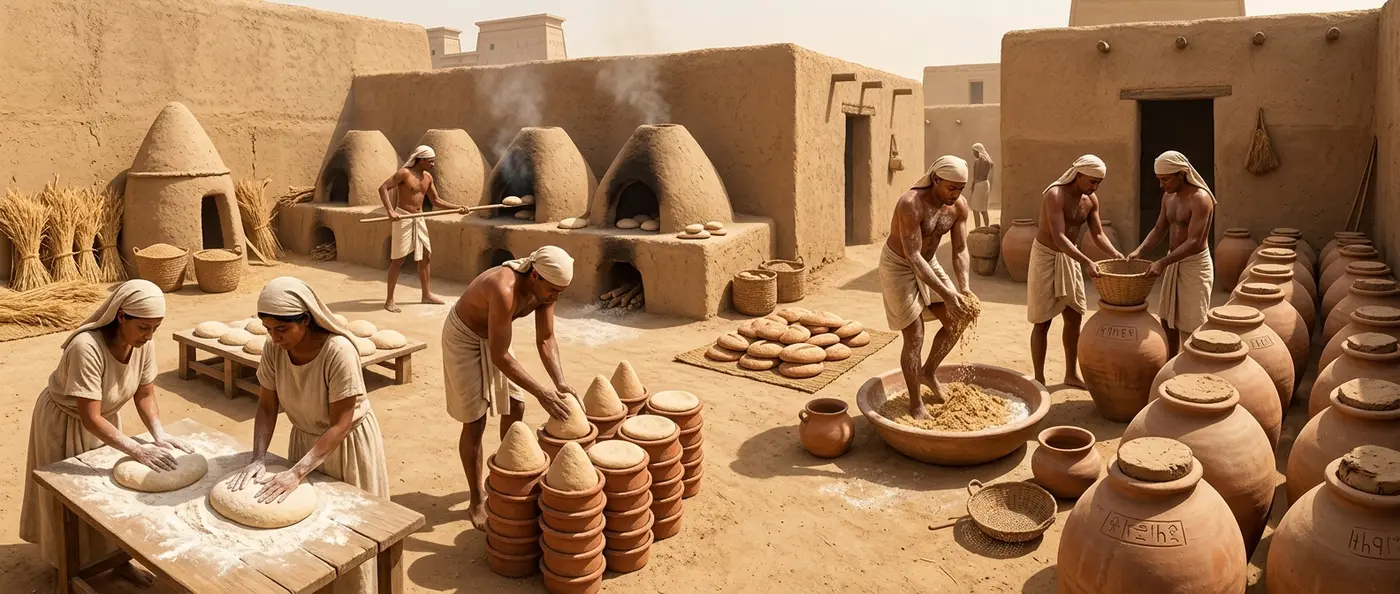
In pharaohs' tombs, among golden jewelry and precious artifacts, archaeologists frequently discover something far simpler yet equally revealing: desiccated loaves of bread and clay vessels that once held beer. These humble foods formed the dietary foundation of ancient Egypt for thousands of years, sustaining everyone from common laborers to the pharaoh himself.
🍞 Bread as the Foundation of Civilization
Bread in ancient Egypt wasn't merely food — it was currency, wages, and a symbol of life itself. The Egyptians developed at least 40 different types of bread, from simple barley loaves for workers to refined white bread with honey and spices served at royal banquets.
Bread production was so central to Egyptian society that New Kingdom scribes (1550-1077 BCE) meticulously recorded every stage of the process. From hieroglyphic papyri, we learn that palace bakers used special granite millstones to grind wheat into the finest flour, while kneading was done by foot in large clay troughs.
Most remarkably, the ancient Egyptians discovered yeast around 3000 BCE, making them the first to produce leavened bread. This technological innovation wasn't accidental — it directly connected to beer production, as the same yeast was used for both products.
🍺 Beer of Gods and Mortals
If bread was the solid foundation of Egyptian diet, beer was the liquid that gave life. Egyptians called it "zythum" and consumed it daily across all social classes. It was so important that there was a special goddess of beer, Tenenet, while the goddess Hathor protected the intoxicated.
Egyptian beer bore little resemblance to today's clear, bitter brews. It was thick, nutritious, and often sweet, with an alcohol content of just 2-4%. It was made from partially baked barley bread dissolved in water and left to ferment. The result was a cloudy, viscous drink consumed through straws to avoid solid residue.
In royal breweries, the process was far more refined. The pharaoh's brewers added dates, honey, cinnamon, and other aromatics to create special varieties. One such luxury beer, the "beer of eternity," was made specifically for funeral ceremonies and placed in tombs to accompany the deceased in the afterlife.
🏺 Daily Diet of the Workers
For the thousands of workers building pyramids and temples, bread and beer weren't just food but official currency. Papyri from Deir el-Medina, the village of craftsmen who built royal tombs, reveal detailed information about the food distribution system.
Each worker received 10 loaves of bread and 2 jars of beer daily as basic wages. Skilled craftsmen and foremen received double or triple portions. When bread deliveries ran late, workers downed their tools — history's first recorded strike erupted in 1170 BCE over missing loaves and empty beer jars.
Beyond basic sustenance, workers supplemented their meals with onions, garlic, radishes, and dried fish. During festivals, the administration distributed extra portions of meat, usually beef or goat, along with sweets made with honey and dates.
Worker's Ration
10 loaves of bread, 2 jars of beer, onions, garlic, and dried fish daily
Craftsman's Ration
20 loaves of bread, 4 jars of beer, vegetables, and occasional meat
Foreman's Ration
30 loaves of bread, 6 jars of beer, meat twice weekly
👑 Royal Banquets
In the pharaoh's palaces, bread and beer transformed into gastronomic masterpieces. Royal bakers created breads shaped like animals, flowers, and sacred symbols, while using imported spices from Nubia and Asia to provide exotic flavors.
The most impressive example of royal diet comes from Tutankhamun's tomb. Along with his treasures, archaeologists found 116 baskets containing various types of bread, some preserved so well they could identify the ingredients: white flour enriched with eggs, butter, honey, and sesame.
Royal beer was equally refined. Special varieties were made with wheat instead of barley, while exotic fruits like pomegranates and figs were added. The "beer of Horus," served only during religious ceremonies, contained sacred herbs and was said to grant vision to the drinker.
💎 Ramesses II's Menu
According to inscriptions from his palace at Pi-Ramesses, the pharaoh consumed daily: 50 different types of bread, 20 types of beer, roasted beef with honey, pigeons stuffed with wheat, and sweets made from almonds and dates. The meal was always accompanied by the sacred "beer of eternity."
🔬 Archaeological Revelations
Modern archaeological techniques have revealed stunning details about Egyptian diet. Residue analysis from vessels shows that beer contained high levels of tetracycline, a natural antibiotic from bacteria in grains. This explains why ancient Egyptians considered beer medicine and gave it to patients.
Additionally, microscopic analysis of mummy teeth revealed that bread often contained sand from millstones, causing severe dental wear. This was such a common problem that Egyptians developed special dental treatments, making them pioneers in dentistry as well.
A recent discovery at Saqqara uncovered an entire industrial complex for baking and brewing from the 5th Dynasty (2465-2323 BCE). The complex included 20 ovens, massive fermentation tanks, and storage facilities that could feed thousands of workers. This confirms that mass food production was already organized on an industrial scale 4,500 years ago.
🌾 Legacy in Modern Times
The influence of Egyptian baking and brewing spread throughout the Mediterranean. Ancient Greeks adopted fermentation techniques, while Romans introduced Egyptian beer to their empire. Even today, traditional Egyptian bread "aish baladi" is made using similar methods.
Today's bakers and brewers are reviving ancient recipes. Using ancient yeast strains isolated from Egyptian vessels and following hieroglyphic instructions, they've managed to reproduce flavors lost for millennia.
🏺 Ancient vs Modern Production
📜 Conclusions from the Study
The study of bread and beer in ancient Egypt reveals far more than simple dietary habits. It shows us a civilization that had developed complex systems of production, distribution, and quality control thousands of years before the industrial revolution.
The fact that these basic foods were used as currency, religious offerings, and symbols of social status underscores the deep connection between food and civilization. The Egyptians understood that controlling food production meant controlling society — a lesson that remains relevant today.
Perhaps most impressive is the timeless nature of these foods. In a world where culinary trends constantly change, bread and beer remain fundamental elements of human diet, exactly as they were in the pharaohs' time. Every time we break bread or raise a glass of beer, we continue a tradition that began on the banks of the Nile 5,000 years ago.