📜 What Were Ostraca and Why Were They Used
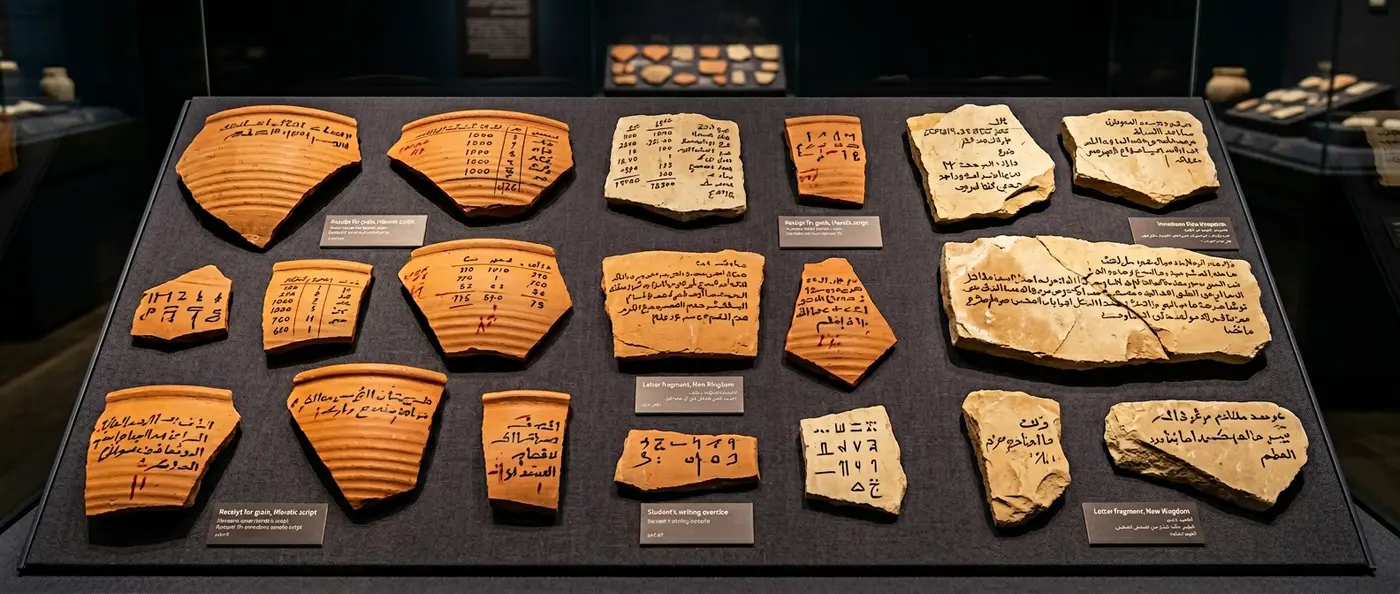
Ostraca (singular: ostracon) were essentially the "poor man's paper" in ancient Egypt. While papyrus was expensive and required processing, broken pottery fragments or flat limestone pieces were available everywhere. Ancient Egyptians used them to record business transactions, keep notes, make sketches, and even practice writing.
Their use was so widespread that we find ostraca from the Old Kingdom period (around 2700-2200 BCE) through the Roman era. It wasn't just Egyptians who used them — ancient Greeks and Hebrews also adopted this practice. In Greece, ostraca gave their name to "ostracism," as citizens wrote the names of politicians they wanted exiled on pottery shards.
🏺 Types of Ostraca and Their Content
Ancient Egyptian ostraca fall into various categories based on their content. Some contained supply lists, others transaction receipts, while some served as notebooks for scribes practicing hieroglyphic writing. Particularly interesting are the so-called "figured ostraca" — pottery with sketches depicting scenes from daily life, gods, animals, and even satirical representations.
Archaeologists have discovered thousands of ostraca at various Egyptian sites. At Deir el-Medina, the village of craftsmen who built royal tombs in the Valley of the Kings, hundreds of ostraca were found with everyday notes: shopping lists, letters, and even love poems. These simple fragments reveal ordinary people's lives — their shopping lists, love letters, and daily concerns — beyond the pharaohs' monuments.
Business Ostraca
Receipts, contracts, goods lists, and product prices. They provide valuable sources for understanding ancient economics.
Educational Ostraca
Writing exercises, copies of sacred texts, and student assignments showing how ancient Egyptians learned to write.
Artistic Ostraca
Sketches, preliminary drawings for murals, and free drawings revealing the artistic expression of the era.
🔍 The Significance of Ostraca for Archaeology
For modern archaeologists, ostraca are invaluable. Unlike official papyri that often contained religious texts or royal decrees, ostraca give us access to ordinary people's thoughts and concerns. Through them we learn about bread prices, workers' names, neighborhood disputes, and even their dreams and fears.
One of the most famous ostraca collections was found at Samaria in Palestine, dated to the 8th century BCE during King Jeroboam II's reign. These ostraca contained administrative records and help us understand ancient Israel's taxation system. Similar finds from Egypt reveal details about administration, economy, and social organization.
⚒️ Writing Techniques and Materials
Writing on ostraca required special techniques. Scribes used reeds cut at oblique angles as pens, which they dipped in ink made from soot mixed with gum. For red ink, used for titles or important words, they used iron oxide. The ostracon's surface had to be smooth enough to accept ink, so they preferred pieces from thin vessels or flat limestone stones.
The writing used was usually hieratic — a simplified form of hieroglyphs that allowed faster writing. Later, during the Ptolemaic period (304-30 BCE), we find ostraca written in demotic script, an even more simplified form used for daily needs. There are also ostraca with Greek writing from the Hellenistic and Roman periods.
💡 Did You Know?
Some ostraca contained "punishment exercises" where student scribes had to copy the same phrase hundreds of times — exactly like modern students punished with repetitive writing tasks!
🗿 Famous Finds and Controversial Interpretations
Recently, a new interpretation of two inscriptions from Serabit el-Khadim in the Sinai Peninsula caused a sensation. Researcher Michael S. Bar-Ron argues that the inscriptions, written in proto-Sinaitic script around 1800 BCE, refer to the biblical Moses. According to his analysis, inscriptions 357 and 361 read as "This is Moses" and "Saying of Moses."
However, the academic community remains skeptical. Thomas Schneider from the University of British Columbia called the interpretation "completely unproven and misleading." Other experts point out that the name Moses was quite common in ancient Egypt and appears in various documents from the New Kingdom period, including a court case about land inheritance.
Whether or not they mention Moses, these inscriptions rank among the earliest alphabetic writing ever discovered. Together with two even earlier inscriptions from Wadi el-Hol on the Nile's west bank, they suggest that proto-Sinaitic script originated in Egypt and is the ancestor of many modern alphabets.
📊 Comparison of Ancient Writing Media
🌍 Ostraca in Other Civilizations
Ostraca use wasn't limited to Egypt. In ancient Greece, ostraca played a significant role in the democratic process. Each year, Athenian citizens could vote to exile someone they considered dangerous to democracy by writing their name on an ostracon. If at least 6,000 votes were collected, the "winner" was exiled for ten years.
In ancient Palestine, the Samaria ostraca give us information about the administrative organization of the Kingdom of Israel. In Mesopotamia, although they preferred clay tablets, there's evidence of occasional ostraca use. Even in the Roman Empire, especially in the provinces of Egypt and the Near East, ostraca continued to be used for daily notes.
Ostraca appeared across civilizations because they solved a universal problem: the need for cheap, accessible writing material. In an age when paper didn't exist and other writing materials were expensive or difficult to prepare, simple pottery fragments gave voice to thousands of people who would otherwise remain silent in history.
🔬 Modern Study Methods
Ostraca study has benefited significantly from modern technologies. Researchers now use high-resolution photography and 3D scanning to analyze inscriptions that are nearly invisible to the naked eye. Multispectral imaging allows reading of faded ink, while digital processing helps restore damaged text sections.
Additionally, databases collecting digitized ostraca from museums worldwide allow researchers to compare scripts, identify the same hand in different texts, and reconstruct archives that had been scattered. These techniques reveal previously invisible text and help scholars piece together scattered archives.
📚 The Legacy of Ostraca
Ostraca remind us that the need for communication and recording is universal and timeless. From ancient scribes noting their accounts on broken vessels to modern people writing notes on smartphones, the human desire to record our thoughts and experiences remains unchanged.
Without these pottery scraps, we'd never hear from the workers who built the pyramids or know that ancient students got punished with repetitive writing exercises, just like today. The fragments prove that ordinary people, not just pharaohs, shaped history.
Ostraca study continues, with new finds coming to light from excavations throughout Egypt and the Middle East. As technologies improve and more ostraca are digitized, we can expect new revelations about life in the ancient world. Perhaps someday, a forgotten ostracon in some museum storage will give us the answer to one of history's great mysteries.