🏛️ The Birth of Aesthetics in Ancient Greece
The ancient Greeks didn't view art merely as decoration. For them, beauty was a cosmic principle, a way to understand their place in the universe. Plato and Aristotle, the two giants of Greek philosophy, devoted significant portions of their work to studying aesthetics, considering music, poetry, architecture, and drama fundamental institutions of the city-state.
Plato, in his ideal republic, proposed banishing poets and painters — a position that seems radical even now. His theory of mimesis argued that art distances humans from truth, creating copies of copies of the ideal world of forms. Conversely, Aristotle defended mimesis as the foundation of moral education and as a means of catharsis through tragedy.
The Pythagorean theory of cosmic harmony shaped Greek artistic thinking. According to this, beauty emerges from mathematical proportions — the same laws governing the music of the spheres also govern perfect sculpture. This idea passed to the Neoplatonists and, through Saint Augustine, profoundly influenced medieval thought.
🏺 Art as Prize and Honor
At the Panathenaic Games, held every four years in Athens, winners didn't receive gold medals. Instead, they earned dozens of clay vessels — the famous Panathenaic amphorae — filled with precious oil from Athena's sacred olive groves. These vessels, standing about 62 centimeters tall, weren't mere containers but works of art.
Each amphora depicted the winner's specific sport. An exceptional example from 530 BC, found in Vulci, Italy, shows five runners in a sprint race. The athletes are depicted nude, as they believed their perfect bodies would intimidate opponents. The black-figure pottery technique, with its silhouetted forms, captures the runners mid-stride.
The olive oil contained in these amphorae came from Athena's sacred trees and was considered holy. In ancient Greece, the olive symbolized Zeus and later became connected to the Olympic Games. Thus, the prize combined religious significance, artistic value, and practical utility — a triad that characterizes the Greek approach to art.
⚔️ Black-Figure and Red-Figure Techniques
Greek pottery painting shows how artists pushed their craft forward. The black-figure technique, which dominated the 6th century BC, required exceptional precision. Artists painted figures with black slip and carved details with fine tools before firing.
Around 530 BC, the red-figure technique emerged, reversing the process. Now the background was black and the figures remained in the natural red color of the clay. This allowed greater detail and realism in depicting the human body, clothing, and expressions.
Black-Figure Technique
Black figures on red background with incised details. Dominated from 700-530 BC and required exceptional precision in carving.
Red-Figure Technique
Red figures on black background with painted details. Prevailed after 530 BC and allowed greater realism.
Firing Technique
Triple firing in special kilns reaching 950°C. Alternating oxidizing and reducing atmospheres created the characteristic colors.
🗿 Sculpture and the Quest for the Ideal
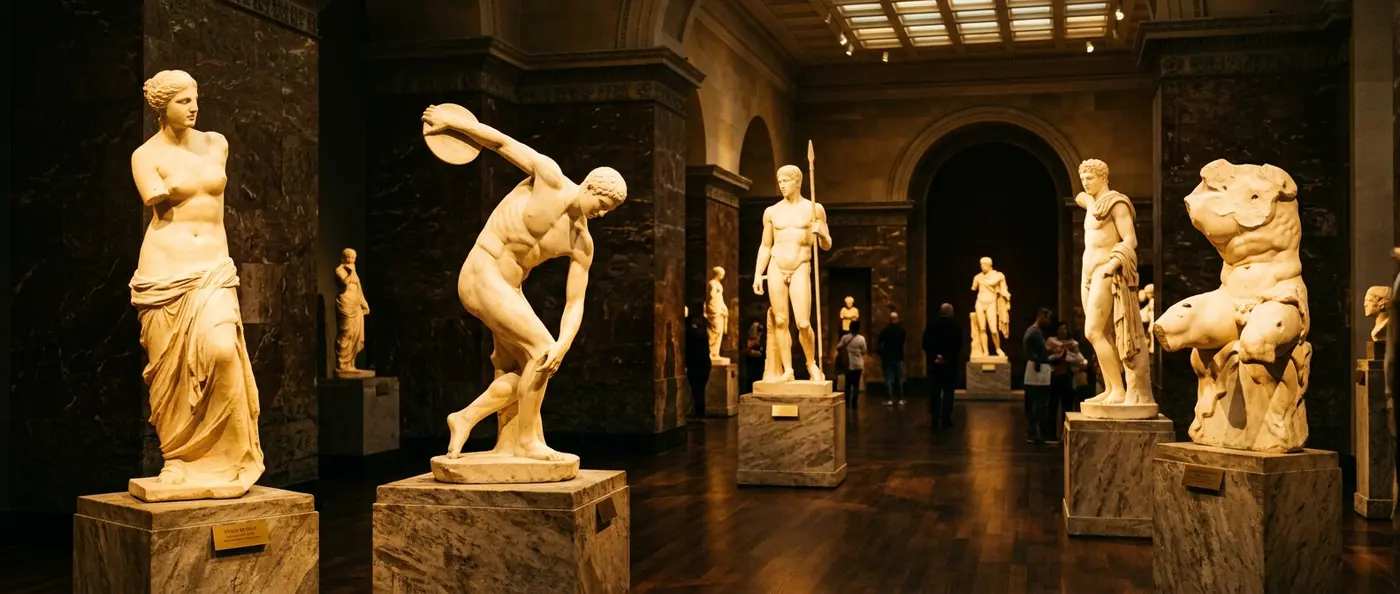
If pottery was the everyday art of the Greeks, sculpture was their highest ambition. Greek sculpture moved from the rigid kouroi of the archaic period to the fluid movement of the Discobolus — a transformation driven by both technical innovation and philosophical inquiry.
Sculptors didn't simply copy the human body. They created an ideal that combined the best proportions from various models. Polykleitos, in the 5th century BC, composed the "Canon," a mathematical system of ideal proportions for the human body. His work "Doryphoros" embodied these principles and became a model for centuries.
The concept of contrapposto — the balanced opposition of the body with weight on one foot — revolutionized sculpture. For the first time, statues seemed to breathe, move, live. They were no longer static idols but representations of human dynamism.
💡 The Secret of the Golden Ratio
The Greeks discovered that the ratio 1:1.618 (φ) appears everywhere in nature — from shells to flower petals. They applied this "divine proportion" to their art, from the Parthenon to vessels, believing it reflected cosmic harmony.
🏛️ Architecture: The Temple as Sculpture
Greek temples were more than buildings — they were massive sculptures that housed the gods. Each temple was designed with mathematical precision, applying principles of symmetry and proportion that the Greeks considered fundamental to beauty.
The Parthenon, built between 447-432 BC, represents the pinnacle of this approach. Architects Ictinus and Callicrates applied subtle optical corrections — slightly curved lines instead of straight ones — so the building would appear perfect to the human eye. Each column leaned slightly inward, the stylobate had imperceptible curvature, and the corner columns were slightly thicker.
These "imperfections" created the optical illusion of perfection. The Greeks understood that true beauty isn't mathematical precision but adaptation to human perception.
🏛️ The Three Orders
🎭 Theater as Total Art
Ancient Greek theater wasn't merely entertainment. It was religious ritual, political education, and artistic expression in one. At the Great Dionysia, thousands of citizens watched tragedies and comedies that examined the deepest questions of human existence.
Aristotle, in his "Poetics," analyzed how tragedy achieves catharsis — the purifying release of emotions through pity and fear. The structure of tragedy, with exposition, complication, climax, and resolution, became the model for every dramatic narrative to this day.
Theaters were designed with remarkable acoustics. At the theater of Epidaurus, with a capacity of 14,000 spectators, even a whisper from the stage can be heard in the last row. This was achieved through the semicircular arrangement and slope of the seating, which created a natural acoustic filter.
🗺️ Art in Daily Life
Recent excavations in Eretria, Euboea, revealed an impressive 4th century BC mosaic floor in excellent condition. The mosaic, measuring 1.13 meters, depicts two nude satyrs — the younger playing a flute while the older dances. The figures, made from polychrome pebbles, have a liveliness that testifies to the artists' technical skill.
This discovery reminds us of something important. Art wasn't confined to temples and public buildings. Wealthy Greeks decorated their homes with mosaics, frescoes, and sculptures. The room where the mosaic was found was likely used for symposia — the famous gatherings where men discussed philosophy, politics, and art accompanied by music and wine.
The satyrs in the mosaic, symbols of Dionysus, reminded symposiasts of the Dionysiac nature of the gathering. They were a visual reference to the "sacred madness" that Dionysus represented — the temporary liberation from social constraints that allowed creative expression.
💎 The Enduring Legacy
Greek artistic principles still shape how we create today. When Leon Alberti, in the 15th century, defined beauty as "such order and arrangement of parts that nothing can be changed except for the worse," he was essentially repeating the ideas of Greek philosophers.
Even today, the principles established by Greek artists remain fundamental. The golden ratio is used in modern design. The three-act structure of tragedy is taught in every film school. The optical corrections of the Parthenon are applied to contemporary buildings.
The greatest legacy may be the Greeks' conviction that art is necessity, not luxury — that beauty carries moral weight and aesthetic experience reveals truths about ourselves and our world.
The Venus de Milo achieves perfection not despite its missing arms, but because of them. Without complete forms, we must use imagination to fill the gaps, becoming co-creators. Greek art works this way — instead of providing answers, it starts conversations that have lasted over two thousand years.