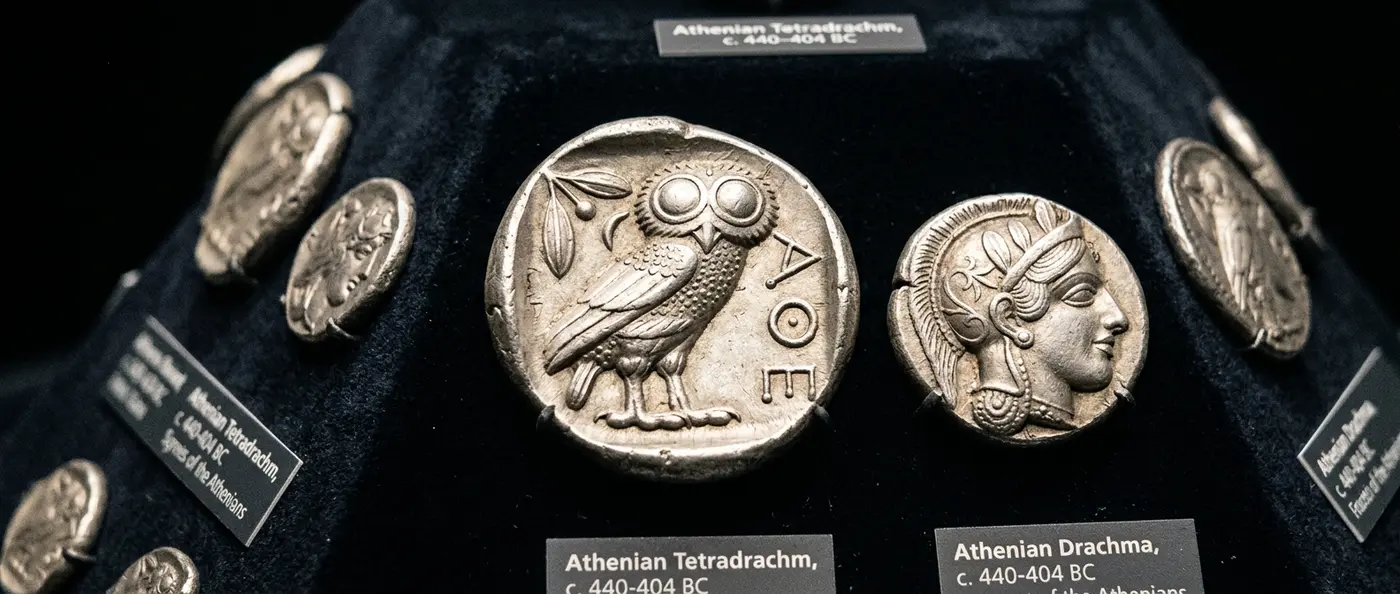
Hold an ancient Greek coin in your palm. Athena's profile on one side. Her owl on the other. This small piece of silver isn't just an artifact — it's the birth certificate of an economic revolution that forever changed how humans trade, value, and think about wealth.
📖 Read more: 10 Hidden Secrets of the Athenian Acropolis You Never Knew
🪙 The Birth of the First Coin
Before coins, ancient peoples relied on barter. Wheat for wine, sheep for tools, cloth for oil. The system worked, but barely. How do you calculate the value of an ox against an amphora? What happens when you want to buy something small but only have a large animal to trade?
📖 Read more: Olmec Colossal Heads: 44-Ton Stone Giants of Ancient Mexico
The solution came from Lydia, in modern-day western Turkey, around 650 BC. There, the first coins were struck from electrum — a natural alloy of gold and silver found in the Pactolus River. The Greeks of Ionia quickly adopted the idea and evolved it.
📖 Read more: France's Cave Art: 36,000-Year-Old Masterpieces
The first Greek coins appeared in the city-states of Asia Minor around 600 BC. Aegina, an island in the Saronic Gulf, became the first Greek city to mint its own silver coins around 595 BC, featuring the distinctive symbol of a turtle.
📖 Read more: Diogenes: The Philosopher Who Lived in a Barrel
⚒️ The Art of Coin Making
Creating an ancient coin was stunningly complex. First, the metal had to be purified and weighed with precision. Small amounts of silver or gold were heated and shaped into round discs of specific weight.
Then came the striking. The craftsman placed the metal disc on an engraved die made of hard metal. A second die with the relief design was positioned on top. With one powerful hammer blow, the two dies compressed the metal, imprinting the designs on both sides.
Each city-state had its own symbols. Athens had the owl, Corinth the Pegasus, Syracuse the head of Arethusa. These symbols weren't just decorative — they functioned as guarantees of quality and authenticity.
💰 From Local to International Trade
The introduction of coins transformed commerce. Suddenly, a merchant from Athens could travel to Sicily and buy grain without hauling sheep or amphorae. Coins were portable, retained their value, and became accepted throughout the Mediterranean.
The Athenian tetradrachm became the first truly international currency. Weighing about 17.2 grams of pure silver, it was so reliable that it was accepted from Spain to Persia. Traders called them "owls" after the bird depicted on one side.
Maritime Trade
Coins facilitated transactions in Mediterranean ports. Merchants from different regions could agree on prices without complex bartering.
Stable Value
Standardized weight and metal purity guaranteed stable value. A tetradrachm had the same purchasing power everywhere.
International Acceptance
Athenian coins became the "dollar" of antiquity, accepted from Marseilles to Babylon.
🏛️ Coins and Political Power
Coins weren't just economic tools. They quickly became symbols of political power and propaganda. Rulers used coins to spread messages, honor victories, proclaim their divine lineage.
Alexander the Great was the first to place his portrait on a coin while alive, breaking the tradition that only gods appeared on currency. After his death, his successors continued the practice, establishing the ruler's portrait as a fundamental element.
Coins also became a way to record history. Military victories, city foundations, religious festivals — all were immortalized in metal. Today, these small artworks give us invaluable information about events that would otherwise be lost.
💡 Did You Know?
The word "coin" comes from the Latin "nummus," but the Greeks used the term "nomisma" meaning "that which is established by law." The English word "money" derives from the Roman goddess Juno Moneta, in whose temple Roman coins were minted.
🔍 The Technology Behind the Metal
The ancient Greeks developed remarkable techniques to ensure coin quality. They used the cupellation method to purify silver, heating it in special vessels made from bone or ash that absorbed impurities.
To test authenticity, they developed the touchstone method — using a black stone that left different marks depending on the metal's purity. An experienced money changer could spot fake coins with a simple test.
Weight accuracy was impressive. Athenian tetradrachms had a standard deviation of just 0.1 grams, a performance that modern mints would envy. This consistency built trust and facilitated trade.
📊 The Economic Revolution
The introduction of coins triggered a genuine economic revolution. For the first time, wealth accumulation in compact form became possible. Banks, as we know them today, were born in ancient Greece as "trapezites" — from the tables where money changers exchanged coins.
Wages began to be paid in coin instead of goods. A hoplite in 5th century BC Athens earned one drachma per day — enough to feed a family. Public works, like building the Parthenon, were financed and organized thanks to the monetary system.
⚖️ Purchasing Power in Classical Athens
🌍 The Spread of the Monetary System
From Greece, the coin idea spread like wildfire. Romans adopted the system in the 3rd century BC, creating the denarius that would dominate for centuries. Carthaginians, Celts, even the distant peoples of India began minting their own coins.
Each civilization added its own touch. Celts created coins with abstract designs, Indians experimented with square coins, Chinese developed coins with holes in the center to string them together.
But Greek influence remained dominant. Even today, many monetary symbols and terms have Greek roots. The "drachma" survived as a currency until 2001, when Greece adopted the euro.
🏺 The Legacy of Ancient Coins
Ancient Greek coins weren't just means of exchange. They were artworks, historical documents, symbols of power and identity. This innovation forever changed how societies organize and interact.
Today, as we move toward digital currencies and immaterial transactions, we should remember that revolutionary moment 2,600 years ago. When some unknown craftsman in Lydia struck the first coin, he didn't just create an object. He created a system that would allow people to dream, trade, build civilizations.
The next step in money's evolution may be digital, but the basic idea remains the same: a commonly accepted medium that represents value, trust, and the possibility of exchange. An idea born in ancient Greece that continues to shape our world.