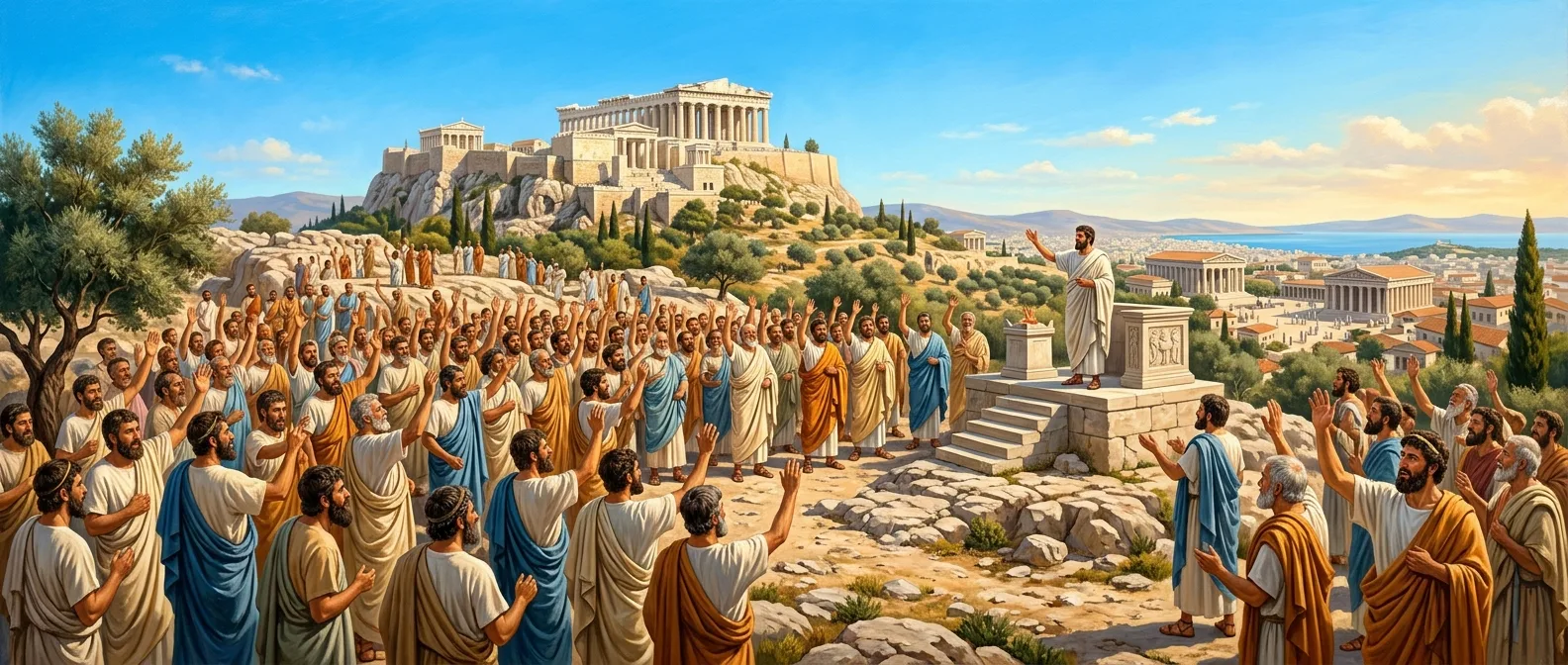
When Xenophon reached Trapezus on the Black Sea coast in 400 BCE with his Ten Thousand, he encountered a city that spoke the same language and worshipped the same gods as his homeland. Nearly 1,000 kilometers from Athens, the Greek presence was as vibrant as in the heart of Attica. This was Greek colonization—a movement that transformed the Mediterranean into a Greek lake for centuries.
🏛️ The Greek Colonization Movement
Greek colonization began around 750 BCE and continued for over three centuries. This wasn't an organized state expansion but a wave of migration driven by multiple factors. Overpopulation in the mother cities, lack of arable land, and political conflicts pushed thousands of Greeks to seek new homelands.
These colonies weren't mere trading posts. They were autonomous city-states that maintained close ties with their metropolis but had their own political organization. From Massalia in modern France to Trapezus on the Black Sea, Greeks created a network of cities that forever changed the map of the ancient Mediterranean.
The process of founding a colony followed specific steps. First, the metropolis consulted the Oracle at Delphi. Then they selected an oikist who would lead the mission. The colonists carried with them the sacred flame from their mother city's hearth, symbolizing continuity with their homeland.
🗺️ Magna Graecia (Greater Greece)
Southern Italy and Sicily became the epicenter of Greek colonization in the West. So dense was the Greek presence that the region was called Magna Graecia. Cities like Syracuse, Tarentum, and Neapolis became cultural centers that rivaled the splendor of Greece's mother cities.
Syracuse, founded by Corinthian colonists in 734 BCE, evolved into the most powerful Greek city in the West. Under Dionysius I in the 4th century BCE, the city controlled most of Sicily and maintained a fleet that rivaled Athens'. Its theater, carved into rock, could accommodate 15,000 spectators.
In Calabria, which received its name later, there were 13 flourishing Greek cities according to the geographer Strabo. Tarentum and Brindisi were famous for wool trade and purple dye production. The region maintained its Greek character until the Roman conquest and even beyond.
⚓ Black Sea Colonies
The Black Sea, initially called Axeinos (inhospitable) due to difficult navigation conditions, was renamed Euxeinos (hospitable) once Greeks became familiar with its waters. Miletus led the colonization of the region, founding over 90 colonies.
Trapezus, Sinope, and Heraclea Pontica became major commercial centers. From there, grain, timber, honey, and slaves were exported to Greece. The Greek colonies of the Black Sea maintained their identity for millennia. Even in the 20th century, Pontic Greeks spoke a dialect that preserved archaic elements of the Greek language.
On the northern Black Sea coast, Greeks came into contact with the Scythians. The relationship was mutually beneficial. Scythians provided grain and raw materials, while Greeks brought wine, oil, and manufactured goods. This cultural exchange created a unique Greco-Scythian art form.
Naval Supremacy
Greek colonists were masters of the sea. Their ships, equipped with sails and oars, could travel vast distances carrying hundreds of colonists and essential equipment for establishing new settlements.
Diplomacy
The success of colonization was based on diplomacy. Greeks rarely used force. They preferred to negotiate with locals, offering trade and technological expertise in exchange for land and cooperation.
Cultural Influence
Each colony brought Greek education, art, and philosophy. Temples, theaters, and gymnasiums were built everywhere, spreading the Greek way of life throughout the Mediterranean world.
🏺 Colonial Organization
Each colony was organized as an independent city-state with its own laws and institutions. However, ties with the metropolis remained strong. The mother city sent priests for major festivals, and colonies participated in Panhellenic games as representatives of their metropolis.
The social structure of colonies was often more flexible than that of the mother cities. In new cities, people without land or political rights in their homeland could become landowners and citizens. This social mobility made colonies attractive to poorer Greeks.
Economically, colonies functioned as trade bridges. They imported raw materials from the interior and exported Greek products. Coinage, a Greek invention, facilitated transactions. Many colonies minted their own coins, which today serve as valuable sources for their history.
💎 Cultural Brilliance
Greek colonies became intellectual powerhouses. In Magna Graecia were born some of antiquity's most important philosophers and scientists. Pythagoras founded his school in Croton. Parmenides and Zeno taught in Elea. Empedocles came from Acragas in Sicily.
Colonial architecture often surpassed that of the mother cities in grandeur. The temples of Acragas and Syracuse rivaled the Parthenon in size. Tarentum's theater was among the largest in the Greek world. These monuments weren't mere imitations but original creations combining Greek and local influences.
🔬 Did You Know?
The word "colony" in ancient Greek didn't mean dependence but "new home." Greeks used the term "apoikia" (from "apo-oikos") to indicate that colonists were leaving their home to create a new one. Unlike modern colonies, Greek colonies were independent from day one.
⚔️ Conflicts and Challenges
The expansion of Greek colonies wasn't always peaceful. In the West, Greeks clashed with Carthaginians for control of Sicily. The Battle of Himera in 480 BCE, where Syracuse defeated the Carthaginians, was considered as significant as the victory at Salamis the same year.
In the Black Sea, relations with nomadic populations were complex. Periods of peaceful trade alternated with raids and conflicts. Greek cities were built with strong walls and maintained mercenary forces for their defense.
Internal conflicts also plagued the colonies. Strife between oligarchic and democratic factions was common. Many cities experienced periods of tyranny, like Syracuse under the Dionysii. Nevertheless, colonies managed to maintain their independence for centuries.
🌅 The Legacy of Colonization
Greek colonization forever changed the map of the ancient world. From the Pillars of Hercules to the Caucasus, Greek language and culture spread to millions of people. This cultural diffusion prepared the ground for the Hellenism of Alexander the Great's era.
Many modern cities owe their existence to ancient Greek colonists. Marseilles (Massalia), Nice (Nicaea), Naples (Neapolis), Constantinople (Byzantion) are just a few examples. Even today, in Southern Italy there are villages where an archaic Greek dialect called Griko is still spoken.
The Greek colonization model influenced later civilizations. Romans adopted many Greek practices in creating their own colonies. The idea of the city as an autonomous political entity, born in Greek colonies, influenced the development of Western civilization.
🏛️ Metropolis vs Colonies
📜 Epilogue: A Greek World
Plato wrote that Greeks sit around the Mediterranean "like frogs around a pond." This image perfectly captures the extent of Greek colonization. For more than five centuries, from the 8th to the 3rd century BCE, Greeks created a network of cities connecting three continents.
Magna Graecia wasn't just a geographical expanse. It was an idea—a world where Greek education, democracy, and rational thought would prevail. This vision emerged from the colonies themselves. The legacy of ancient Greek colonists survives in the cities they founded, the ideas they spread, the democratic principles they practiced.
Excavations continue to reveal new evidence about life in ancient Greek colonies. Each discovery reveals more about how these cities operated. Magna Graecia may no longer exist as a political entity, but its spirit survives—an eternal monument to the power of human civilization to transcend borders and unite peoples.