📚 The Structure of Ancient Greek Education
Education in ancient Greece served one purpose: forging the "kalos kagathos" citizen — the ideal person who combined virtue with beauty, wisdom with physical strength.
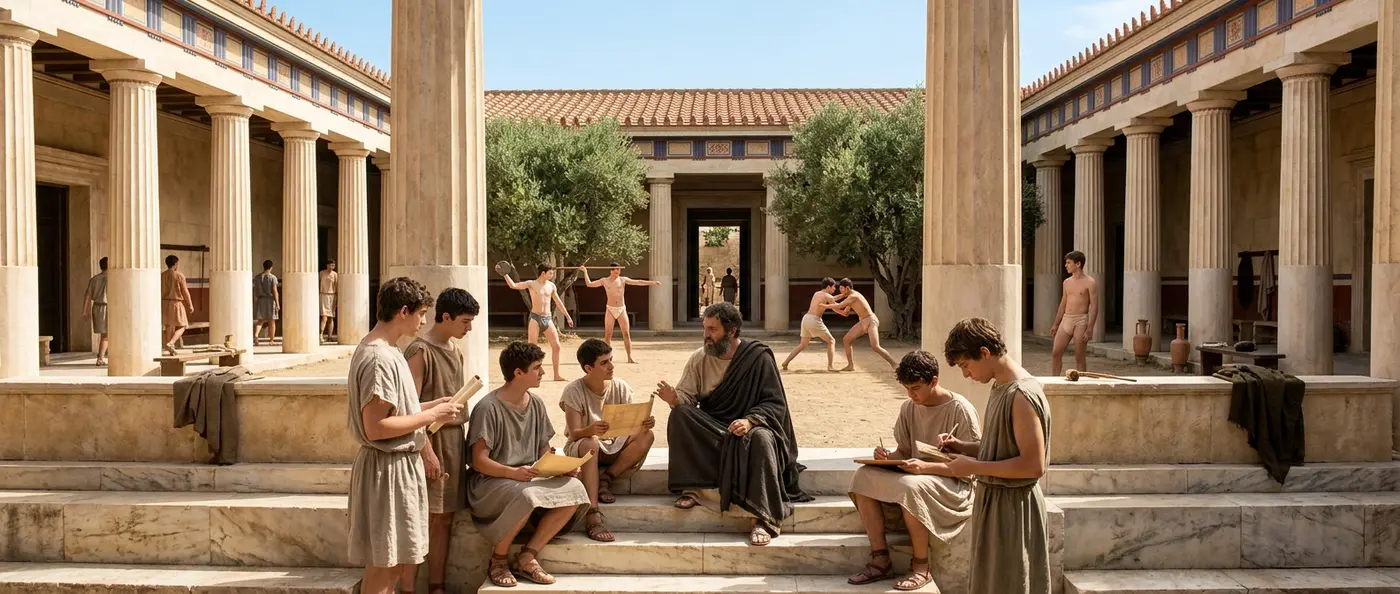
Boys began their education around age 7. The early years involved three basic teachers: the grammatistes who taught writing and reading, the kitharistes who taught music and poetry, and the paidotribes who handled physical education. Each morning, accompanied by the paidagogos — a household slave who protected and supervised them — children walked to school.
Learning happened through repetition and memorization. Children wrote on wax tablets with a stylus, practiced calligraphy, and memorized long passages from Homer and Hesiod. Music was considered as important as letters — they believed it refined the soul and cultivated character harmony.
Literary Education
Reading, writing, and memorizing epic poems. Children learned to write on wax tablets and studied Homer's works as the foundation of their education.
Musical Training
Learning the lyre and aulos, reciting poems with musical accompaniment. Music was considered essential for cultivating the soul and character.
Physical Education
Training in the palaestra with wrestling, running, jumping, and discus throwing. Physical exercise was as important as intellectual cultivation.
🏛️ The Gymnasium: Center of Athletics and Mind
The gymnasium was much more than an exercise space. According to our evidence, the word "gymnasion" literally meant "school for naked exercise" — athletes trained nude, believing their naked bodies would intimidate opponents. Every major city had at least one gymnasium, usually built with public funding.
These impressive buildings included changing rooms, baths, training areas, and special competition zones. Here, men over 18 trained for public games, unlike the palaestrae which were private schools for younger boys.
Gymnasiums also hosted lectures and discussions on philosophy, literature, and music. Public libraries were located nearby, making these spaces centers of complete education. Gymnasiarchs, public officials responsible for conducting athletics and competitions, oversaw their operation, while gymnastai were the teachers and trainers of athletes.
🎭 Daily Life of a Student
A typical day for a young Athenian student began at sunrise. Accompanied by his paidagogos, he arrived at school where the grammatistes awaited. Students sat on stools, holding their wax tablets on their knees.
The morning was devoted to letters. First they learned the alphabet, then syllables, and finally complete words. Reading was done aloud — ancient Greeks didn't read silently as we do today. Each student had to recite with proper rhythm and intonation the verses he studied.
At midday, after a light meal, came the music lesson. The lyre was the basic instrument, though some learned the aulos as well. Learning an instrument meant more — music connected directly to poetry and religion. Young people learned to sing hymns to the gods and accompany with music the poems they memorized.
💡 Did you know?
Ancient Greeks believed music directly influenced character. Certain musical modes were thought to inspire courage, others melancholy, and others self-control. That's why musical selection in education was done with great care.
⚔️ The Spartan Exception
While Athens cultivated the balance of body and mind, Sparta followed a completely different path. Education there was a state matter from age 7. Boys left home and lived in barracks, undergoing harsh military training.
They learned only the absolutely essential letters. Emphasis was placed on physical endurance, discipline, and absolute obedience. They slept on hard reed mats, walked barefoot even in winter, and ate minimally to learn to endure hunger. Even girls in Sparta exercised physically — something unthinkable for other Greek cities.
🏺 The Panathenaic Games and Prizes
Education in the gymnasium had an ultimate goal: participation in the great games. The Panathenaic Games, held every four years in Athens, were among the most important. Unlike modern Olympics where winners receive medals, there champions won dozens of clay amphoras filled with sacred oil from Athena's trees.
These amphoras, about 62 centimeters tall, were decorated with scenes from the winner's sport. One such amphora found and dated around 530 BCE depicts five runners in a race — the earliest known Panathenaic event. The athletes are depicted nude, exactly as they competed, in an impressive black-figure technique.
📖 Higher Education and the Philosophers
After age 18, those with financial means continued their education. This higher paideia included rhetoric, philosophy, mathematics, and astronomy. The Sophists, traveling teachers, taught the art of speech and persuasion for a fee.
Later came the great philosophical schools. Plato's Academy, founded around 387 BCE, operated in a grove dedicated to the hero Academus. There students studied mathematics, dialectic, and philosophy for years. Aristotle's Lyceum, with its famous peripatetic walks where the philosopher taught while walking, emphasized empirical observation and scientific method.
🏛️ Athens vs Sparta: Educational Systems
🎨 The Legacy of Ancient Education
Ancient Greece's educational system shaped Western civilization. The idea of developing body, mind, and soul together survives today. Even the term "gymnasium" survives, though with different meanings in various countries.
In German-speaking countries, the Gymnasium is high school, with no connection to athletics. In the English-speaking world, the gymnasium became the exercise space, cut off from academic education. The original gymnasium trained both body and spirit equally — something modern education has abandoned.
The ancient Greeks understood something fundamental: paideia isn't simply transmitting information. It's shaping complete human beings, capable of thinking, creating, competing, and actively participating in political life. This understanding, born in the schools and gymnasiums of ancient Greece, continues to inspire and challenge us.