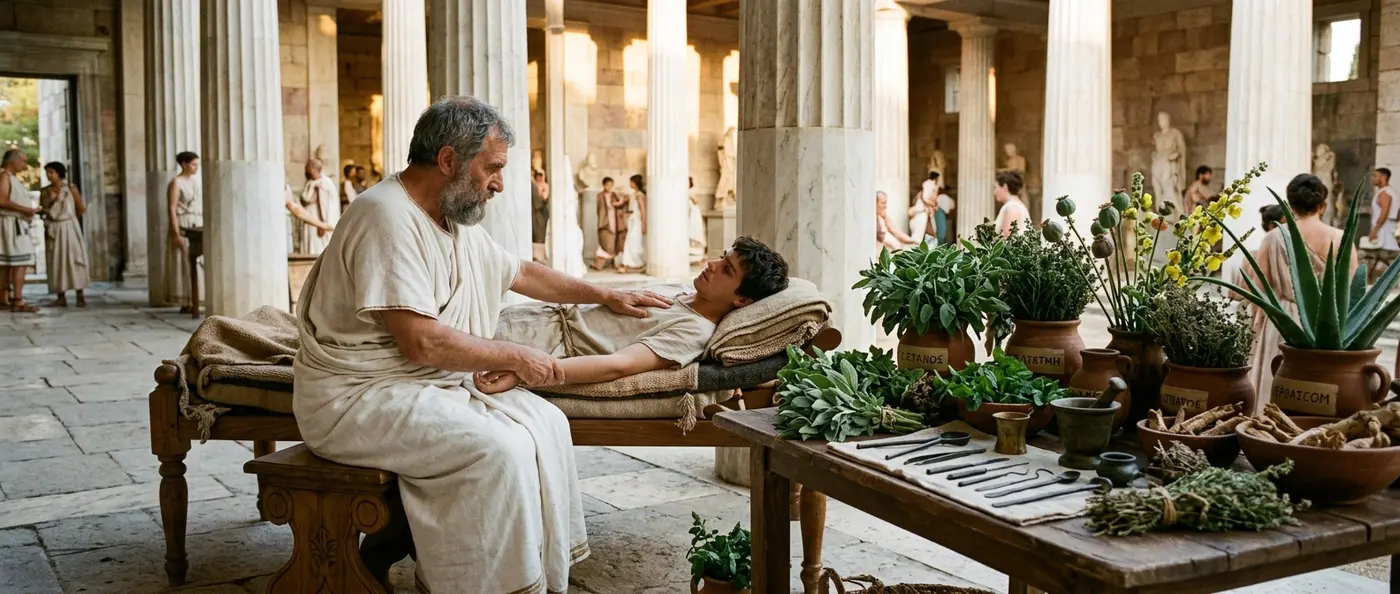
What if I told you ancient Greek doctors figured out the mind-body connection 2,400 years before modern psychosomatic medicine? The texts of Hippocrates and Galen reveal how physicians of their era connected diet, environment, and thought patterns directly to disease. They weren't just treating symptoms. They were mapping the invisible threads between mental state and physical health.
🏛️ When Medicine Broke Free from the Gods
Before Hippocrates, Greek medicine belonged to priests and magicians. Diseases were divine punishment. Treatment meant prayers, sacrifices, and magic spells. Everything changed around 460 BCE when a doctor from the island of Kos decided to hunt for natural causes instead of angry gods.
Hippocrates and his school introduced a radical idea: diseases have physical causes that can be observed and recorded. Instead of searching for divine wrath, they examined the patient's environment, diet, lifestyle. This was the birth of clinical observation.
In the work "Epidemics," written around 400 BCE, an anonymous physician from the Hippocratic school recorded something unprecedented: our thinking habits, combined with lifestyle, clothing, housing, physical exercise, and sexual activity, are the primary determining factors of our health. For the first time in history, mental state was directly linked to physical well-being.
Clinical Observation
Detailed recording of symptoms, disease progression, treatment responses - the foundation of modern diagnosis.
Hippocratic Oath
The first code of medical ethics that defined the morality of medical practice for millennia.
Theory of Humors
Blood, phlegm, yellow and black bile - their balance determined health according to the ancients.
💊 Hippocrates: The Father of Medicine
Hippocrates (460-370 BCE) wasn't just a doctor. He was the man who transformed medicine from art into science. Born on Kos into a family of Asclepion physicians, he learned traditional healing methods from childhood. But he didn't stop there.
The Corpus Hippocraticum, a collection of about 60 medical texts attributed to him and his students, contains observations of stunning accuracy. It describes epilepsy with precision, demystifying it by stating it's not a "sacred disease" but has natural causes in the brain. It recorded symptoms of tuberculosis, pneumonia, malaria.
The holistic approach was the key. Hippocrates saw humans as unified wholes, not as collections of parts. He believed doctors must treat the patient, not just the disease. He examined environment, climate, diet, even the patient's psychological state.
🧠 Ancient Psychosomatic Medicine
Their clinical records from the 4th century BCE document: mental state directly affects physical health. In "Epidemics," they describe the case of Parmeniscus, a patient whose poor mental state led to delirium. He eventually lost his speech and remained bedridden for 14 days before recovering.
Centuries later, Galen recorded the case of a man who had lost money. He developed a fever that tormented him for a long period. In his sleep he scolded himself for the loss, regretted it, and was disturbed until he woke up. While awake, he continued to waste away from grief. He then became delirious and developed brain fever. Finally he fell into delirium that was obvious from what he said, and remained in this state until he died.
Dozens of similar cases are recorded. Ancient doctors had developed an entire treatment system for mental disorders. They recommended lifestyle changes, exercise, different diets, sea voyages, listening to philosophical lectures, games like zatrikio, and mental exercises equivalent to today's crosswords or sudoku.
💡 Did You Know?
The philosopher Kleinias in the 4th century BCE had developed his own anger management method: every time he felt angry, he would go play the lyre to calm down. The first documented music therapy in history.
🔬 Galen: The Giant of Roman Medicine
If Hippocrates laid the foundation, Galen (129-216 CE) built the edifice of ancient medicine. Born in Pergamon in Asia Minor, he studied philosophy and medicine, traveled throughout the Mediterranean to learn from the best doctors of his time, and ended up in Rome as personal physician to the emperors.
Galen was a passionate anatomist. Since human dissection was forbidden, he studied animals - monkeys, pigs, goats. His anatomical descriptions were so detailed they remained the basis of medical education for over 1,300 years. He conducted experiments that proved arteries contain blood, not air as previously believed.
The most innovative element of his work was his understanding of the body-mind relationship. He observed that people often become ill due to poor mental state: "It can happen under certain conditions that 'thought' is one of the causes that bring health or disease, because people who get angry about everything and get confused, worry and fear for the slightest reason often become ill for this reason and have difficulty overcoming these diseases."
⚕️ Therapeutic Methods and Drugs
Their therapeutic arsenal was extensive. Diet was considered the first medicine. Hippocrates said: "Let food be thy medicine and medicine be thy food." They prescribed specific diets for different diseases, from light wines and fruits for mental disorders to strict diets for digestive problems.
Herbal medicines were the foundation of pharmacy. Hellebore was used for paranoia, but doctors knew it was dangerous and could cause toxic spasms. Opium from poppies was used as a painkiller. Willow gave the first aspirin-like drug. Each plant had its properties, and doctors knew them well.
But perhaps the most advanced aspect of ancient Greek medicine was its emphasis on prevention. Doctors advised patients on lifestyle, exercise, diet. The Asclepia, healing centers dedicated to Asclepius the god of medicine, were built in locations with clean air and water, surrounded by gardens. Patients followed a program that included baths, exercise, diet, even theatrical performances for their mental health.
📜 The Legacy in Modern Medicine
Many achievements of ancient Greek medicine survive today. The Hippocratic Oath, though modified, remains the foundation of medical ethics. Clinical observation, taking patient history, examining the patient - all started with Hippocrates.
The idea of holistic medicine, which sees humans as wholes rather than collections of organs, is returning powerfully to modern medicine. Psychosomatic medicine, which recognizes the mind-body relationship, confirms what the ancient Greeks knew for millennia.
Even specific medical practices have their roots in antiquity. Trepanation for relieving intracranial pressure, surgical cataract removal, orthopedics with splints and bandages - all are described in ancient texts. Galen even performed experimental neurosurgery on animals, proving that the brain controls body movements.
⚕️ Ancient vs Modern Medicine
🌟 Lessons for the Modern World
Perhaps the most important lesson from ancient Greek medicine is its emphasis on prevention and healthy lifestyle. In an era where modern medicine often focuses on treatment rather than prevention, the ancients remind us that the best treatment is not getting sick at all.
Recognition of the mind-body relationship is also extremely relevant. In a world where stress and depression affect millions of people, ancient wisdom connecting mental and physical health takes on new meaning. Ancient doctors didn't have antidepressants, but they had a deep understanding of how lifestyle, diet, exercise, and mental state interact.
Finally, the ethical dimension of medicine, as expressed in the Hippocratic Oath, remains fundamental. The idea that doctors must first do no harm, that they must respect patient dignity, that medicine is both art and science - all these are the legacy of ancient Greek physicians.
In today's era of gene therapy and artificial intelligence, Hippocrates' words remain relevant: "Life is short, art is long, opportunity fleeting, experiment dangerous, judgment difficult." Words that after 2,400 years still echo in hospitals and clinics around the world.