📖 Read more: Ancient Greek Education: Schools and Gymnasiums
🎵 Music at the Heart of Civilization
For the ancient Greeks, music wasn't simply entertainment. It was a fundamental element of education, religion, and social life. Plato and Aristotle devoted entire chapters to studying music's influence on the soul and character. They believed that specific musical modes could shape young people's personalities.
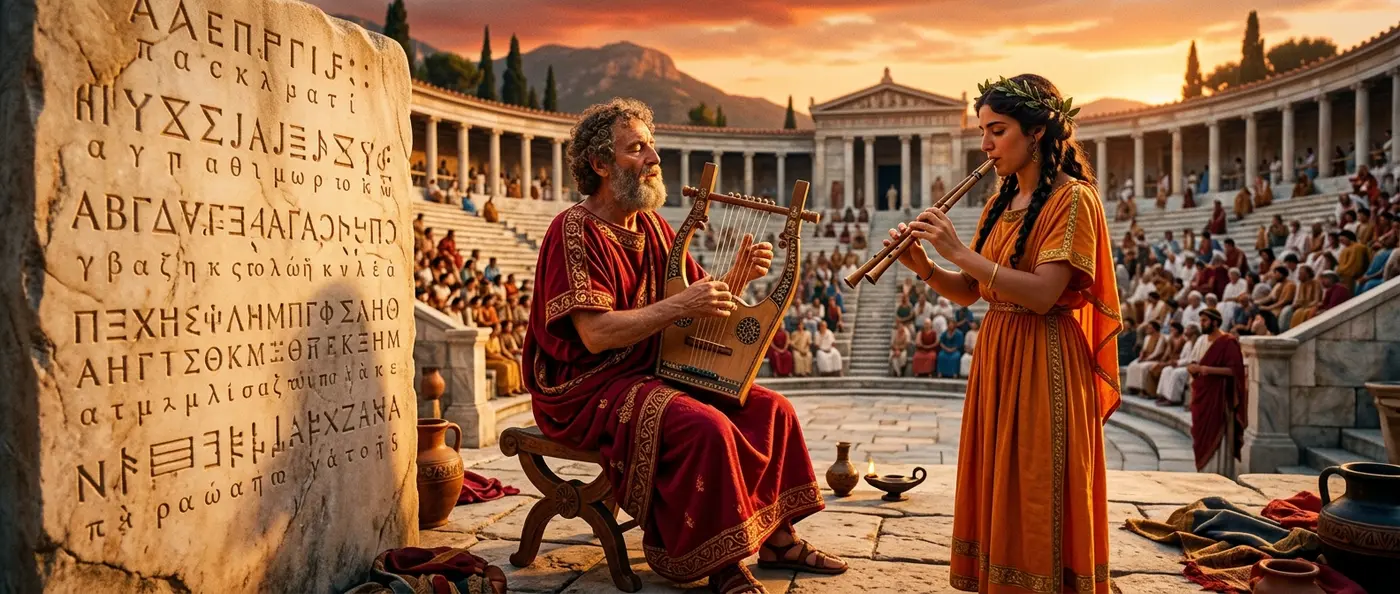
Music accompanied every aspect of life. From birth to death, from weddings to religious ceremonies, from symposiums to military campaigns. Flutes echoed in gymnasiums where athletes trained. Lyres accompanied rhapsodes reciting Homer's epics. Kitharas played in sanctuaries where priests performed sacrifices.
The Greeks treated music as a science. The Pythagoreans discovered the mathematical relationships of musical intervals, laying the foundations for acoustics. They believed that the harmony of the spheres — the music produced by planets in their motion — governed the entire universe.
Musical Instruments
Lyre, kithara, aulos, trumpet, castanets — the instruments that defined ancient Greece's sound
Theatrical Music
Choruses, monodies, and musical interludes that brought tragedies and comedies to life
Musical Notation
Europe's earliest musical writing system with symbols for pitches and rhythms
🏛️ Musical Modes and Theory
The ancient Greeks developed a complex system of musical modes, each with its own "personality" and emotional coloring. The Dorian mode was considered serious and masculine, suitable for war songs. The Phrygian was passionate and ecstatic, ideal for Dionysiac worship. The Lydian was soft and effeminate, preferred at symposiums.
This theory of modes shaped Western music for centuries. Medieval ecclesiastical modes were based on ancient Greek ones, though with significant misinterpretations. Even today, terms like "Dorian" and "Phrygian" are used in music theory, albeit with different meanings than in antiquity.
🎭 Music and Drama: Inseparable Companions
In ancient Greek theater, music wasn't optional — it was an integral part of the performance. The chorus, consisting of 12 or 15 members, sang and danced between episodes. Actors delivered parts of their roles with musical accompaniment. Even dialogues had a melodic quality.
The choral stasima weren't mere pauses in the action. They were moments of profound emotional intensity where music and poetry combined to comment on events, express characters' fears and hopes, and connect myth with the audience's present. Unfortunately, almost none of this music survives.
The few musical notations found on papyri and inscriptions give us only a faint idea. The Epitaph of Seikilos, carved on a tombstone from the 1st century CE, is the oldest complete musical piece that survives. Just six lines speaking of life's transience.
🔬 The Search for Lost Sounds
Contemporary researchers attempt to reconstruct the sounds of ancient Greek music. Using the few surviving fragments, descriptions by ancient writers, and reproductions of ancient instruments, they try to bring this lost art back to life.
The problem is enormous. Even if we have the notes, we don't know exactly how the instruments sounded, what the rhythm was, how musicians interpreted them. It's like trying to reconstruct a language having only the alphabet.
Nevertheless, each new discovery brings more light. Papyri from Egypt with musical notations, inscriptions with hymns, vases with depictions of musicians. Each piece of the puzzle brings us closer to understanding this lost art that once filled the temples, theaters, and agoras of ancient Greece with sound.
📖 Read more: Ancient Gymnasiums: The Birthplace of Athletic Culture
🎼 The Paradox of Silence
From a civilization that considered music so important as to include it in every free citizen's education, very few musical texts survive. Most papyri and parchments were destroyed by time, humidity, and fires. What survives is barely a whisper of what once was.
🏺 The Instruments That Fell Silent
The lyre, Apollo's emblematic instrument, was the most widespread stringed instrument. With seven strings stretched across a frame of tortoise shell or wood, it accompanied poetry recitation and songs at symposiums. The kithara, larger and more complex, was the instrument of professional musicians.
The aulos, a type of double oboe, was Dionysus's instrument. With its penetrating, almost ecstatic sound, it accompanied Dionysiac ceremonies and dances. It was considered more "dangerous" than stringed instruments, capable of inducing ecstasy and loss of self-control.
There were other instruments: the trumpet for military signals, castanets and drums for rhythmic accompaniment, Pan's syrinx for shepherds. Each had its place in social and religious life.
📜 The Theorists and Philosophers
Pythagoras wasn't just a mathematician. He was the first to discover music's mathematical foundation. He observed that when two strings have lengths in simple ratios (2:1, 3:2, 4:3), they produce harmonious sounds. This discovery laid the foundations for acoustic science.
Aristoxenus, Aristotle's student, wrote the first systematic treatise on music theory that survives. His "Harmonic Elements" describes in detail the musical modes, intervals, and scales. Without this work, our understanding of ancient Greek music would be even more limited.
Plato in his "Republic" devotes entire chapters to musical education. He believed that proper music could shape virtuous citizens, while bad music corrupts the soul. He banned certain modes and rhythms from his ideal state.
🎵 Ancient vs Modern Music Theory
🌅 The Legacy That Survives
The melodies vanished, but Greek musical ideas endure. The idea that music has moral power, that it can influence character and behavior, survived in Christian and Islamic thought. The mathematical approach to music laid the foundations for acoustic science.
In modern Greece, composers like Iannis Xenakis return to ancient sources for inspiration. Using mathematical principles that Pythagoras would recognize, they create music that bridges the ancient with the contemporary.
We may never hear Greek music as the ancients did. Yet the search itself reveals something essential: every civilization creates its own sounds, its own way of marking joy and sorrow. The instruments break, the notation fades, but the human impulse to make music survives.