🏺 Art That Speaks Across Millennia
Ancient Greek pottery gives us our clearest glimpse into ancient Greek life. Beyond their practical value as everyday vessels, these pots functioned as canvases where ancient craftsmen captured mythology, history, religious beliefs, and daily life of their era.
From the 11th century BC to the 1st century BC, Greek pottery evolved continuously, passing through various phases and artistic styles. Each period had its own characteristics, techniques, and aesthetic sensibilities. The vase painters weren't mere craftsmen — they were artists whose work shaped the visual culture of the ancient world.
These vessels became accidental time capsules. Unlike most organic materials that decompose over time, fired clay is virtually indestructible. Thus, thousands of vessels have survived to this day, offering a unique window into the past.
🎨 The Great Techniques and Their Evolution
Greek pottery changed as dramatically as Greek society itself. From the earliest geometric patterns to the realistic depictions of the Hellenistic period, each style tells its own story.
The Protogeometric period (1050-900 BC) marks the beginning. After the collapse of Mycenaean civilization, pottery became simplified. Craftsmen used simple geometric shapes — circles, semicircles, triangles. It was as if they were starting from scratch, building a new tradition upon the ruins of the old.
The Geometric period (900-700 BC) brought an explosion of creativity. Vessels were covered with complex geometric patterns — meanders, diamonds, crosses. Gradually, the first human figures appeared, stylized but full of vitality. Scenes of war, funerals, and dancing were depicted in a unique, almost abstract manner.
Geometric Art
Characterized by strict geometric patterns, meanders, and stylized human figures. The large funerary vessels from the Dipylon cemetery represent masterful examples.
Orientalizing Period
Eastern influences introduced mythical creatures, sphinxes, griffins, and floral motifs. Corinth became a production center with distinctive Proto-Corinthian pottery.
Black-Figure Technique
Figures painted with black slip over red clay. Details incised with sharp tools, creating sharp detail that brought stories to life.
⚫ The Black Revolution: Black-Figure Technique
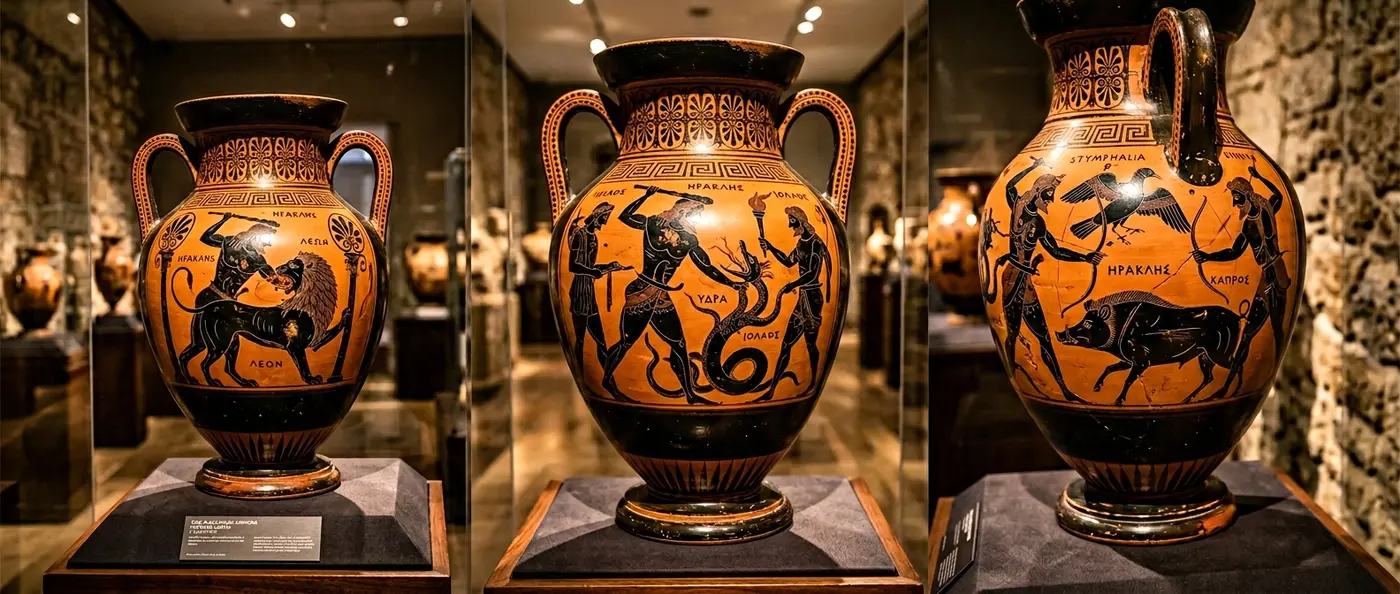
Around 700 BC, a new technique began to dominate — the black-figure style. Craftsmen painted figures with black slip over the natural red clay of the vessel. Then, using a sharp tool, they incised details within the black figures, revealing the red clay beneath.
This technique let artists render fine details impossible before. Muscles, clothing folds, facial expressions — everything could now be rendered with precision. Athens became the center of this art, with vase painters like Exekias creating masterpieces that rival the finest paintings.
The subjects were varied. Mythological scenes dominated — Heracles and his labors, the Trojan siege, Odysseus's adventures. But there were also scenes from daily life: symposia, athletic competitions, weddings. Each vessel was a small theater where dramas and comedies unfolded.
🔴 The Red Revolution: Red-Figure Technique
Around 530 BC, a radical change occurred. Athenian vase painters reversed the process: instead of painting figures with black, they left the natural red clay showing for the figures and covered the background with black slip. The red-figure technique was born.
This switch transformed Greek art. Artists could now paint with a brush instead of incising, allowing much greater freedom and detail. Lines became more fluid, expressions more vivid, anatomy more realistic.
Great masters like Euphronios and Euthymides competed with each other to create the most impressive compositions. There's even a vessel where Euthymides wrote "as never Euphronios" — a challenge to his rival!
💡 The Secret of Triple Firing
The characteristic black slip of Greek vessels was created through a complex triple-firing process. Potters alternated oxidizing and reducing conditions in the kiln, creating the glossy black finish that remains unchanged today. The exact recipe was lost for centuries and only rediscovered in the 20th century!
🏛️ Shapes with Purpose: Form Follows Function
Every vessel shape had a specific purpose, and the ancient Greeks had developed an impressive number of specialized types. The form of each vessel was perfectly adapted to its use, combining functionality with aesthetics.
The amphora, perhaps the most iconic Greek vessel, was used for transporting and storing liquids — mainly wine and oil. Its two handles allowed easy transport, while its pointed bottom could be stuck in sand or placed in a special stand. Thousands of amphorae have been found in shipwrecks throughout the Mediterranean, testimony to the extensive trade of the era.
The krater was the vessel of the symposium. In this, they mixed wine with water — the ancient Greeks considered it barbaric to drink undiluted wine. The large opening allowed easy mixing, while its decorations often depicted symposium scenes, creating a visual dialogue with its use.
🏺 Vessel Types and Uses
📜 The Stories They Tell
The vessels weren't merely decorative objects. They were narrative carriers, visual books that transmitted myths, values, and ideas. Vase painters carefully chose which moments from each story to depict, often focusing on the most dramatic or symbolic scenes.
The Trojan cycle was particularly popular. We see Achilles and Ajax playing dice, a moment of calm before battle. Penthesilea falling to Achilles' spear, their eyes meeting in a tragic moment of recognition. Odysseus tied to the mast as his ship passes the Sirens.
But it wasn't only mythology. Scenes from daily life give us valuable information about how the ancient Greeks lived. We see women weaving, men exercising in the gymnasium, children playing, musicians entertaining symposiasts. Each scene captures a moment from daily Greek life.
Particularly moving are the farewell scenes on funerary vessels. Warriors leaving for battle, families mourning their dead. Art becomes a means of expressing pain and loss, emotions we still recognize today.
🔬 Workshop Techniques and Secrets
Creating a vessel was a complex process requiring specialized knowledge and skills. From selecting the clay to the final firing, every step was crucial for the final result.
Clay was carefully chosen. Attic clay, rich in iron oxide, gave the characteristic orange-red color that made Athenian vessels so recognizable. After cleaning and kneading, the clay was shaped on the wheel — a technique the Greeks had perfected.
Painting was done when the vessel was still "leather-hard" — dry enough not to deform, but wet enough to absorb the slip. Vase painters used brushes made from animal hair, with the finest having just one hair for the most delicate lines.
The black slip wasn't simply paint. It was a refined clay mixture that, through the triple-firing process, transformed into a glossy, almost metallic surface. The process involved three phases: first oxidizing firing that made the entire vessel red, then reducing firing that made it black, and finally oxidizing again that restored the red color only in areas without slip.
Triple Firing
The secret technique that created the characteristic black slip through alternating oxidizing and reducing conditions in the kiln.
Precision Tools
Brushes made from a single hair for fine lines, sharp tools for incision, and circular instruments for perfect circles.
Artist Signatures
Many vase painters signed their works with phrases like "epoiesen" (made) or "egrapsen" (painted), showing pride in their work.
🌍 Exports and Influence Throughout the Mediterranean
Greek pottery didn't remain within the borders of the Greek world. From the 8th century BC onward, Greek vessels traveled throughout the Mediterranean and beyond, reaching from the Iberian Peninsula to the Black Sea.
Etruria (modern Tuscany) was one of the largest importers. Etruscan aristocrats adored Attic vessels, which they used at symposia and buried with their dead as status symbols. Over 80% of surviving Attic vessels have been found in Etruscan tombs!
But the influence wasn't one-way. Greek colonies in Southern Italy and Sicily developed their own ceramic traditions, combining Greek techniques with local elements. The so-called "Magna Graecia" became a center of exceptional pottery production, with workshops in Apulia, Lucania, and Paestum producing vessels that rivaled those of metropolitan Greece in quality.
The spread of Greek pottery wasn't merely commercial. Along with the vessels traveled ideas, myths, aesthetic values. The images on the vessels became ambassadors of Greek culture, teaching Greek mythology and way of life to peoples who might never have had contact with Greeks.
🔍 Modern Discovery and Study
The systematic study of ancient Greek pottery began in the 18th century, when the first collections started forming in European museums. Initially, the vessels were considered "Etruscan," since most came from Italian excavations. Only later was their Greek origin recognized.
Today, pottery study has become highly specialized. Archaeologists can recognize the hand of specific artists, even when they haven't signed their work. Sir John Beazley, the pioneer of this method, managed to attribute thousands of vessels to specific painters and workshops, creating a kind of "who's who" of ancient vase painting.
Modern technologies have opened new horizons. Spectroscopy allows analysis of clay composition, helping locate vessel origins. Digital imaging reveals details invisible to the naked eye. 3D scanning enables creation of precise copies for study and education.
🔬 DNA of Ancient Art
Recent research has identified traces of organic materials in ancient vessels — residues of wine, oil, even perfumes. These analyses give us information not only about vessel contents, but also about dietary habits, trade, and religious practices of the ancient Greeks.
💫 The Continuing Legacy
The influence of ancient Greek pottery extends far beyond museums. From the Renaissance to today, artists and designers have drawn inspiration from the forms and patterns of ancient vessels.
In the 18th and 19th centuries, the neoclassical fashion brought copies of Greek vessels to every aristocratic salon. The Wedgwood company created entire series inspired by red-figure and black-figure techniques. Even today, the amphora shape remains classic in industrial design.
The lasting impact goes beyond decoration. The vessels taught us the value of storytelling through images, the importance of detail, the balance between use and beauty. They remind us that even the most everyday objects can become carriers of art and meaning.
Walk through any museum and watch visitors pause before a painted amphora. Achilles still grips his spear, symposiasts still raise their cups, and children still play their ancient games. The clay endures, and so do the stories.