In 5th century BCE Athens, thousands of citizens gathered on the slopes of the Acropolis to witness something that had never existed anywhere in the world. Masked actors embodied gods and heroes, bringing to life stories that made audiences weep, tremble with fear, and question humanity's place in the universe. Here, theater was born.
📖 Read more: Daily Life in Ancient Athens: Democracy and Culture
🎭 From Dionysiac Festivals to Dramatic Art
Ancient Greek theater didn't begin as entertainment. It emerged from religious ceremonies honoring Dionysus, the god of wine and ecstasy. Every spring, Athenians celebrated the Great Dionysia with songs, dances, and dithyrambs — choral hymns that narrated mythical stories.
Religious ritual slowly gave way to theater. Dithyrambs evolved into dialogues between the chorus and a "hypokrites" — the first actor. This innovation is attributed to Thespis, who around 534 BCE introduced the first independent character who conversed with the chorus. His name gave us the English term "thespian" for actors.
The Dionysia wasn't merely a religious festival. It transformed into a cultural event lasting five days, featuring competitions in tragedy and comedy. Wealthy citizens, the "choregoi," funded performances as a form of civic duty and prestige. The state selected poets who would compete, and each poet presented three tragedies and one satiric drama.
🏛️ Theater Architecture
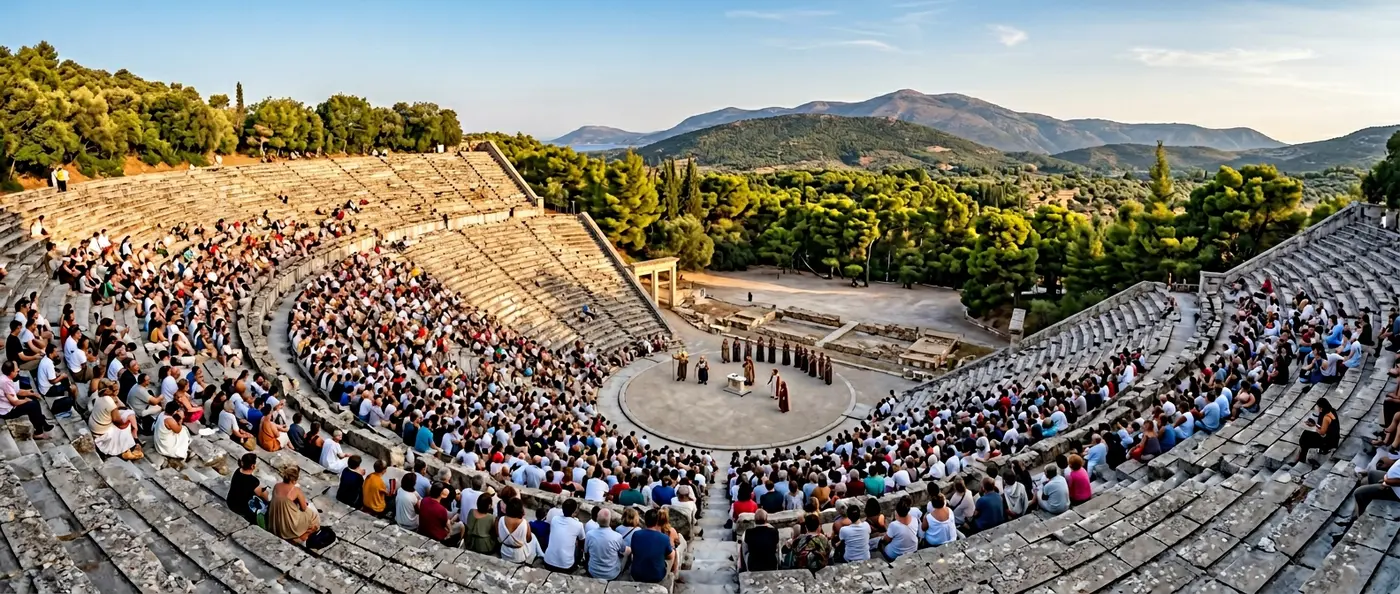
The Theater of Dionysus in Athens, built on the southern slope of the Acropolis, became the model for all ancient theaters. Builders carved the natural slope into the koilon — the seating area where spectators sat. The acoustics were so perfect that even in the last row, you could hear an actor's whisper on stage.
At the center was the orchestra, a circular space about 20 meters in diameter where the chorus danced and sang. Behind the orchestra stood the skene — initially a simple wooden structure serving as dressing rooms and scenic backdrop. The skene grew into a stone building whose facade could represent a palace or temple.
Each spectator's position in the theater reflected their social status. Priests and magistrates sat in the front row on marble thrones. Citizens occupied the middle sections, while women and foreigners sat in the most distant seats. Admission cost two obols, but the state provided the "theorikon" — a subsidy for poor citizens to attend performances.
⚔️ The Great Tragic Poets
Three names dominate the history of ancient tragedy: Aeschylus, Sophocles, and Euripides. Aeschylus (525-456 BCE) is considered the father of tragedy. He introduced the second actor, enabling true dialogue and character conflict. Of his 90 plays, only seven survive, including the trilogy "Oresteia" — the only complete trilogy we possess.
Sophocles (496-406 BCE) perfected the form of tragedy. He added the third actor, increased chorus members from 12 to 15, and introduced scenography. He wrote 123 plays and won 24 victories in dramatic competitions — more than any other poet. "Oedipus Rex" remains his masterpiece, a work Aristotle considered the perfect example of tragedy.
Euripides (480-406 BCE) was the most controversial. His works focused on character psychology and challenged traditional values. He portrayed gods as weak or vindictive and heroes as humans with passions and weaknesses. "Medea" shocked audiences with its depiction of a woman who kills her children for revenge.
Aeschylus
The "father of tragedy" who introduced the second actor and grand spectacle. His works explored divine justice and human hubris.
📖 Read more: Kerameikos Cemetery: Ancient Athens' Sacred Burial Ground
Sophocles
The master of dramatic irony who perfected tragedy's structure. His heroes struggle against fate and moral order.
Euripides
The "philosopher of the stage" who brought psychological realism to theater. He challenged gods and traditions with bold themes.
🎨 Masks, Costumes, and Stage Presence
Ancient theater actors were exclusively men, even for female roles. They wore elaborate masks made from linen, wood, or leather that covered the entire head. Each mask had exaggerated features showing the character's age, gender, and emotional state. The mouth was open and functioned as a megaphone, amplifying the actor's voice.
Costumes were equally impressive. Tragic actors wore the chiton — a long garment with rich decoration — and the himation, a cloak that fell elegantly. To appear more imposing, they wore cothurni — shoes with high platforms that added height. Kings had purple garments, heroes wore armor, while elderly characters carried staffs.
Acting technique relied more on voice and gestures than facial expressions. Actors trained for years to achieve perfect articulation, powerful voice, and rhythmic movement. They had to convey emotions to thousands of spectators using only body posture and vocal tone.
💡 Did You Know?
Ancient Greeks used mechanical effects in their performances. The "mechane" was a crane that lowered gods from heaven (deus ex machina), while the "ekkyklema" was a wheeled platform that revealed scenes happening inside the palace.
📜 Structure and Rules of Tragedy
Ancient tragedy followed a strict structure that Aristotle analyzed in his "Poetics." It began with the prologue, where the situation and characters were presented. This was followed by the parodos — the chorus's entrance with song and dance. The main work was divided into episodes (dialogue scenes) and stasima (choral songs that commented on the action).
The three unities — time, place, and action — were fundamental. The plot had to unfold in one day, in one place, with one central storyline. These constraints forced poets to condense action and focus on critical moments of the story.
Central elements of every tragedy were hubris (arrogance leading to downfall), peripeteia (sudden reversal of fortune), anagnorisis (the moment the hero realizes the truth), and catharsis (purification of the audience's emotions through fear and pity). Together, these elements transformed audiences spiritually and emotionally.
📖 Read more: 1,000-Year-Old Viking Chess King Discovered
🌍 Impact on Western Civilization
Ancient Greek theater didn't die with Athens' decline. Romans adopted and adapted Greek tragedies, translating them into Latin. During the Renaissance, the discovery of ancient texts led to an explosion of interest. Shakespeare, Racine, and other great playwrights studied the ancient Greeks and incorporated their techniques.
Today, ancient tragedies are performed in theaters worldwide. The Epidaurus Festival in Greece attracts thousands of spectators each summer who come to see the works in their natural environment. Contemporary directors interpret classical texts in new ways, proving their timelessness.
The influence extends beyond theater. Cinema, television, even video games use dramatic structures invented by the ancient Greeks. Terms like "tragic hero," "dramatic irony," and "catharsis" are fundamental to modern narratology. The idea that theater can be a mirror of society and a means of social commentary was born in ancient Athens.
🎭 Ancient vs Modern Theater
🔬 Modern Archaeological Discoveries
Excavations continue to reveal new elements about ancient theater. At the Theater of Dionysus, archaeologists recently discovered fragments from ancient masks and pieces from the original wooden seats. At Epidaurus, geophysical surveys revealed underground passages used for special effects.
Technology helps understand the acoustics of ancient theaters. Acoustic studies showed that Epidaurus has perfect acoustics not by chance but by design. Ancient architects had mastered acoustic principles down to the smallest detail. The theater's shape, seating slope, even construction materials contributed to creating perfect acoustics.
DNA analysis of organic remains from ancient masks revealed the use of glues from animal proteins and plant resins. Microscopic analysis of costume fabrics showed the use of complex dyeing techniques with natural pigments from shells and plants. The findings reveal just how skilled ancient craftsmen were.
🏛️ The Living Legacy
Ancient Greek theater lives on, still teaching and inspiring. Every time a modern spectator is moved by a tragic story, every time a writer structures a plot with beginning, middle, and end, every time theater becomes a space for social dialogue, the legacy of ancient Athens comes alive.
The ancient Greeks gave us more than plays and buildings. They gave us the idea that theater is a sacred space where humanity examines itself, where the great questions of existence take flesh and bone. In a rapidly changing world, this legacy remains more relevant than ever.
From the slopes of the Acropolis to modern stages worldwide, theater's journey continues. And every performance, every emotion, every moment of catharsis reminds us that some Greeks, 2,500 years ago, discovered something fundamental about human nature: our need to tell and share stories that make us more human.