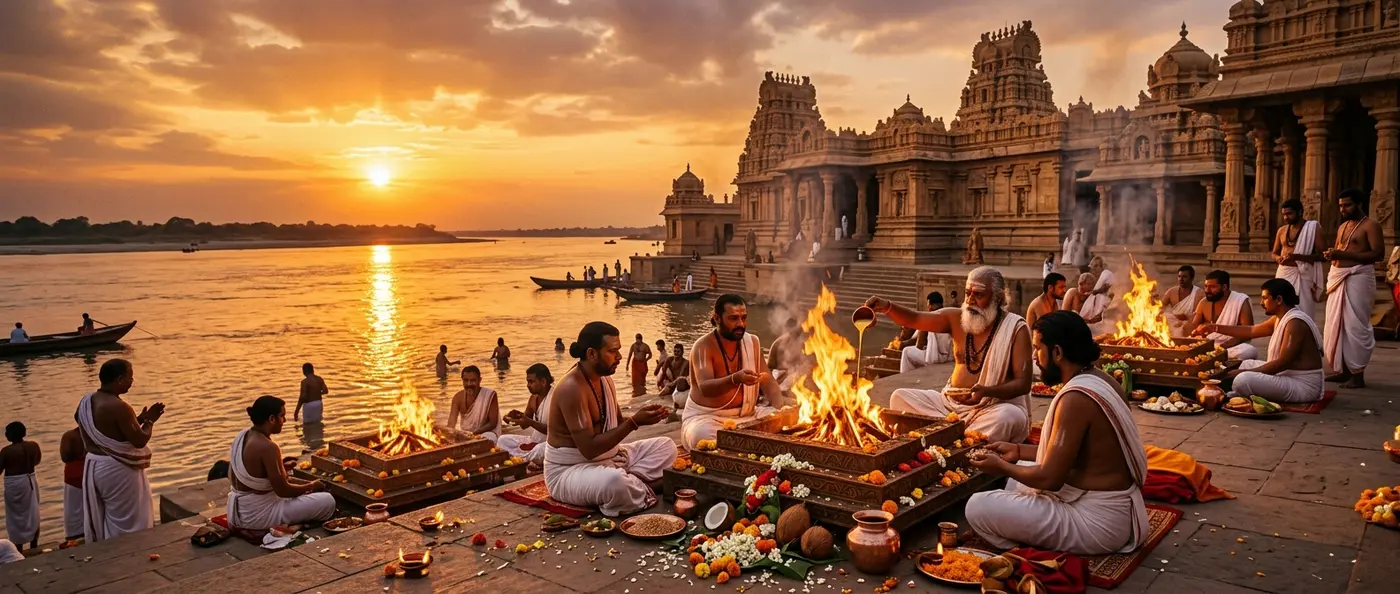
A reference to a solar eclipse in the ancient Hindu hymns of the Rig Veda dates back 6,000 years, making it the oldest known eclipse record in human history. This discovery reveals the complexity of ancient Indian society, where astronomy, religion, and social organization intertwined in a system that influenced billions of people for millennia.
📜 The Vedas: Humanity's Oldest Literary Work
The Vedas constitute a collection of sacred texts composed around 1500 BCE, though they contain references to events dating thousands of years earlier. The Rig Veda, the oldest of the four Vedic texts, includes hymns and verses from various religious and philosophical schools.
Astronomers from the Tata Institute of Fundamental Research in Mumbai and Japan's National Astronomical Observatory discovered that certain poetic passages describe the sun as "pierced" by darkness and sorrow, with references to evil beings that caused the disappearance of the sun's "magical arts." These descriptions don't reference the later mythology of Rahu and Ketu, indicating they were recorded before these stories were created.
Researchers managed to date the eclipse based on astronomical references in the text. The eclipse occurred when the vernal equinox was in the constellation of Orion, three days before an autumnal equinox. Only two dates match these criteria: October 22, 4202 BCE and October 19, 3811 BCE.
🏛️ The Structure of Ancient Indian Society
Ancient Indian society built itself around dharma—duties and obligations that defined each person's place in the world. Beyond social organization, this cosmic order reflected what they saw as the universe's own structure.
The caste system, as we know it today, evolved gradually from the original Vedic divisions. In early Vedic texts, society was divided into four main groups or varnas, each with specific roles and purposes. This division wasn't initially rigid—there was mobility between groups, and one's position was determined more by abilities and achievements than by birth.
Over the centuries, the system became more complex and rigid. The four varnas subdivided into hundreds of jatis or sub-castes, each with its own rules, traditions, and occupations. This evolution reflected the increasing complexity of Indian society as it developed from small agricultural communities into large urban centers.
⚖️ Dharma: The Cosmic Law
Dharma is perhaps the most fundamental concept in ancient Indian thought. There's no exact translation in Western languages—it encompasses concepts like duty, righteousness, moral order, and cosmic law. For ancient Indians, dharma wasn't simply a set of rules, but the very structure that held the universe together.
Each individual had their own svadharma—their personal dharma determined by caste, age, gender, and life stage. A warrior had different dharma from a priest, a young person from an elder, a householder from an ascetic. Fulfilling one's personal dharma was considered the path to spiritual progress and ultimate liberation.
Dharma shaped everything from daily choices to life's biggest decisions. Yet ancient texts overflow with stories where dharma clashed with other values, forcing impossible choices between competing duties.
Cosmic Order
Dharma was considered the law that maintains universal balance, from planetary motion to human relationships.
Personal Duty
Each individual had unique obligations based on their position in society and life stage.
Cycle of Births
Following dharma affected karma and determined future births in the endless cycle of reincarnation.
🎭 The Four Varnas: The Original Social Division
The original system of four varnas is described in the Rig Veda through the myth of Purusha—the cosmic man from whom the world was created. According to this myth, the Brahmins (priests) emerged from Purusha's mouth, the Kshatriyas (warriors) from his arms, the Vaishyas (merchants and farmers) from his thighs, and the Shudras (laborers) from his feet.
This myth did more than explain creation—it justified society's structure. Each varna was considered essential for the social body's functioning, just as each part of the human body is necessary for life. Brahmins maintained spiritual knowledge, Kshatriyas protected society, Vaishyas provided economic prosperity, and Shudras supported everyone else with their labor.
In early Vedic texts, this division appears to have been more functional than hereditary. There are references to individuals who changed varna based on their abilities and achievements. Only later, particularly with the composition of the Laws of Manu around the 2nd century BCE, did the system become rigidly hereditary.
🏛️ The Four Varnas
🌅 Daily Life in Ancient India
Life in ancient India was deeply influenced by the caste system and the concept of dharma, but it wasn't one-dimensional. Great cities like Pataliputra and Taxila were centers of trade, learning, and culture, where people from different castes interacted daily.
Markets bustled with products from across India and beyond—spices from the south, silk from China, precious stones from Sri Lanka. Artisans created intricate jewelry, textiles, and sculptures. Universities like Nalanda attracted students from across Asia.
Despite social restrictions, there were avenues for social mobility. Merchants could accumulate wealth and influence. Scholars from lower castes could gain respect through learning. Ascetics and mystics, regardless of their origin, were honored for their spiritual quest.
📚 The Legacy of Ancient Indian Civilization
The impact of ancient Indian civilization extends far beyond India's borders. The philosophical concepts of dharma and karma influenced thought throughout Asia. The decimal number system and the concept of zero, developed in ancient India, became the foundation of modern mathematics.
Ancient Indian medicine, known as Ayurveda, developed sophisticated theories about health and disease. Ancient Indian surgeons performed complex operations, including cataract surgery and plastic surgery. Yoga and meditative practices, developed as part of the spiritual tradition, have become global phenomena.
However, the legacy is complex. The caste system, which evolved into a rigid hierarchy, created deep social inequalities that persist today. Modern India struggles to balance respect for its ancient heritage with the need for social justice and equality.
💡 Did You Know?
The ancient Indian board game Chaturanga, played from the 6th century CE, is the ancestor of modern chess. The game reflected the military structure of the time with four units: infantry, cavalry, elephants, and chariots.
🔬 Modern Discoveries and New Interpretations
Modern archaeologists and historians continue to discover new aspects of ancient Indian civilization. The discovery of the eclipse reference in the Rig Veda shows that ancient Indians had advanced astronomical knowledge much earlier than previously believed.
New excavations at sites like Rakhigarhi reveal that the Indus Valley civilization, which preceded the Vedic period, was much more extensive and sophisticated than we knew. Genetic analysis of ancient skeletons provides new information about population migrations and interactions.
These findings reveal ancient India as part of a vast network of cultures linked by trade routes, migrations, and shared ideas—not the isolated civilization once imagined.