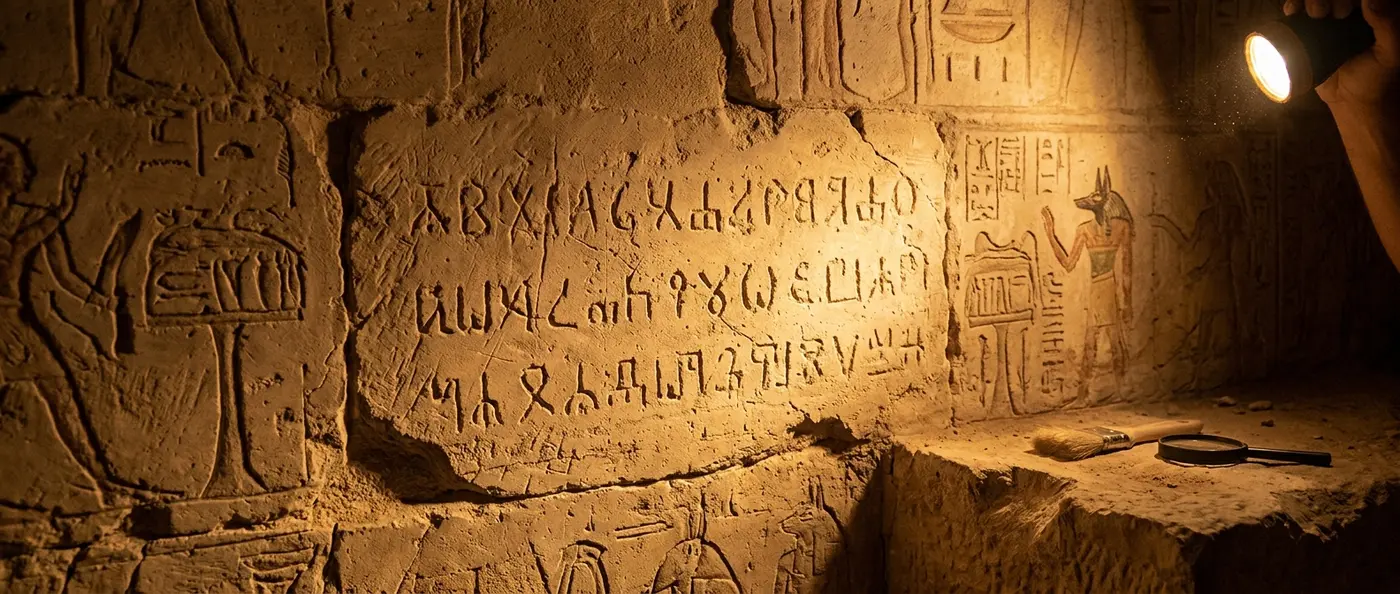
A tourist from India carved his name into a pharaoh's tomb 2,000 years ago. Archaeologists studying inscriptions in Egypt's Valley of the Kings stumbled across something they didn't expect: ancient graffiti left by a traveler who journeyed 5,000 miles from the subcontinent to see the pyramids and royal burial chambers. The discovery rewrites what we know about ancient tourism and cultural exchange.
🗿 The Find That Stunned Archaeologists
Buried among hieroglyphics and sacred artwork, researchers found something decidedly unofficial. Ancient "tourist graffiti" dating to the 1st century AD scattered across tomb walls. One inscription stands out: a visitor from India left his mark, proving that Egypt's most famous burial ground attracted travelers from the farthest corners of the known world.
The team initially dismissed these markings as routine ancient inscriptions. Closer examination revealed the truth. These weren't religious texts or official records. They were signatures. Ancient visitors wanted to leave proof they'd been there, just like tourists today — except instead of Instagram posts, they carved their names in stone.
🌍 Ancient Trade Routes and Early Tourism
Indians didn't just stumble into Egypt by accident. During Roman rule, trade routes between India and the Mediterranean buzzed with activity. Merchants, diplomats, and adventurers regularly traveled between the regions, carrying spices, gems, silk — and apparently, wanderlust.
The Valley of the Kings had already become a tourist destination during Ptolemaic times. Ancient Greeks and Romans visited the tombs to marvel at monuments from Egypt's golden age, exactly like modern tourists do. But the Indian graffiti proves the Valley's fame spread much further than anyone imagined.
Greek sailors had cracked the code of monsoon winds in the Indian Ocean by the 1st century BC. This discovery slashed travel times and made India-Egypt journeys safer and more predictable. Trade boomed. Cultural exchange followed. Buddhist monks, Indian merchants, and curious travelers started showing up in Egyptian ports with increasing frequency.
📜 What Ancient Tourists Actually Wrote
Ancient visitor inscriptions range from simple name-drops to elaborate poetry. Some just record "I was here" with a name and hometown. Others include short reviews or even verses. The Indian inscription appears to include the traveler's name and a reference to his homeland, written in characters that clearly indicate subcontinental origins.
This wasn't unique to Egypt. Similar tourist graffiti has turned up at archaeological sites across the Mediterranean — from Pompeii to Ephesus. But inscriptions from visitors as far away as India are rare. They show just how far ancient wanderlust could take people when they had the means and motivation to travel.
Types of Inscriptions
From simple signatures to complete poems, ancient visitors left varied messages on monument walls, creating an early form of travel blogging.
Languages and Scripts
Greek, Latin, Demotic Egyptian, and now Indian characters reveal the multicultural nature of ancient tourism in Egypt.
Visitor Origins
From Rome and Athens to Alexandria and now India, the Valley attracted visitors from across the known world.
⚓ The India-Egypt Connection in Antiquity
Trade and cultural ties between India and Egypt run deep. Ptolemaic ships regularly reached Indian shores, while Indian spices, precious stones, and textiles flooded Alexandria's markets. The relationship was ancient, lucrative, and surprisingly sophisticated.
The discovery of monsoon patterns transformed this trade. What once took months of dangerous coastal sailing could now be accomplished in weeks with favorable winds. This didn't just boost commerce — it enabled cultural exchange on an unprecedented scale. Buddhist monks, Indian traders, and curious travelers could now reach Egypt more easily than ever before.
Ancient writers confirm Indian communities existed in Alexandria. Archaeological evidence — coins, pottery, religious artifacts — proves extensive contact between the civilizations. The Valley graffiti adds a personal dimension to this story. Real people made these journeys. They had names, hometowns, and apparently, a desire to leave their mark on history.
💡 Did You Know?
The Sanskrit word for Egypt is "Mishra" or "Misr," meaning "mixed land," suggesting ancient Indians recognized Egypt's multicultural nature long before modern historians did.
🔬 What This Means for Archaeology
The Indian graffiti changes how we see the ancient world. First, it proves the Valley wasn't just a sacred burial ground — it was a living destination that drew visitors from across the known world. Second, it confirms the extent and intensity of cultural exchange between East and West during antiquity.
Archaeologists now plan to systematically examine all Valley inscriptions using advanced techniques like multispectral imaging and 3D scanning. These technologies can reveal inscriptions invisible to the naked eye due to weathering or overlay. Who knows what other surprises are hiding in plain sight?
The discovery also highlights the need for more careful examination of ancient inscriptions often dismissed as "vandalism." What modern archaeologists might see as damage could actually be valuable sources of information about social history and cultural contacts from the past.
🏺 Other Recent Egyptian Inscription Discoveries
Egypt keeps revealing its treasures. Recently, an Egyptian-German archaeological mission discovered 13,000 inscribed pottery fragments, known as ostraca, in the ancient city of Athribis in Upper Egypt's Sohag. Among these, over 130 texts relate to ancient astrology, including horoscopes and zodiacal symbols.
This discovery brings the total ostraca found at the site to 43,000 — the largest collection ever found at a single location in Egypt. The texts span an enormous time period, from the 3rd century BC to the 11th century AD, written in various languages and scripts including Demotic, Greek, Hieratic, Hieroglyphic, Coptic, and Arabic.
📊 Comparing Egyptian Inscription Discoveries
🗺️ The Future of Research
The Indian graffiti discovery opens new research avenues. Archaeologists plan systematic examination of all Valley inscriptions using cutting-edge technology. Multispectral imaging and 3D scanning can reveal inscriptions invisible to the naked eye due to weathering or overlay.
Interdisciplinary collaboration between Egyptologists, Indologists, and ancient script specialists promises to uncover more details about these ancient travelers. Who were they? Why did they travel so far? What impressions did they have of the monuments they visited? Each inscription is a small window into the lives and experiences of people who lived two millennia ago.
The ancient world was far more connected than we think. People traveled, explored, learned, and left their traces in distant places, just like we do today. Instead of selfies, though, they carved their names in stone — creating a permanent record that still speaks to us across the centuries.