🏛️ Three Kingdoms That Defined an Era
Ancient Korea of the 1st century BC was a mosaic of tribal confederations and small states. From this chaos emerged three powers that would dominate for seven centuries: Goguryeo in the north, Baekje in the southwest, and Silla in the southeast.
Each kingdom had its own founding mythology. Goguryeo was established by Chumo in 37 BC, Baekje by Onjo in 18 BC, and Silla by Pak Hyeokgeose in 57 BC. These dates come from legends, but the actual state-building began later - for Goguryeo under King Taejo (53-146 AD), for Baekje under King Koi (234-286 AD), and for Silla under King Naemul (356-402 AD).
The transition from tribal confederations to organized states wasn't peaceful. Continuous wars of expansion, centralized military systems, and the rise of powerful aristocracies marked this period. Tribal chiefs moved to the capitals, creating a new elite that would define politics for centuries.
🗺️ Geography and Strategic Position
Goguryeo, the largest of the three kingdoms, stretched from the Sungari River basin in Manchuria to the central part of the Korean Peninsula. Its strategic position allowed it to control trade routes between China and Korea, but also brought it into constant conflict with Chinese dynasties.
Baekje occupied the fertile plains of the southwestern peninsula and had access to the Yellow Sea. This position made it a naval power and trading hub with China and Japan. Silla, initially the smallest and most isolated in the southeast, was protected by natural barriers but had limited sea access.
Geography determined not only military strategy but also each kingdom's culture. Goguryeo developed strong cavalry to counter threats from the steppes. Baekje became a naval power with refined arts. Silla, protected but isolated, developed unique cultural traditions.
Conflicts between the three kingdoms were almost constant. Alliances formed and dissolved according to circumstances. Baekje and Silla often allied against powerful Goguryeo, but when the threat receded, they turned against each other.
Goguryeo faced repeated invasions from China. The Sui and Tang dynasties launched massive campaigns that failed spectacularly. Goguryeo's defense became legendary - fortified cities like Pyongyang and guerrilla tactics exhausted the invaders.
Diplomacy was as crucial as warfare. The kingdoms sent embassies to China and Japan, seeking allies and technology. Baekje had particularly close relations with Japan, transmitting Buddhism, art, and construction techniques.
Military Organization
Each kingdom developed specialized military corps. Goguryeo had the kyŏngdang, Silla the famous hwarangdo - groups of young aristocrats trained in martial arts and philosophy.
Fortifications
Hundreds of castles and fortresses were built at strategic points. Many survive today, testifying to the advanced engineering of the era.
🏺 Culture and Daily Life
Despite constant wars, culture flourished. Each kingdom compiled its own history to strengthen its power. The introduction of Buddhism in the 4th century AD radically transformed society. It was considered a state religion for the protection and prosperity of the state.
Technology advanced rapidly. Iron plows and sickles indicate the use of animals in agriculture. Wooden houses were built on the ground, and ondol developed - a floor heating system still used in Korea. The appearance of iron weapons, horse equipment, and carts shows that horses and chariots were used in warfare.
Social structure was strictly hierarchical. Silla's kolp'um ("bone-rank") system was characteristic - ruling families monopolized political power. Silla's Council of Nobles (Hwabaek), composed of men of the chin'gol ("true bone") rank, made important decisions.
💡 The Mystery of Tangun
According to legend, the son of heaven Hwanung descended to earth and married a bear that transformed into a woman. Their son, Tangun, founded the first Korean kingdom Gojoseon in 2333 BC. This myth remains central to Korean national identity.
🔱 Religion and Spiritual Life
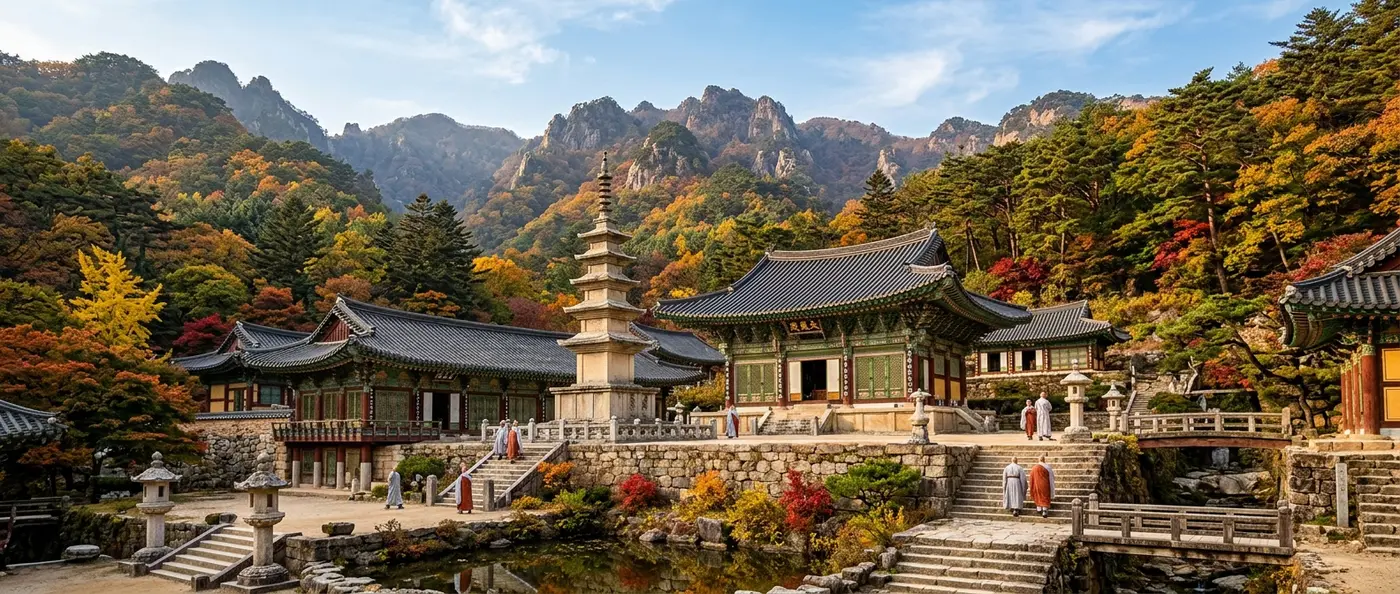
Buddhism arrived in Goguryeo in 372 AD, in Baekje in 384 AD, and in Silla in 527 AD. Each kingdom adopted it as the official religion, building magnificent temples and monasteries. Buddhist monks became royal advisors and diplomats.
Alongside Buddhism, traditional shamanistic beliefs continued to thrive. Rituals for earth's fertility, protection from evil spirits, and honoring ancestors remained integral to life. This syncretism created a unique religious tradition.
Art and architecture flourished under Buddhist influence. Pagodas, Buddha statues, and murals were created with exceptional craftsmanship. Baekje was particularly renowned for its elegant and refined art, which deeply influenced Japanese aesthetics.
The three kingdoms developed sophisticated governance systems. Each was divided into administrative units - pu in Goguryeo, pang in Baekje, chu in Silla. To these provincial units, the central government sent officials who ensured that people, as royal subjects, provided taxes and corvée labor.
Royal power was gradually strengthened and hereditary monarchies developed. Aristocrats were divided into social classes with specific privileges. The system was rigid but allowed some mobility through military distinction or royal favor.
Laws and regulations were codified. Punishments for crimes ranged from fines to exile or death. Justice was administered by local governors under central authority supervision. The system was strict but allowed appeals to the king.
⚔️ Comparison of the Three Kingdoms
🗿 Archaeological Discoveries and Legacy
The royal tombs of Silla in Gyeongju reveal the wealth and technical skill of the era. Golden crowns, jewelry, and weapons show contacts with Central Asia and beyond. Murals in Goguryeo tombs depict scenes of daily life, mythology, and warfare with vivid colors that survive after 1,500 years.
Recent discoveries continue to enrich our understanding. In 2025, archaeologists discovered rare Silla commander armor with a gilt bronze crown in Gyeongju. The find included complete armor for both human and horse, showing how Silla's elite warriors equipped themselves for battle.
Also in 2025, the first Baekje-era ice storage facility was discovered at Busosanseong fortress, a UNESCO World Heritage site. This discovery reveals the advanced engineering of ancient Koreans - the ability to preserve ice for months in an age without refrigeration.
🌅 The End of an Era
The Three Kingdoms period ended in 668 AD when Silla, allying with China's Tang dynasty, conquered Baekje (660 AD) and Goguryeo (668 AD). Victory wasn't easy. It required decades of warfare and diplomacy.
After defeating its rivals, Silla expelled its Chinese allies and established Unified Silla (668-935 AD), controlling most of the Korean Peninsula. It was the first time Korea was united under one authority.
The legacy of the Three Kingdoms survives. From the ondol heating system to martial arts, from Buddhist art to administrative systems, the innovations of this period shaped Korean identity. The rivalries and collaborations of the three kingdoms created a dynamic culture that endured through time.