🏛️ The Kingdom of Lydia: Bridge Between Civilizations
Ancient Lydia stretched across western Asia Minor, in what is now western Turkey. With its capital at Sardis, the kingdom occupied a strategic position between the Greek civilizations of Ionia and the great empires of the East. This geographical location made Lydia a natural hub for trade and cultural exchange.
The Lydians were renowned for their wealth, which came primarily from rich gold deposits in the Pactolus River. According to Herodotus, this river carried gold dust from Mount Tmolus, creating natural alloys of gold and silver that the Greeks called "electrum." It was precisely this natural alloy that would become the raw material for crafting the world's first coins.
The kingdom flourished particularly during the 7th and 6th centuries BCE under the Mermnad dynasty. The dynasty's founder, Gyges (c. 680-644 BCE), established Lydia as a regional power, while his successors expanded its influence throughout western Asia Minor. Trade boomed, but merchants grew frustrated with weighing metal scraps for every purchase.
Strategic Position
Lydia controlled trade routes between East and West, connecting the Greek world with Mesopotamia and Persia.
Natural Wealth
The Pactolus River and Tmolus mines supplied abundant gold and electrum, giving Lydians the means for economic innovation.
Powerful Kings
From Gyges to Croesus, the Mermnads created a stable and prosperous state that encouraged trade and innovation.
💰 The Birth of the World's First Coin
Before the invention of coinage, transactions were conducted through barter or using rods and lumps of precious metals that had to be weighed each time. This system was time-consuming and difficult, especially for merchants traveling between different regions with different measurement systems.
Around 650-630 BCE, the Lydians took the revolutionary step: they began cutting small, standardized pieces of electrum with consistent weight and stamping them with official symbols. These first coins were simple in appearance — they usually bore basic geometric seals or the image of a lion, symbol of Lydian royal power.
This changed everything. For the first time, an object's value depended not only on its material but also on the guarantee of state authority. The king's seal certified the weight and purity of the metal, creating trust in transactions.
🔬 The Technology Behind the Miracle
Manufacturing the first coins required techniques that were advanced for their time. Lydian craftsmen first had to purify and standardize the electrum from the Pactolus. The metal was then heated and cast into small, uniform masses.
The crucial step was stamping. Using engraved dies made from hard metal or stone, craftsmen struck the coin with a hammer, leaving the relief image. This process required precision and skill — each coin had to have the correct weight and bear a clear seal.
Over time, the technology improved. Under Croesus (c. 560-546 BCE), the Lydians developed methods for separating gold from silver in electrum, allowing the minting of coins from pure gold and pure silver. This was a tremendous technological achievement that gave Lydia an even greater advantage in international trade.
👑 Croesus and the Golden Age
No Lydian king was as closely associated with wealth as Croesus. The phrase "rich as Croesus" survives to this day, reminding us of the legendary wealth of Lydia's last great king. Under his leadership, Lydia's monetary system reached perfection.
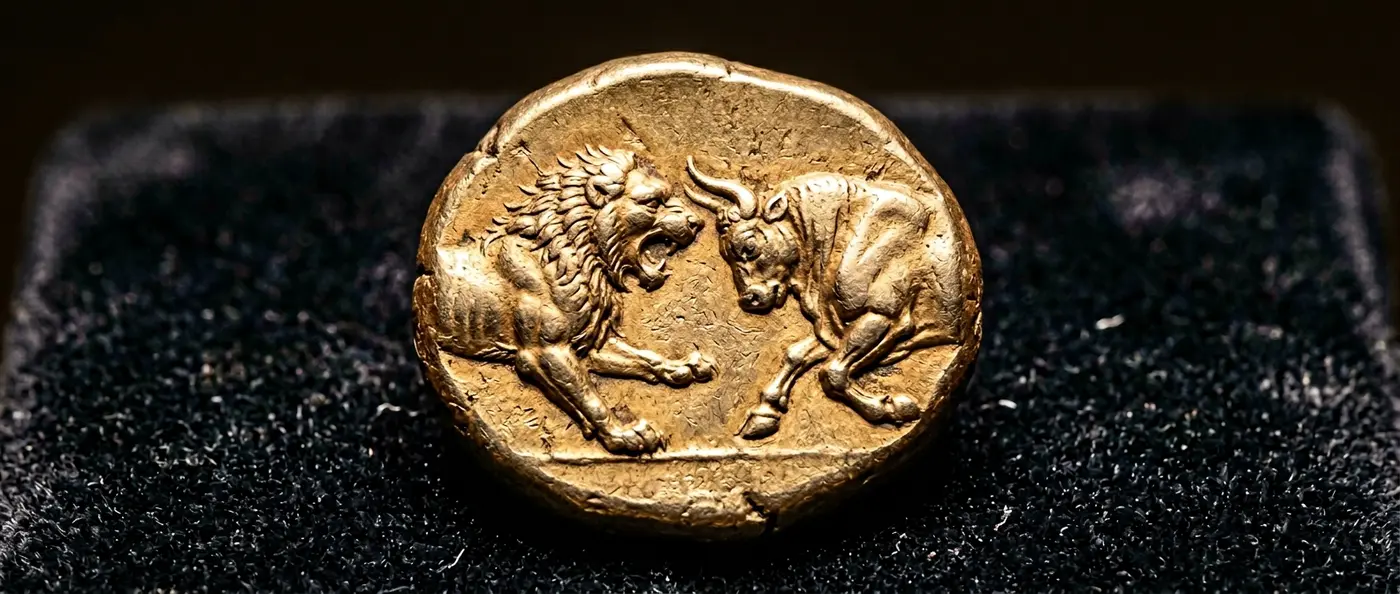
Croesus introduced the world's first bimetallic monetary system. The gold "Croeseid staters" and their silver counterparts had a fixed value relationship (1:13), creating a flexible system that facilitated both large and small transactions. These coins bore the image of a lion and bull facing each other, symbols of power and prosperity.
The success of the Lydian monetary system was so great that it was quickly adopted by the Greek cities of Ionia. Within a few decades, Miletus, Ephesus, Phocaea, and other cities began minting their own coins, following the Lydian model but with their own symbols and deities.
💡 Why Electrum?
The natural gold-silver alloy from the Pactolus was ideal for the first coins. It was harder than pure gold, making it more resistant to wear, while its golden hue made it easily recognizable and difficult to counterfeit.
🌍 The Revolution Spreads
Coinage spread like wildfire across the Mediterranean. The Greeks, always quick to adopt useful innovations, immediately embraced the new technology. Aegina minted the first Greek coins around 595 BCE, followed by Athens, Corinth, and dozens of other cities.
Each city-state gave its coins a unique identity. Athens featured Athena's owl, Aegina the sea turtle, Corinth the Pegasus. These symbols weren't merely decorative — they functioned as "trademarks" that advertised the coin's origin and reliability throughout the known world.
The Persian Empire, which conquered Lydia in 546 BCE, also adopted the monetary system. Darius I introduced the gold "daric," which became the first international currency, accepted from India to Egypt. Thus, a Lydian invention became the foundation of the first global economy.
📊 The Economic Revolution
Coinage didn't just speed up transactions — it rewired how people thought about value itself. For the first time, value could be easily stored, transported, and measured with precision.
Merchants could now travel with small quantities of coins instead of bulky loads of trade goods. Wages could be paid consistently, allowing the development of specialized professions. Taxes could be collected more efficiently, strengthening state organization.
Perhaps most importantly, coinage created a common language of value that transcended cultural and linguistic boundaries. A Greek merchant could trade with a Phoenician or Egyptian without needing to agree on the value of different goods — coins made comparison immediate and objective.
💱 Before and After Coinage
🏛️ Lydia's Legacy
Although the kingdom of Lydia ceased to exist after the Persian conquest, its impact on world civilization remains indelible. Coinage, this simple yet revolutionary idea, became the foundation of all modern economies.
From Rome's silver denarii to Florence's gold florins, from Spanish pieces of eight to the modern dollar, every currency in history owes its existence to those first pieces of electrum stamped on the banks of the Pactolus.
Today, as we move toward digital forms of money, the basic principle remains the same: a symbol of value, guaranteed by an authority, that facilitates exchanges and enables economic organization. The Lydians may not have imagined credit cards or cryptocurrencies, but they laid the foundation for all of them.
Lydia's story reminds us how a small innovation in a small kingdom can change the world. It wasn't military might or territorial expansion that made Lydia immortal, but an idea — the idea that trust and standardization can transform a piece of metal into something much more: into money.