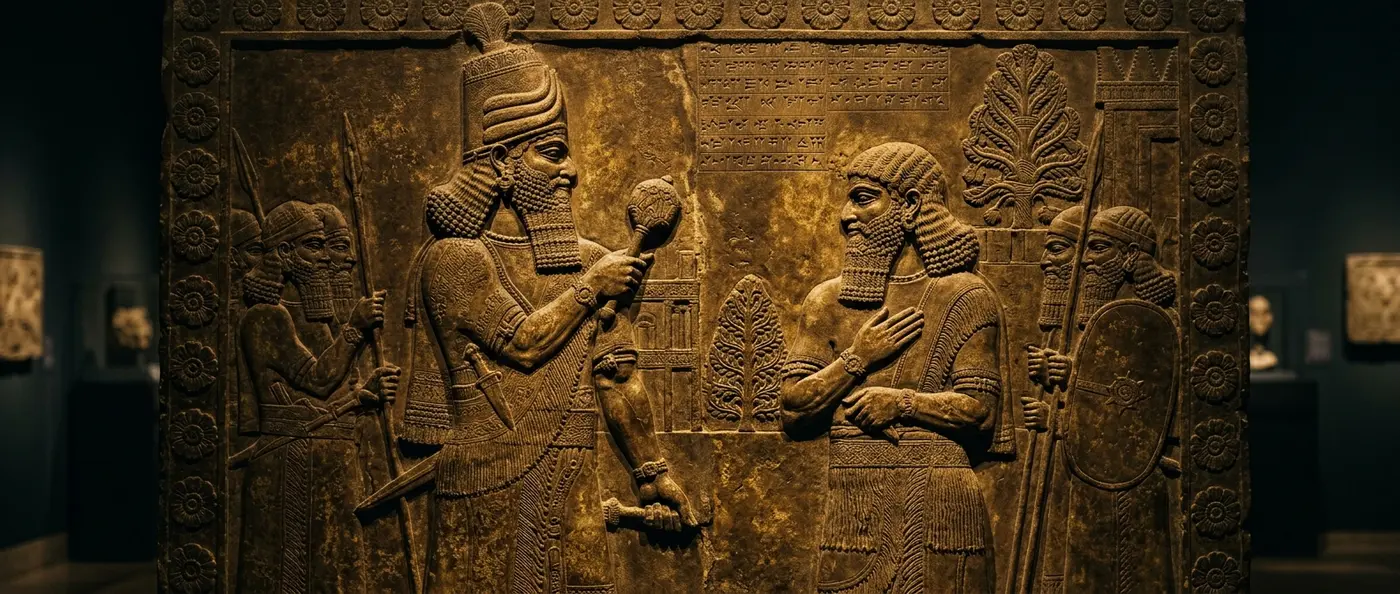
Clay tablets don't lie. The 4,500-year-old cuneiform texts that Oxford archaeologists announced in early 2026 tell a story that upends conventional ideas about ancient gender roles. In Mesopotamia, people with fluid gender identities didn't just survive—they thrived. They held positions of extraordinary power, not despite their ambiguity, but because of it.
🏛️ The Land Between Two Rivers
Mesopotamia stretched across what we now call Iraq, with chunks of Syria, Turkey, and Iran thrown in for good measure. The name literally means "between rivers" in Greek—the Tigris and Euphrates carved out the fertile crescent where humanity first figured out cities, writing, and complex government.
The Sumerians got there first. They invented cuneiform writing, pressing wedge-shaped marks into wet clay that would outlast empires. Later, the Akkadians, Assyrians, and Babylonians adopted the script to record their own dialects of Akkadian, the oldest known Semitic language.
These civilizations didn't just replace each other—they layered, mixed, and evolved over millennia. What emerged was a cultural mosaic where gender wasn't a binary prison, but a spectrum of sacred possibilities. Gender wasn't a binary prison. It was a spectrum of sacred possibilities.
🔱 The Assinnu: Priests of the Love-War Goddess
Ishtar ruled the Mesopotamian pantheon with an iron fist wrapped in silk. Known to the Sumerians as Inanna, she was the "Queen of Heaven"—goddess of love, war, and everything in between. She could legitimize kings with a nod and topple empires with a frown. Love, sexuality, fertility—all fell under her domain.
Her priests were called assinnu. The Akkadian term connects to words meaning "like a woman," "man-woman," but also "hero" and "priestess." These weren't just religious functionaries. They were the goddess's chosen vessels, responsible for temple maintenance and sacred rituals that kept the cosmic order intact.
Their gender fluidity wasn't an accident—it was Ishtar's gift. A Sumerian hymn describes the goddess as having the power to "turn a man into a woman and a woman into a man," to "dress women in men's clothing" and "give weapons to women." The assinnu embodied this divine transformation.
⚔️ Magic, Medicine, and Political Clout
The assinnu wielded power that went far beyond temple walls. They were believed to possess magical healing abilities. One incantation reads: "Let the assinnu stand beside you and remove your illness. Let him make the sickness that has seized you go out through the window."
But their real influence was political. A Neo-Babylonian almanac states: "If the king touches the head of an assinnu, he will defeat his enemy and the land will obey his command." This wasn't metaphor—it was statecraft. Kings literally needed the blessing of gender-fluid priests to maintain legitimacy.
Even more striking, a Neo-Assyrian omen reveals that sexual relations with an assinnu could bring personal benefits: "If a man approaches an assinnu for sex, restrictions will be relaxed for him." These weren't marginalized figures begging for acceptance. They were power brokers whose very bodies carried divine authority.
Magical Powers
The assinnu were believed to heal diseases and remove curses through specialized rituals that channeled divine energy.
Political Influence
Their blessing was considered essential for military success and the stability of kingdoms across Mesopotamia.
Divine Transformation
Their gender fluidity was attributed to Ishtar herself, who had "transformed" them as a sacred gift.
👑 The Ša Rēši: Courtiers with Access
While the assinnu served the gods, another group of gender-ambiguous individuals served kings directly: the ša rēši. The Akkadian term literally means "he of the head"—the king's innermost circle of advisors and confidants.
Evidence for their unique nature comes from both texts and art. Various documents describe them as sterile, like an incantation that curses: "Like a ša rēši who does not give birth, may your seed dry up!" In palace reliefs, they appear consistently beardless, contrasting sharply with the ša ziqnī ("bearded ones") who had descendants.
In Mesopotamian culture, beards symbolized masculine identity. A beardless man violated social norms. Yet palace art shows the ša rēši wearing the same elite clothing as other high-ranking men, displaying their power despite—or because of—their difference.
💡 The Paradox of Power
The ša rēši were the only men besides the king allowed to enter the women's quarters of the palace. This unique access gave them enormous influence and the complete trust of the monarch.
🗿 Military Might and Administrative Authority
The ša rēši weren't confined to ceremonial roles. Their absolute loyalty to the king earned them significant military positions as guards and charioteers. Some even commanded their own armies.
After successful campaigns, ša rēši were rewarded with land grants and administrative posts in newly conquered territories. One such official even erected his own royal inscription in stone, proving the high status and autonomy they could achieve.
Their ability to transcend gender boundaries allowed them to cross not just gendered spaces, but the gap between rulers and subjects. They were simultaneously servants and lords, mediators and executors of royal will.
🏺 Ambiguity as a Source of Strength
Gender ambiguity wasn't a liability in ancient Mesopotamia—it was a superpower. Both the assinnu and ša rēši derived their authority precisely from their ability to move beyond conventional gender boundaries.
For ancient Mesopotamians, these individuals functioned as bridges. The assinnu connected the divine and human worlds, while the ša rēši bridged male and female palace spaces. Their fluidity gave them access to realms that remained closed to most people.
While gender-fluid individuals today often face discrimination, in ancient Mesopotamia their difference was seen as a source of special abilities and powers.
⚖️ Ancient vs Modern Perception
📜 What the Past Teaches Us
These Mesopotamian discoveries remind us that modern assumptions about gender aren't universal or timeless. 4,500 years ago, in one of humanity's first organized societies, gender diversity wasn't just recognized—it was celebrated and empowered.
The assinnu and ša rēši occupied central positions in religious and political life, their ability to transcend conventional boundaries acknowledged throughout their society.
As archaeologists continue deciphering ancient tablets and interpreting new finds, it becomes increasingly clear that human history is far more complex and diverse than we often assume. Ancient civilizations have much to teach us about acceptance and understanding of human difference.